|
|
We got the day bus back from the coast to Quito where it was raining and cold, such a change from the hot weather at the coast. The following morning we took a taxi to the massive new southern bus station in Quito known as Quitumbe, which is a modern, purpose-built bus terminal set on a green-field site, and is a marked contrast to most bus terminals we have encountered (almost airport-like). Elsewhere, the various companies try to sell you tickets as you are walking along, shouting the names of destinations, crowding round you in groups, trying to get you to buy their tickets. Here, it was a model of calm, although the ticket sellers, behind their windows, couldn’t resist bending down to the little slot at the bottom of the glass screen and shouting a few destination names. Banos Express suited us nicely, and we duly handed over our $3.50 each for the three and a half hour trip to Banos, a small town with hot spring baths. Sounds a bit like Bath, our home town. Bus travel in Ecuador is generally a dollar an hour, so a ten hour journey will cost you $10. We got to Banos, about 90 miles away, for about the same as a ticket into Bath from our house on our local bus service, a distance of some 1.5 miles. The journey was amazingly scenic with views of Cotopaxi volcano with snow on its summit and lush and fertile valleys. At Banos we arrived at a bus terminal in the middle of town and for once an easy walk to our hostel where we get a nice room with a balcony and views of the hills and waterfall.

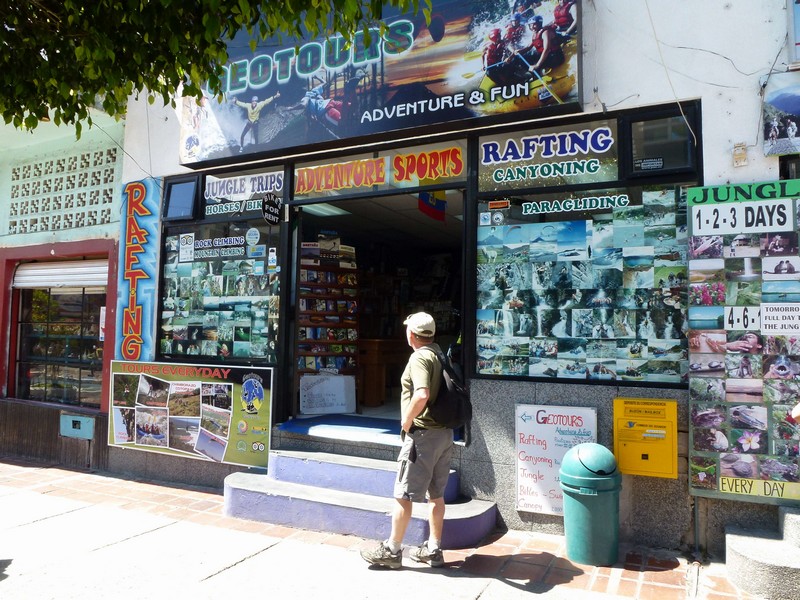
After replenishing ourselves with delicious coffee we toured town, which apart from a nice cathedral and central square seems to consist mainly of restaurants and adventure tour operators offering any activity you can imagine.
Here’s a picture of Paul trying to decide which trips to do. You can white-water raft, mountain bike, hack around on the volcano on an ATV, go paragliding, or head off to the jungle in the Amazon basin for a spot of wildlife-watching.
Whilst we decided how adventurous to be we visited the Stray Dog Brewery, where the brewer uses water from the local natural spring near the town’s waterfall called “Agua de la Vida”. He even transports the water to his brewery by bicycle. More importantly, great beer!
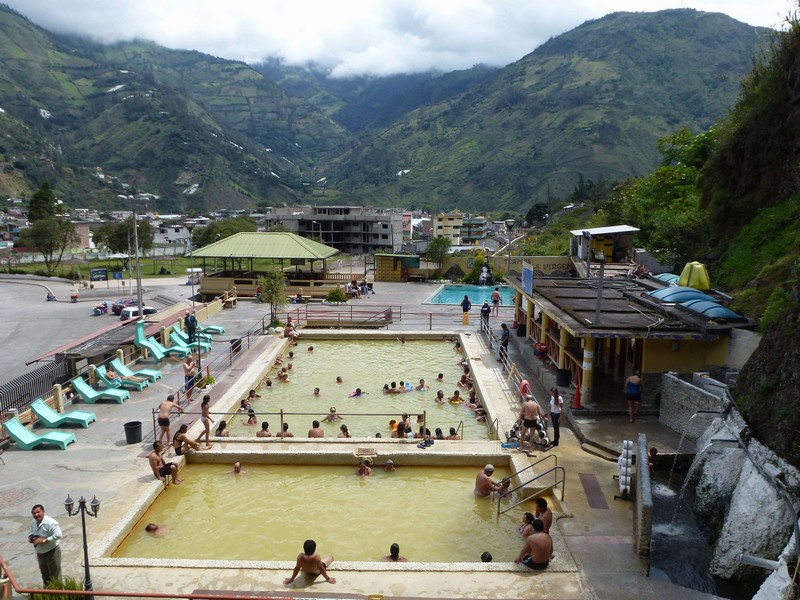
Next day we visited the town baths – well it would be churlish to refuse. The large bath is nicely warm, the small one in the front is very very hot, and the far (blue) one is icy cold. The idea, so we were told, was to alternate between the baths – surprisingly we didn’t spend much time in the cold bath! We would have stayed there all evening, but strangely the level of the water in the warm bath was reducing – we supposed as it was near to closing time. We loved it – a great experience.
The next day we felt like taking some exercise and decided to hike up a couple of the nearby hills. Somehow in the excitement we forgot that Banos is at about 1500m, so with the steep incline it was hard work! But we reached some great viewpoints.
Another day we took a bus down the “waterfall route” in a Chiva bus, consisting of tourists packed onto hard seats and listening to extremely loud Ecuadorian rap music – all very entertaining.
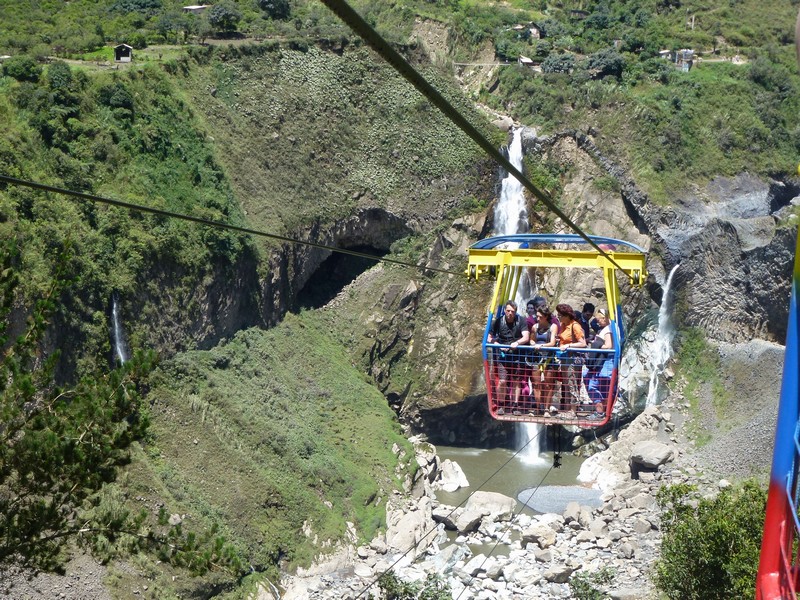
Not to lose out on the adventure side of things the bus stopped from time to time to allow us to see the waterfalls at close range. We took one of these odd looking contraptions across the ravine to view the falls close up.
The final stop was to walk to the base of the Devil’s Waterfall – hundreds of steps and an amazing force of water.
Banos was a great place to spend a few days, and even some of the locals found the touristy shops interesting!
We are continuing south on our journey – next stop Cuenca.
We were thinking of nipping out to the west coast before heading south, and the ever-helpful Crystal from our travel company in the Galapagos recommended Canoa, and particularly Hostal Baloo, where, as well as accommodation, they do surfing lessons and yoga J So, we boarded the overnight bus in Quito at 11:30pm, and arrived in Canoa at 7:30am the following morning. This was not really a peaceful night’s sleep. Here’s me looking very glad to have reached our beach hut home for the week.
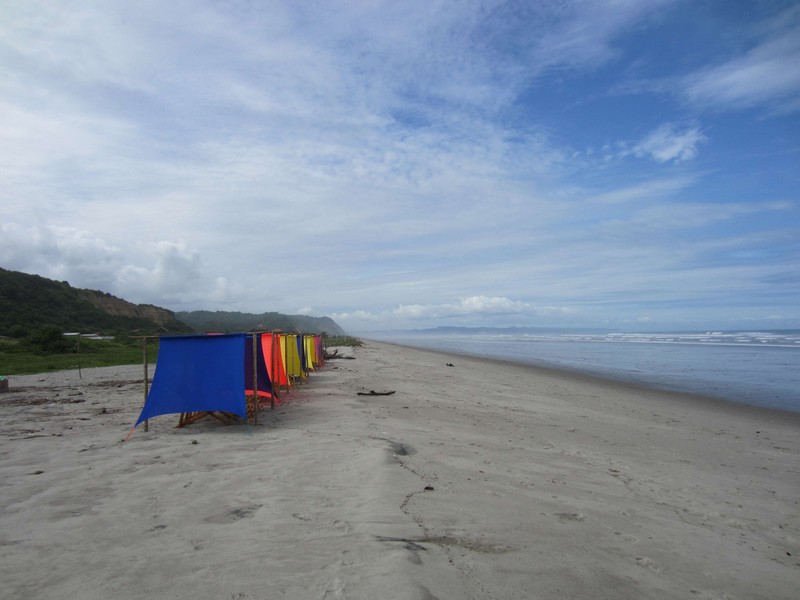
Canoa was a small fishing village until recently, and then surfers arrived, attracted by it’s beach breaks. There used to be only a ferry connecting it to the nearest big town, but about 18 months ago a causeway was built. Since that time, the town has doubled in size, and is popular with weekenders also. We’re here for Easter, so heaven only knows what it’ll be like. At the moment, though, it’s quiet, with a fantastic empty beach.
Diane likes it, anyway. We went walking on the beach every morning, before the heat really kicked in at about noon.
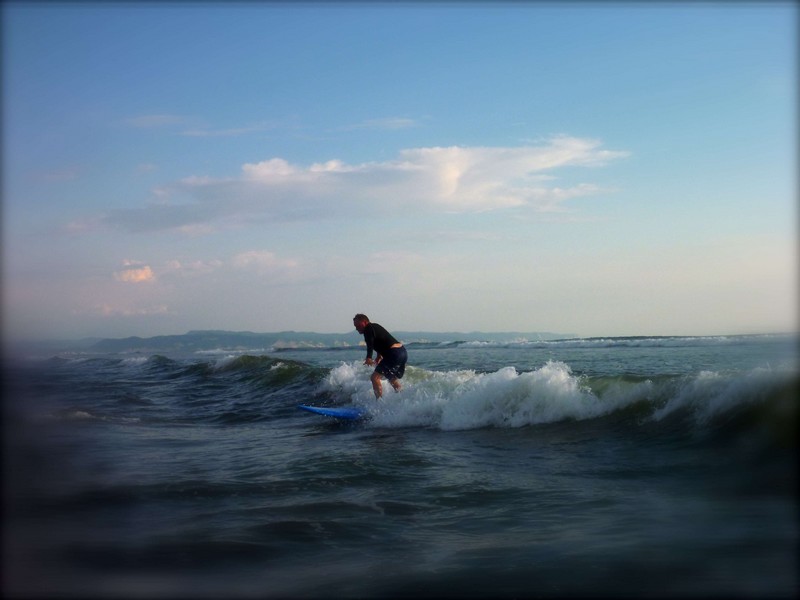
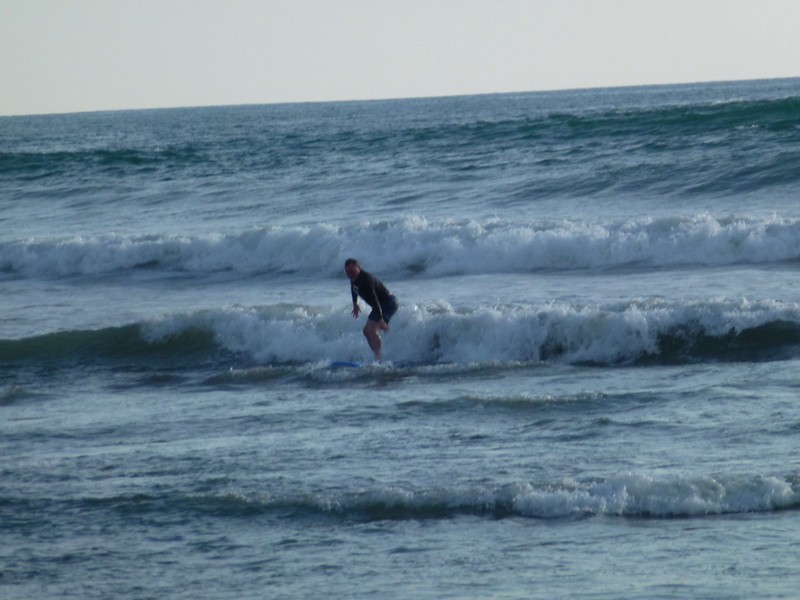
We really did try surfing and yoga, too ! Ignoring the fact that I am, I think, a man, we did both with Betty Surf and Yoga, based at our hostel. Here we are on our first surfing lessons, trying to master the pop: that is, to move from prone on the board to standing in a single, fluid motion. Diane decides staying on both knees is quite stable actually. I’ve got my right flat foot on the board here, and now I’m wondering how to get off my left knee. Well, it didn’t happen in the first lesson, but I did manage it on the second, helped by Roxy, the instructor’s surfing dog, who kept trying to climb onto my board. It probably would have helped to have at least one animal on board that knew what they were doing.
And here I am, surfing with style. Bad style. Lord only knows what I’m doing with my hands.
And here’s Diane emerging from the Pacific.
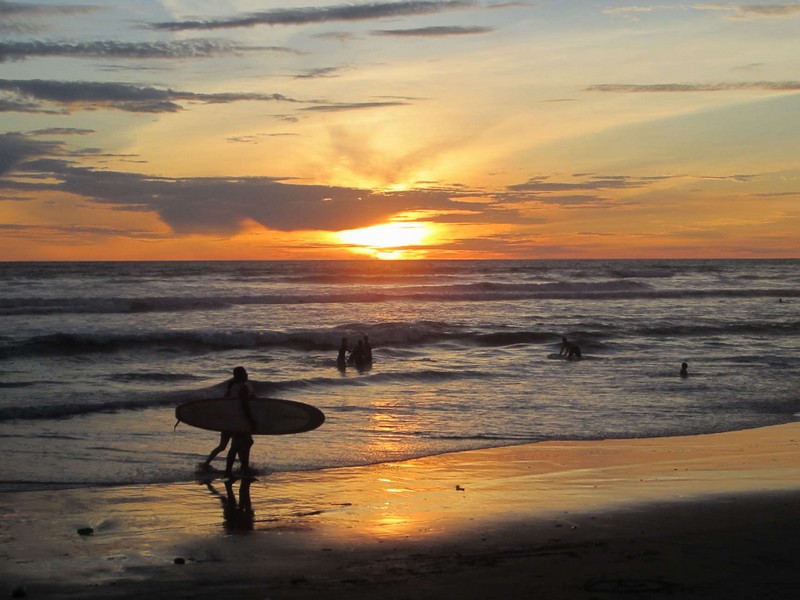
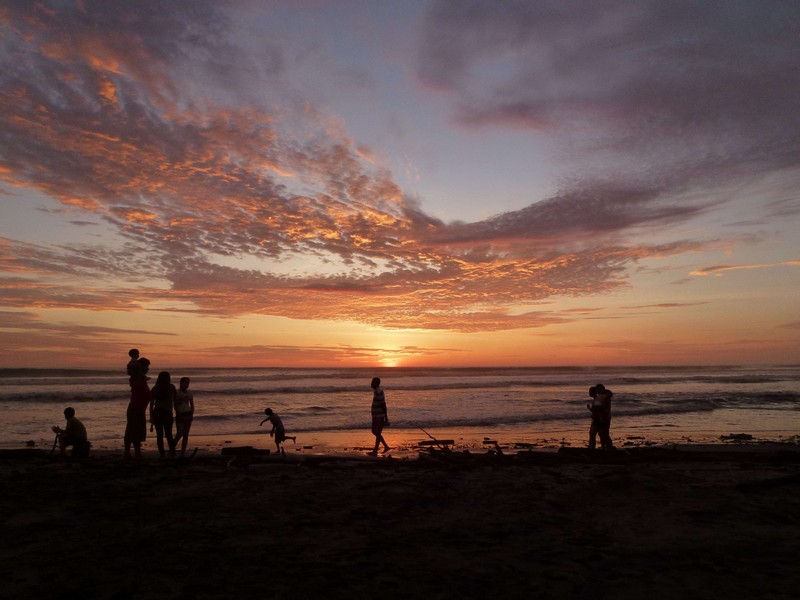
As you might expect, the sunsets here are spectacular, so here’s one.
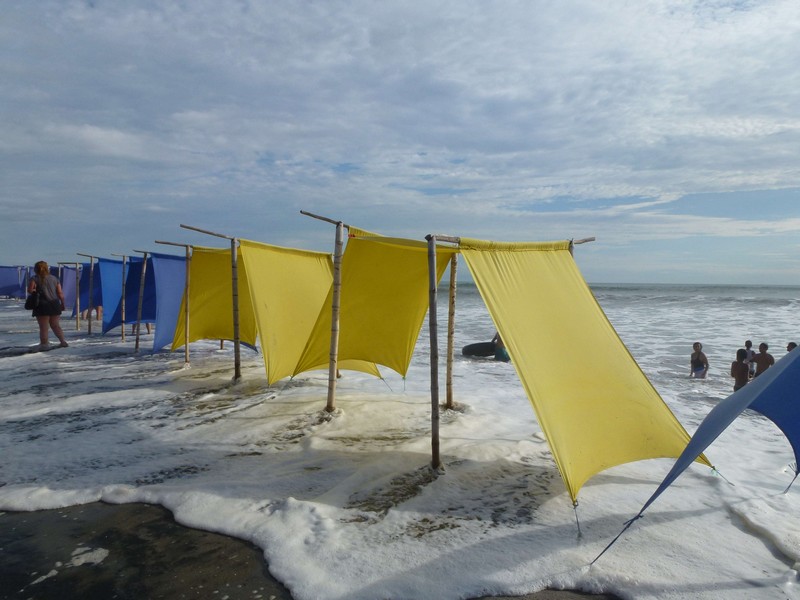
The tide was getting bigger and bigger during the week, and reached it’s peak over the Easter weekend itself. It went through some of the sun shelters on the beach, and down towards the Malecon, the dirt road along the back of the beach lined with restaurants and bars.
All good fun. Nobody really seemed to mind, but then I suppose it happens fairly regularly. We had a lovely time, but heavens it was hot, and the mosquitoes are both prolific and active, so we’re off back to Quito briefly, and then down to Baños, in the Andes. Here’s a final sunset anyway.
Oh, where to start ! We’d anticipated that the Galapagos Islands would be one of the highlights of our trip, and so it was. The variety and abundance of wildlife here is astonishing. We decided that there wasn’t any point skimping on a trip as expensive as this (and, believe me, the Galapagos is expensive), so we arrived in Quito on a Sunday night and spent Monday trotting round the travel agents trying to decide whether we should go on a cruise, or be land-based. We’d also done some googling around, and come across a company called Galakiwi offering land-based cruises, with space departing in a few days time. They offered a good mix of activities with an expert guide, so we went with them, and on the following Saturday, we flew to San Cristobal Island in the Galapagos Archipelago. The itinerary would also take us to the islands of Floreana, Isabella and Santa Cruz, travelling by boat. By way of light relief, our hotel room on San Cristobal used to be the island’s disco, so it has a bar, sadly no longer in use, a cloakroom and two separate toilets. It must have been a bit of a crush on a Saturday night.

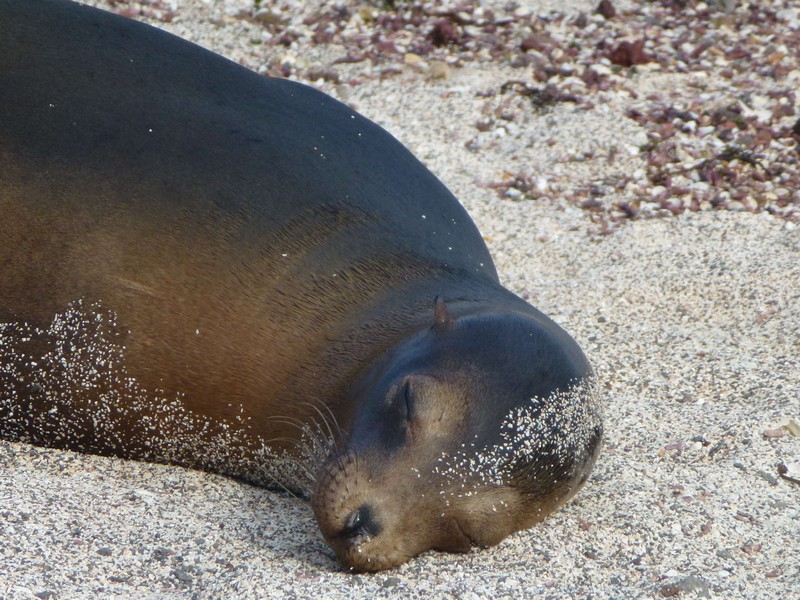
Anyway, rather than bang on about how we got around and where we stayed, here’s some photographs of the wildlife and other notable sights. We took about 800 photographs during the week, and these are only a few of them. Wildlife is everywhere, and it doesn’t seem too concerned about people. Of the islands, 97% is national park. Here’s a sea lion.
The weather was pretty much perfect for our trips between the islands, and also for the snorkelling we did. This is Kicker Rock, where we snorkelled with Galapagos Sharks in the prominent gully between the two parts of the rock. I’d never seen that many sharks in one place before: there must have been 60 or 70 of them as well as turtles, rays, inquisitive sea lions and massive shoals of fish. The abundance is amazing.
We saw a large pod of dolphin as we journeyed between San Cristobal and Floreana. They played in front of the boat for half an hour or so.
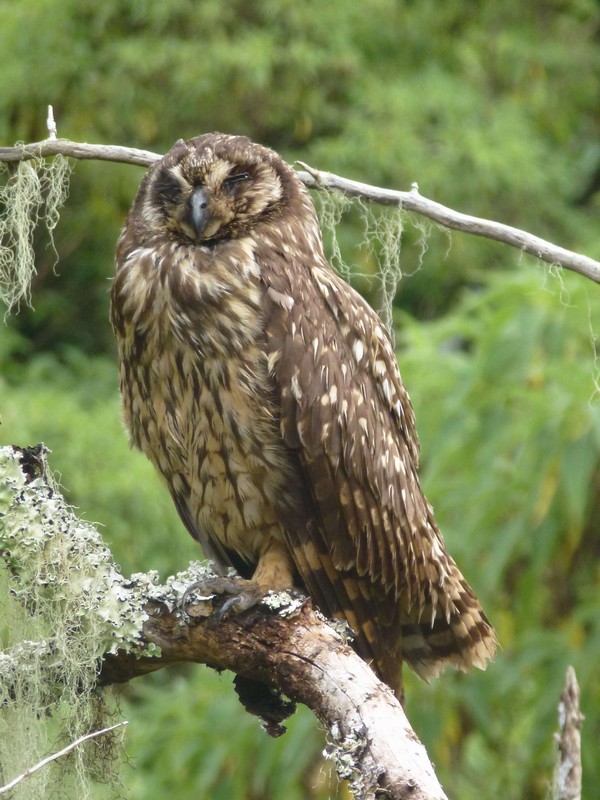
On Floreana, we ventured into the highlands and saw this short-eared owl.
Frigate birds are everywhere. This one’s got his pouch inflated and heart-shaped!
And, of course, marine iguanas, one of the Galapagos’ iconic animals. They get everywhere, and we saw them in town, on remote islands, and also swimming in the water whilst we were snorkelling.
Careful, now. Don’t seen many signs like this in the UK 🙂
Another iconic animal, the giant tortoise.
They’re making great efforts to increase the populations of tortoises: here’s a small giant at a breeding centre. The young are released back to the island of their ancestors at 4 or 5 years old.
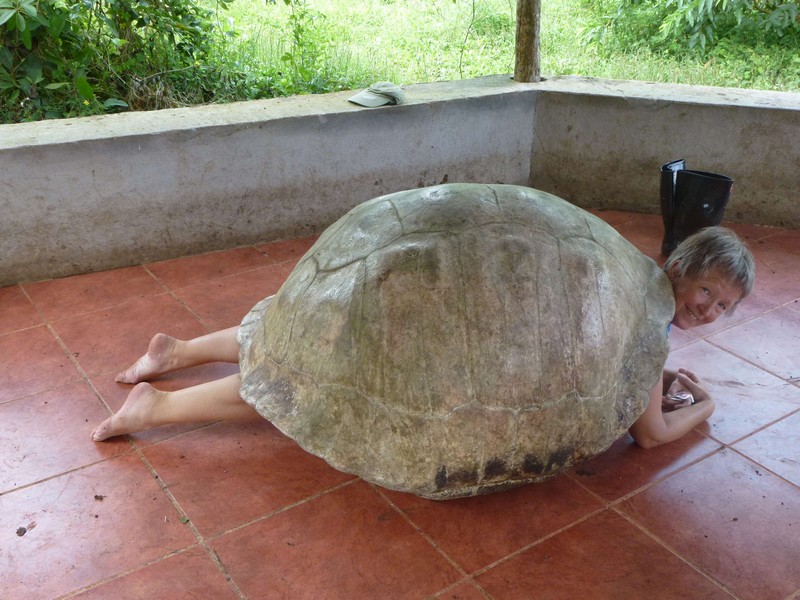
Here’s Diane wondering what life would be like carrying around such a huge shell.
We walked up and round the caldera of Volcan Sierra Negra, on Isabella Island. It’s reportedly the second-largest caldera in the world, after Ngorogoro in Africa. It was a seven hour round trip, and just after we turned round to come home, it rained. Not slightly, but really, really heavily, and for a couple of hours. By the end, all the paths had flooded, and we were wading through four-inch deep water. It took me three days to dry my shoes, even with the assistance of the tropical sun.
Anyway, here we are looking dry. It started to rain about ten minutes later.
Next to our hotel on Isabella was a salt lagoon, with flamingos.
The tortoises roam wild on parts of Santa Cruz island, like this guy here on the road.
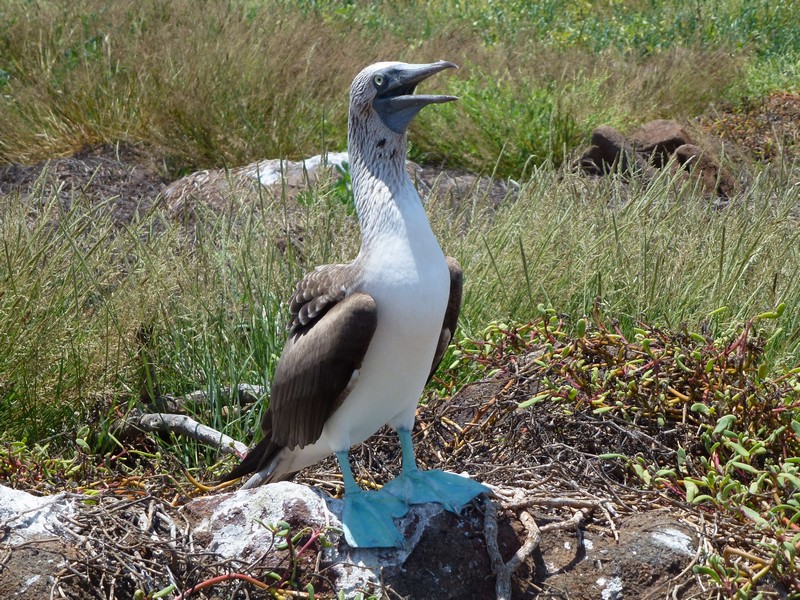
The blue-footed booby. Enough said. We resisted the urge to buy any merchandise, t-shirts, badges, hats, aprons, anything, which made a play on the word booby, though there was plenty to be had.
A Sally Lightfoot crab, and more sea lions.
No visible animals, but a beautiful beach: Tortuga Bay, on Santa Cruz.
The fisherman land their catches in Puerto Ayora, on Santa Cruz, and the sea lions and pelicans know it, and do well. The brown sign in the background says don’t feed the animals 🙂
And here’s Lonesome George, the last of his kind.
We stayed on in Santa Cruz for another five days, and I went diving. Unbelievable. The number of different species, and the abundance of them, were really fantastic. I’ve never dived anywhere before where you needed four different signs for the sharks you might see, and we saw them all, including the famous circling hammerheads. All in all, a fantastic, fantastic experience. Unfortunately, back to Quito now, and then to Canoa, on the coast.
After our restful week in the country we bussed it to Cali, the biggest city in Colombia after Bogota. An easy ride of two buses and only 3 hours and we found ourselves in the big city in the mid-day heat. Later on we wandered around, and found nothing much of interest other than a display of painted cats next to some huge bamboo.
It seems people come to Cali to party and salsa, but as we weren’t really interested in either activity we went to an air-conditioned shopping mall. People who know us might think that was strange, but Diane desperately needed new shoes due to misuse on an earlier volcano. We had attempted to find a pair in smaller towns, but this had only resulted in her being shown to the traditional women’s section – leather shoes/boots with high heels, not so great for our activities. Result, nice new cheap comfy pair! Next day we hightailed it out of the heat.
Another three hours by bus found us in colonial old Popayan, many of the buildings and churches have been tastefully restored after a devastating earthquake in 1983. At 1800 metres the climate is mild, although the white buildings reflect the sunlight and there is the odd heavy shower at this time of year. While we were there, in an effort to do some exercise, we booked on a cycling trip. A small lorry takes you up to a local hot springs, and then you cycle back, 34km, mainly downhill. When we arrived, considerably higher than Popayan, there was a cool breeze sweeping across the springs, and we almost didn’t go in. Eventually, Diane tested the waters, and shamed is into donning our swimmies and soaking for an hour or so. The water didn’t smell, which is odd for a mineral bath in my experience.
Then we rode back down to town. On the way, we stopped in a little town for some food and spotted a bit of impromptu pig-herding going on.
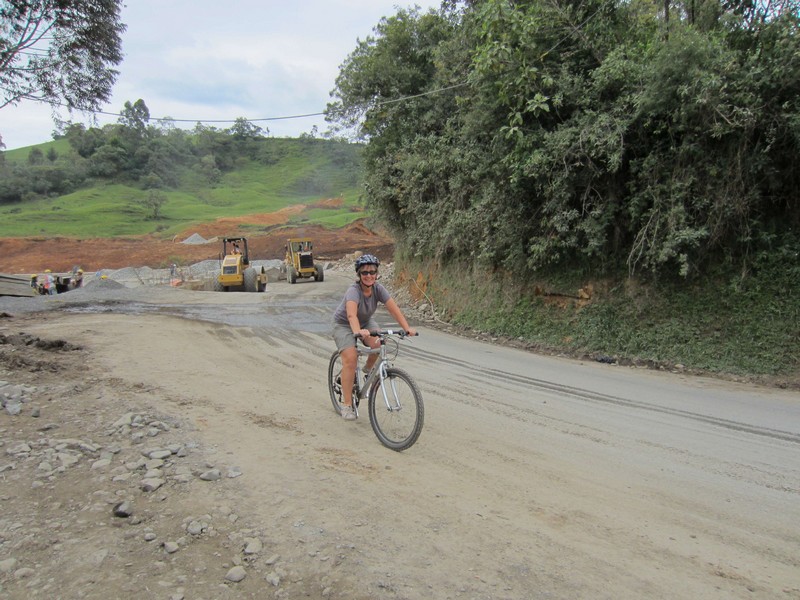
They were remaking some of the road, where it had fallen into the river, so at one point Diane was on one side of the road works and I was on the other while they dumped tons of gravel. Here she is emerging after the gravel had been flattened.
The following morning, we started our two-day trip to Ecuador. We had decided to break our journey in Colombia, near the border, so we didn’t have to do any buses at night, which is a bit unsafe, we are told. Here I am looking a bit frazzled, about 3 hours into the journey, stopped at a little café in a little town I can’t remember the name of. I’m sort of pointing at it, but on the scale of the map my finger is about 300 miles across.
The road, the Pan-American Highway, is spectacular, passing through steep valleys in the Andes. It’s also reasonably narrow and knackered in places, and carrying a lot of heavy traffic. Our bus driver was having a fairly good try at hitting his schedule, which meant overtaking heavy lorries on blind bends while accelerating hard uphill. This style of driving is quite, er, exciting for the passenger. Here’s a picture taken through the window of the coach: the road is visible on the other side of the valley.

After a night in a little town called Pasto, we set off again for the border. We took a taxi to the bus station, where we were, as usual, set upon by salespersons for the bus companies, all of whose buses were leaving “now” (Us: “¿A que hora sale el bus ?” Salesperson: “Ya !!”) We ended up in what is basically a people carrier run by a company called SuperTaxis, and were deposited in the real border town, Ipiales, an hour or so later. There, we took a taxi to the border, where we were, as usual, set upon by money-changers, so we changed our remaining pesos for dollars, checked out of Colombia, and walked over the bridge into Ecuador. Once we’d checked in there, we took a taxi to the bus station in nearby Tulcan, where we were, as usual, set upon by salespersons for the bus companies, although with a new trick here: they open the taxi door before you’ve got out and shout the names of towns at you (“Quito? Quito? Quito?”) We ended up on a bus which had every modern amenity, according to the salesperson, although the toilet didn’t actually work. It was a five hour ride to Quito, including stops for drugs searches, and we got there at about 5pm, eight hours after leaving Pasto. Here’s Diane about to walk over the bridge into Ecuador, our ninth country of the trip.

So we arrived in Quito, at 2850m, which is pretty high, let me tell you. The sun is fierce here, even when it’s cloudy. We had a wander around: this is the Basilica in the old town. Like most cities in Latin America, businesses cluster here: all of the shoe shops are in one area, for example, or clothes shops. Well, the arches under the Basilica is home to a row of electronics shops, so you can pop in to church and buy a power transistor at the same time.
Nearby is another church, San Francisco. While we were admiring it, we were approached by a group of students studying tourism and asked if we would be interviewed by them in English, on video, for their course work. Happy to oblige, they set up with the interviewer reading from cue cards while another operated the camera. ”What is your name?” ”How old are you ?” (Quite old, said Diane, flummoxing them completely). ”What is your favourite Ecuadorian food ?” (Guinea pig with potatoes, said Diane, never having had it in her life).
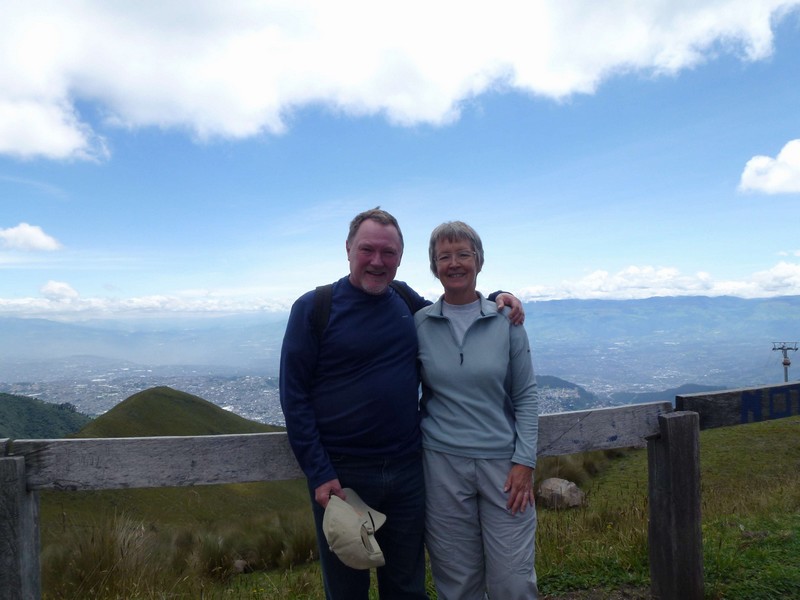
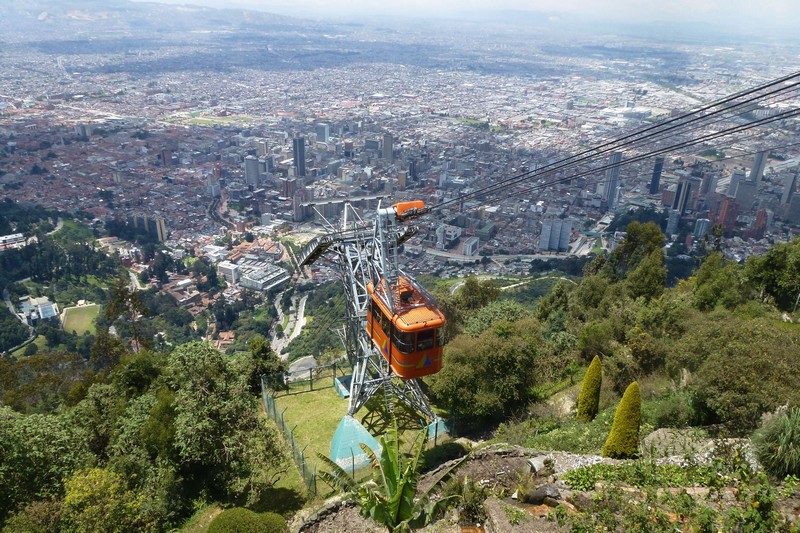
Finally, we headed off up the teleferiqo, a cable car which runs from the city to the top of a nearby mountain at 4100m, to get the view. Here’s my wife (complete with recent $3 haircut) with some old bloke and his hat, Quito spread out below them.
We’re here for a few days more, then we’re off to the Galapagos for two weeks, so we may be off the air until we return. Stay tuned.
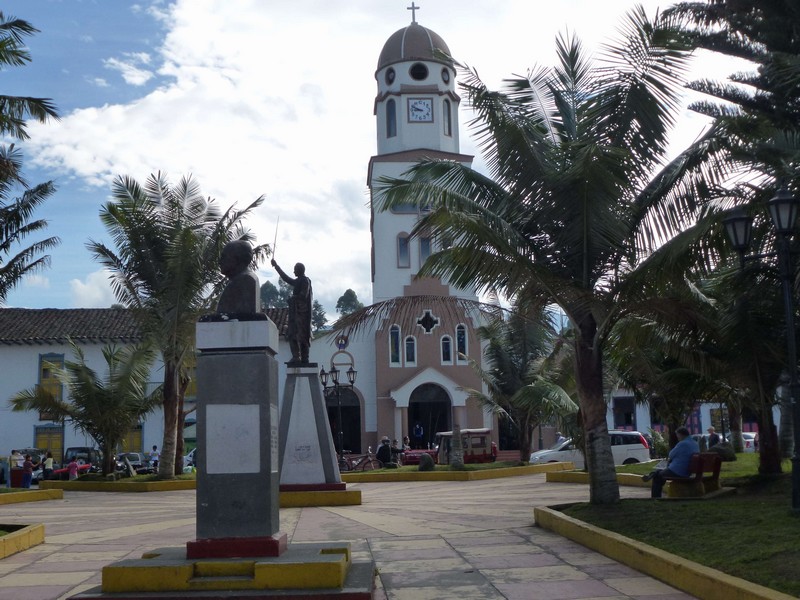
When we arrived in Bogota we had no idea where to go next other than “head south”, so it was good to hear a number of people talk fondly of an area called the Zona Cafetera (coffee country), about eight hours bus ride south-west of Bogota on narrow twisty roads – great scenery and many a steep drop down to the valley floor. The road is quite startling if you’re in a large coach which is trying to overtake two 16-wheel lorries at the same time uphill around a blind bend: but this is normal for around here. They’re building a new (straighter) road, as this is the main road to the west of the country, so lucky you if you travel that way in the next year or three. When arrived at our accommodation in Salento we found they had messed up the reservation; after telling us precisely why their booking system didn’t work (it’s crap, I could have told them that), they suggested we stay at an alternative place down the road. After initial irritation, we agreed of course (it was getting late by then). When we woke up the next morning at “El Rancho”, a working dairy farm, we realised we were in the middle of the beautiful countryside, just the birdsong and the milk cooler to interrupt our thoughts. Such a change from the busy city.

After a couple more nights we moved into “town” to be nearer the main square, restaurants and bars. Just about every restaurant around here serves trout every day, so delicious that Diane has it four days on the trot. The tonnage of trout served every day in Salento suggest it isn’t all line-caught in the local river, the Rio Quindio.
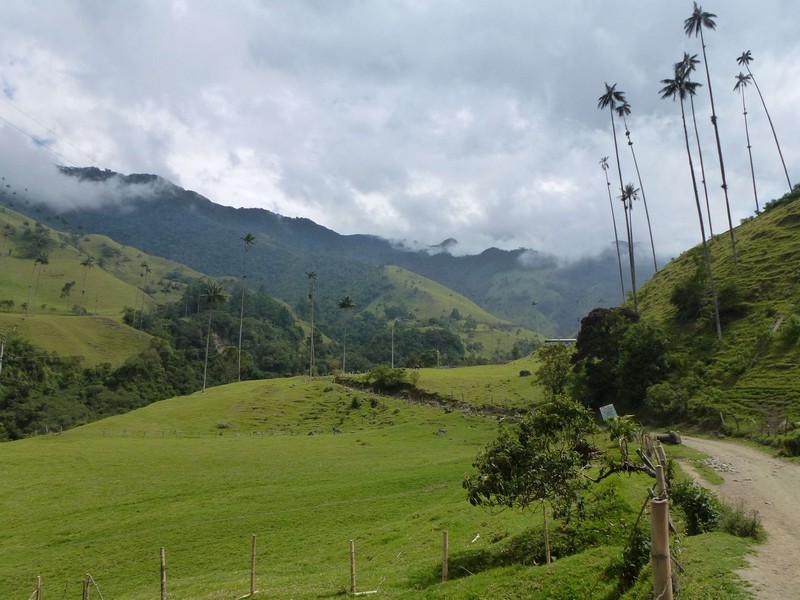
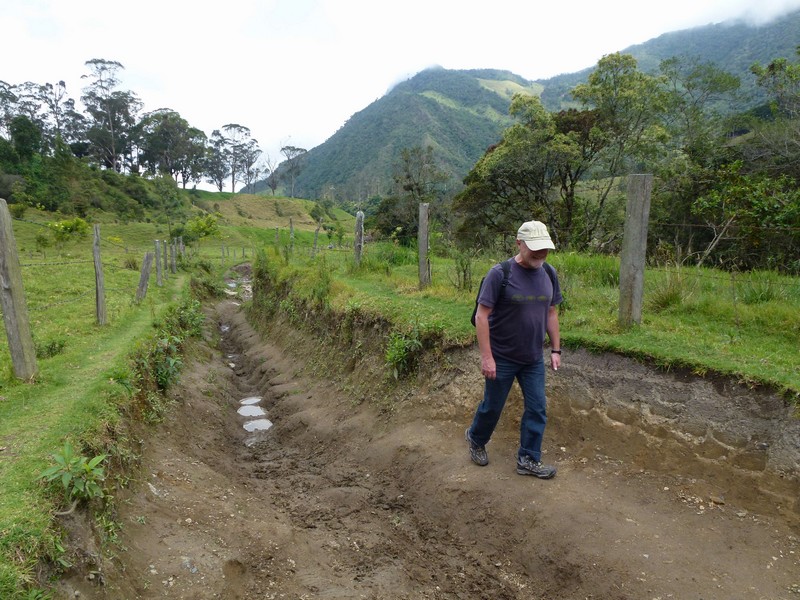
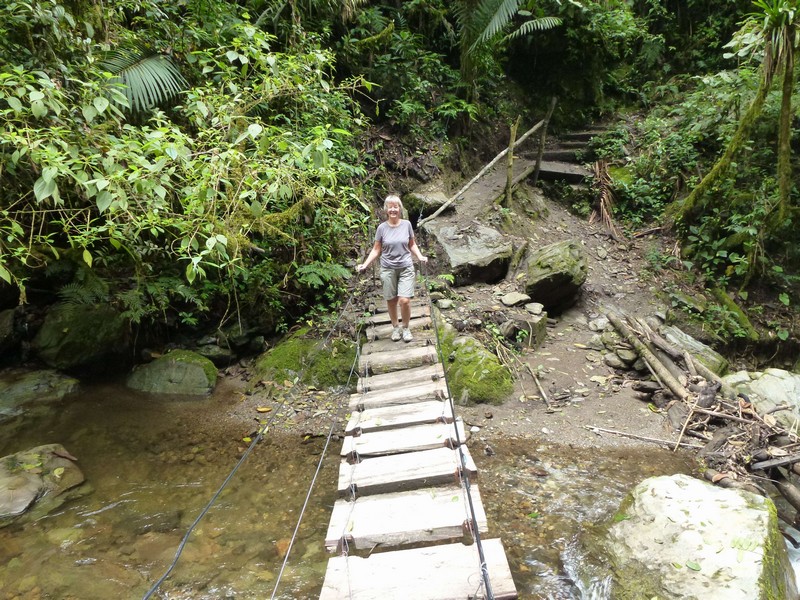
There is a beautiful area near here called the Valle de Cocora, and the guidebook promised hummingbirds and 60m high wax palms. Transport is provided by local guys driving jeeps – although we’re not sure why they don’t run buses as it’s only about 20 minutes on a (mostly) paved road. The guys take enormous pleasure in packing as many tourists into each jeep as is humanly possible. About the only advantage we find to looking slightly older than many of the travellers round here is that we usually get shuffled to a seat straight away. Except for the one time when the usual 8-seater needed somehow to carry 13, and Paul and a couple of others had to ride shotgun hanging on the rear (don’t tell the insurance company!). It was so nice we made the jeep journey twice, then walked through mud, across the river on rickety bridges, past the wax palms and up into the cloud forest. The scenery and the hummingbird reserve more than made up for the effort and dirt!
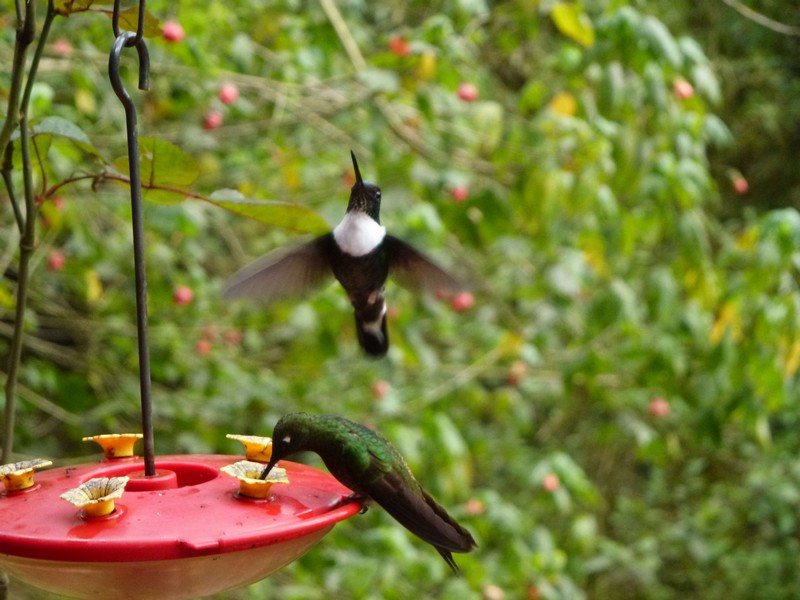
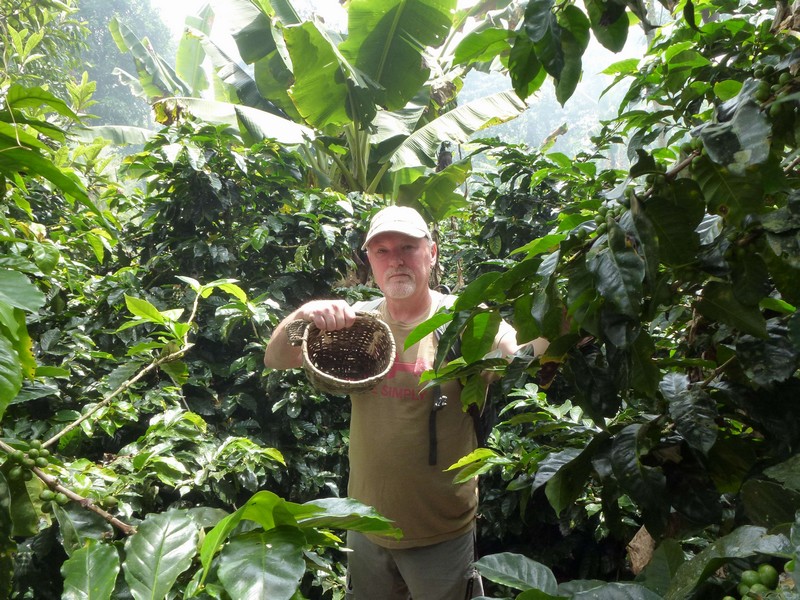
Another day we visited a local coffee farm, where after lengthy explanation in Colombian-Spanish from the owner (not a hope for us to understand much, but luckily there were pictures) we were invited to pick some coffee – apparently experienced workers can pick up to 100kg in a day, but not much luck on our part.
All of this was interspersed by daily visits to our favourite coffee shop and, one evening, the cheapest meal around – £2.25 for soup, a main course, fresh juice and a banana (the latter we fed to the hummingbirds at our hostel). The main course choice included, of course, trout.
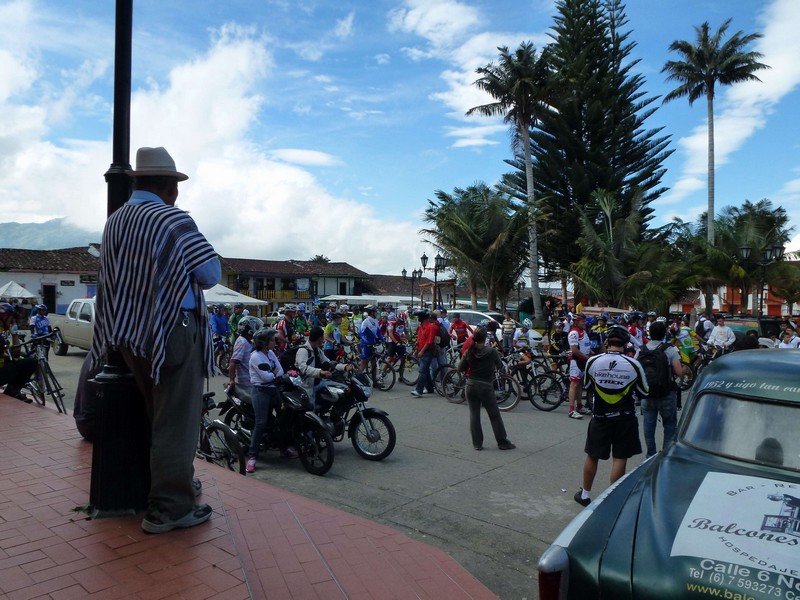
Salento is a beautiful, sleepy town except at weekends when city people descend to hang around, walk up and down the main street looking at souvenirs, drink bottles of rum and dance the salsa. That is, apart from the few who arrived on Sunday morning for a cycle race, most on new bikes with not a trace of mud to be seen. The 9am prompt start advertised on the posters ran a bit late, ahem. Oh, and ponchos are a big deal here for the men of the town, popular and practical when faced with hot days and cold evenings and nights.
All in all, we enjoyed Salento immensely: a lovely town in fantastic countryside. We’re off to Popayan soon on our way down south to Ecuador, but we’ll stop off in Cali for a day or two to break the journey.
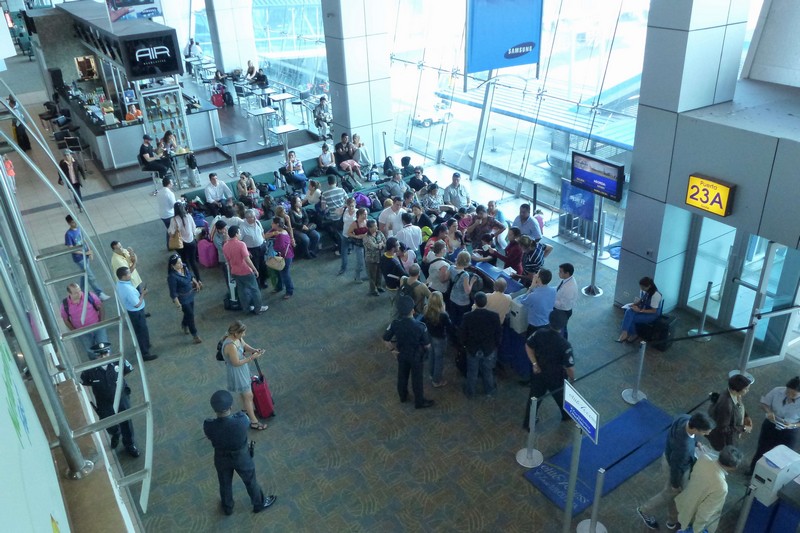
Our flight to Bogota in Colombia is at 11:05, so we’re up at the airport by about 8:30, and duly check in for our one hour flight. How optimistic of us. We lounge about in the departure lounge until our flight shows as delayed, expected to leave at 14:25. It slips a bit further, and then shows as cancelled, so we join the queue at the gate. There are absolutely no Avianca staff to be seen, and the mood in the crowd is getting ugly: they’ve been waiting for five hours, and now no flight. Eventually, one poor bloke turns up, and is completely mobbed by people shouting at him. He can’t say anything, there’s too much noise, everyone is shouting at once, and some of them are pretty angry. An airport security guy tries to help, but it’s still no use, so he gets on the radio and a few minutes later five armed police turn up. They, in turn, get on the radio and arrange for someone from Avianca who actually knows what is happening to come down and explain. In the crowd are all sorts of people with connecting flights to all over the place, including a pair with a Machu Picchu trek booked who have already missed their connection to Lima. Here’s a picture of the mob after it has calmed down, with the police standing around discreetly in case it goes bad again. We’re at Gate 23A, having been to 23A, 31, 16, 31 and 23A again during the course of the day.
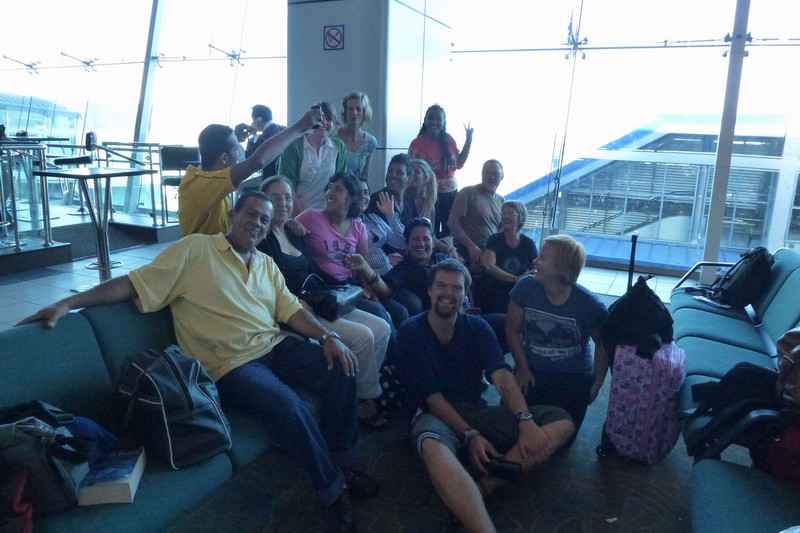
Eventually, the only passengers left are those for Colombia only. We’re all bunched at gate 23 A, and get to chatting, swapping coins in various currencies, and taking photographs like the one below. We’re surprisingly cheerful, really.
We eventually trot back to gate 31, get a free sandwich, and join the 18:30 flight to Bogota. We queue a bit more in the airport on arrival, then hop in a taxi to our hostel, which is in the old district of La Candelaria. It’s now pushing 9pm, and we hit another snag as our taxi grinds to halt due to a traffic problem on Carretera 4, one of the main routes through the district. He improvises, but in the end he drops us about two blocks away from our hostel at about 10pm. It had been a long day, but even so it occurred to me that we were now walking, late at night, through downtown Bogota, with no clear idea where we were going: a situation we usually take great pains to avoid. We hurried up the road, heart rates rising, mostly because Bogota is at 2600 metres and Panama at about 10 metres, until two local women asked us where we were going, telling us that the streets were “muy peligroso”, very dangerous, at night. We told them Hostel Alegria, and they walked us the remaining block or so, for which we were very grateful. A top day’s travelling, all in all J
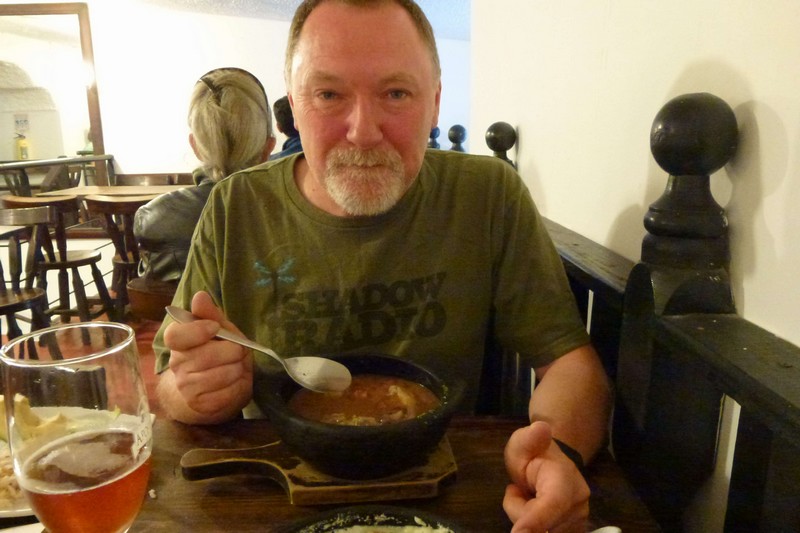
The next day, we content ourselves with checking out the local area, getting hold of a map of the city, and trying the local food. Here I am eating a bean stew, which is delicious, but has somewhat of an, errm, effect on me later in the day. It was however more tasty than another speciality: hot chocolate and cheese, where the idea was to drop chunks of soggy cheese-like substance into the very sweet drink, which neither of us was really keen on !
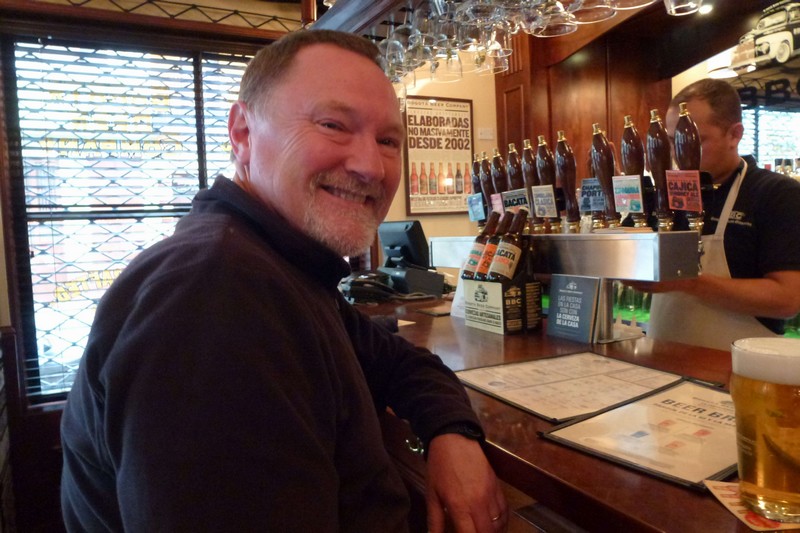
Later, we find our way to the Bogota Beer Company, and drink something which isn’t lager, hoorah !
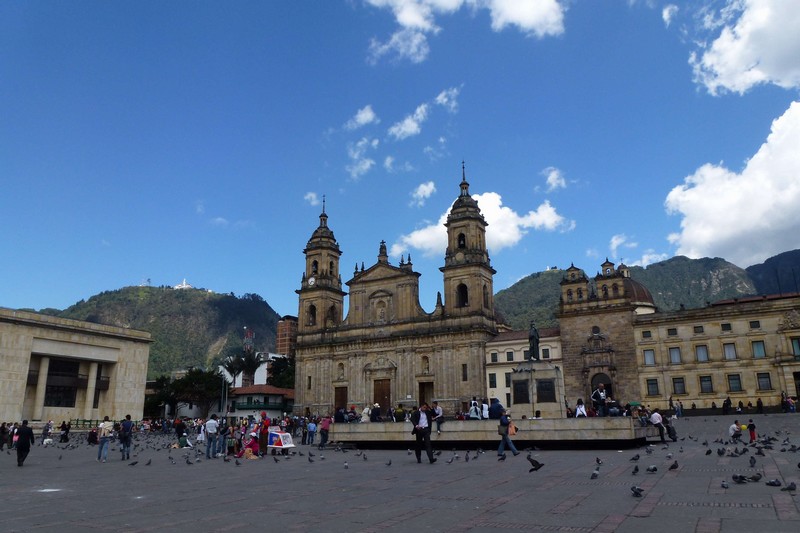
The main square is named after Simon Bolivar who led Colombia to independence and became President in the 1820s. Today it seems pigeons rule the area.
The following day we take the cable car to Monserrate, a Catholic church on the mountain above Bogota. Great views, and the weather is sunny.
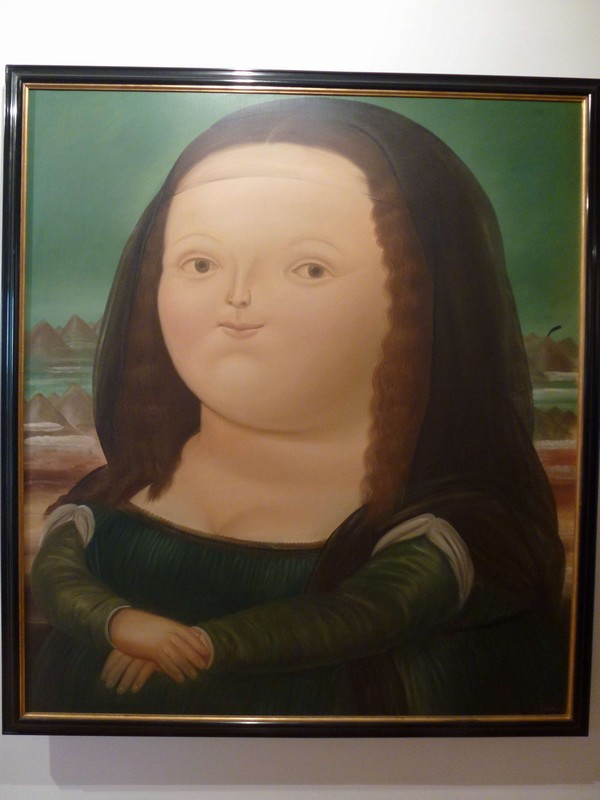
We really like Bogota. It’s got a real energy to it, and there’s always tons going on. We managed to go to two concerts while we were there, one free (latin rock, a band called Veka) and one paid (Claudia Gomez, a Colombian guitarist and singer). In La Candelaria, there are many museums, exhibition halls, concert venues and libraries, so we also go to the Museum of Bogota, which is showing an exhibition of photos of Bogota; the Military Museum; and the Botero Museum, which is dedicated to Fernando Botero, a famous Colombian painter. All of the objects and people in his paintings are larger than life and slightly plump, like the Mona Lisa and the still life with fruit below. Apologies for the photographic quality.
 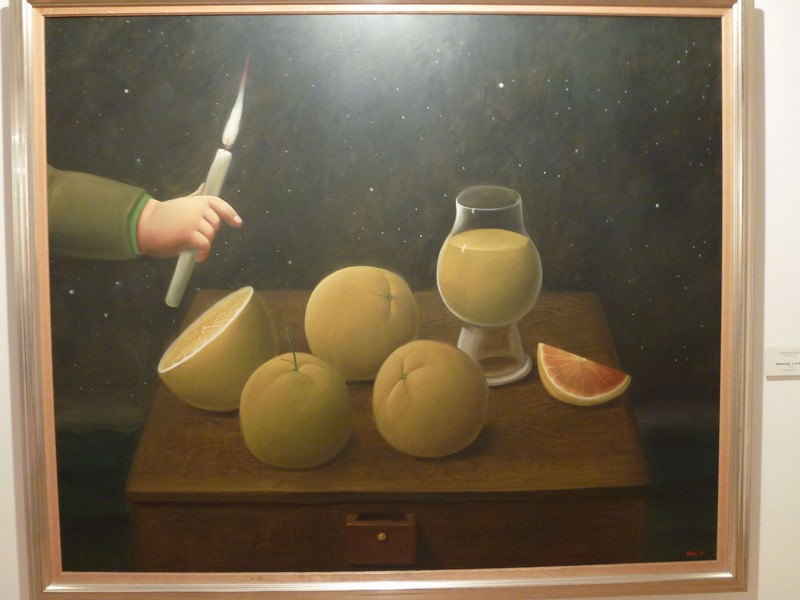
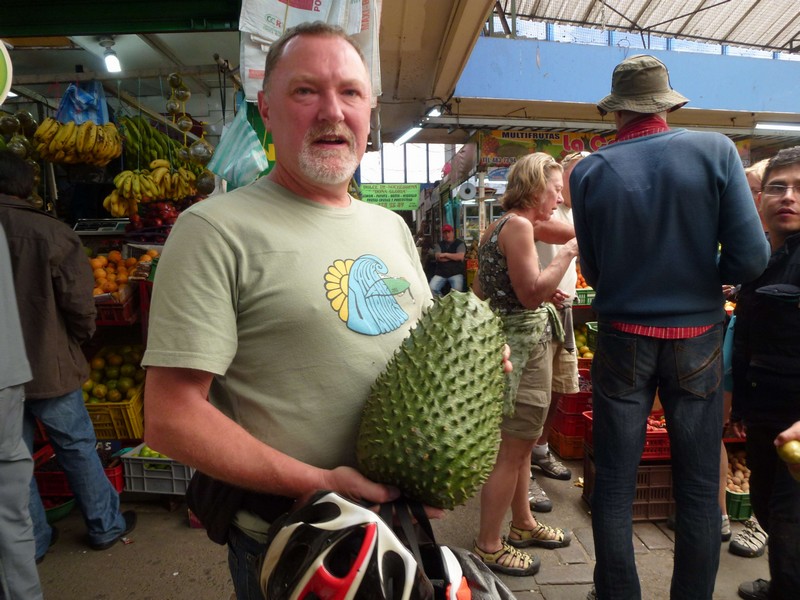
We also sign up for a city tour with Bogota Bike Tours, which was absolutely fantastic. Mike, the owner and guide, took us to parts of Bogota which we would never have seen for ourselves. The fruit and vegetable market was fascination, and we tried many odd-looking but delicious fruits. This is a guanabana.
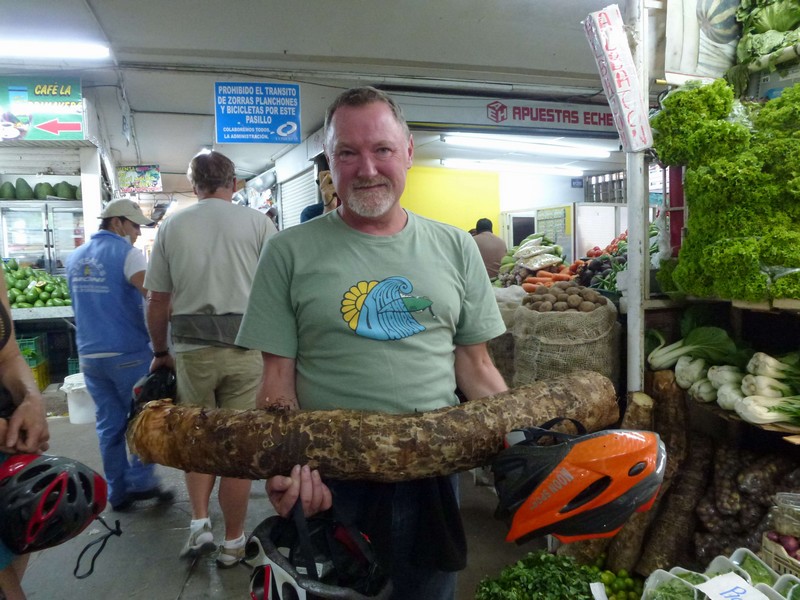
And believe it or not, this is a vegetable. I couldn’t eat a whole one, though.
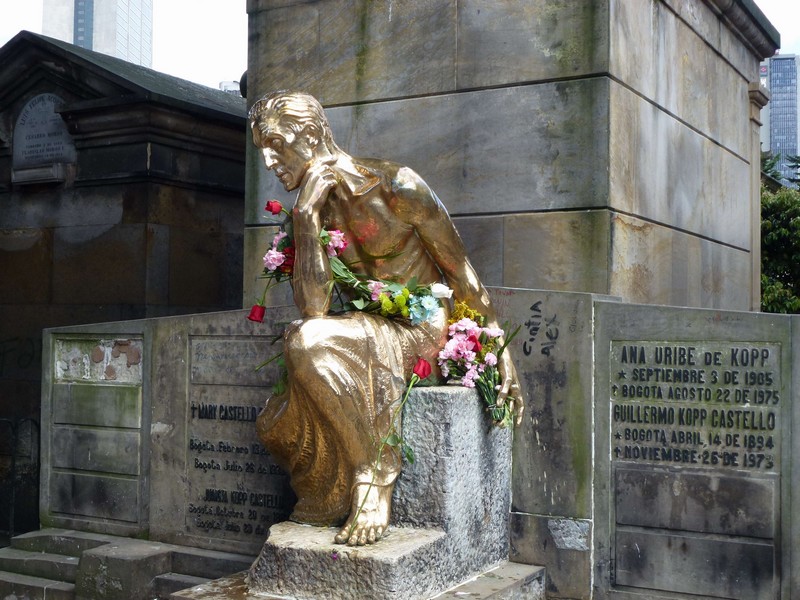
We also tour the cemetery. A number of the persons buried here are believed to be able to help the living, and their tombs are kept spruce by supplicants. This is the grave of Leo Siegfried Kopp, who founded the Bavaria Brewing Company in Bogota in 1889, and did many good works whilst alive, not least brewing beer. It’s still going, but it’s part of SABMiller now, one of the world’s largest brewers and bottlers, now headquartered in London, England.
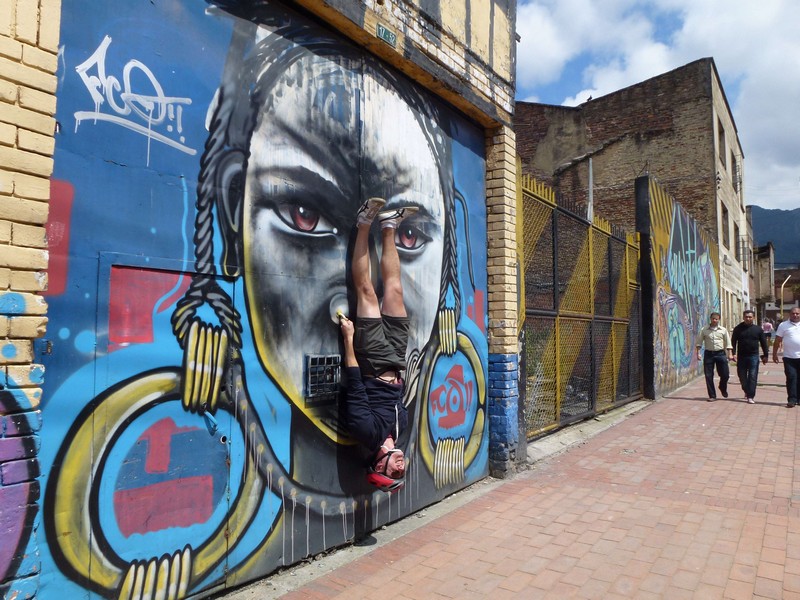
Whilst dodging traffic and pedestrians (no worries about cycling on the pavements/sidewalks here) we come across many murals, here is one with one of the fitter members of our team showing his flexibility!
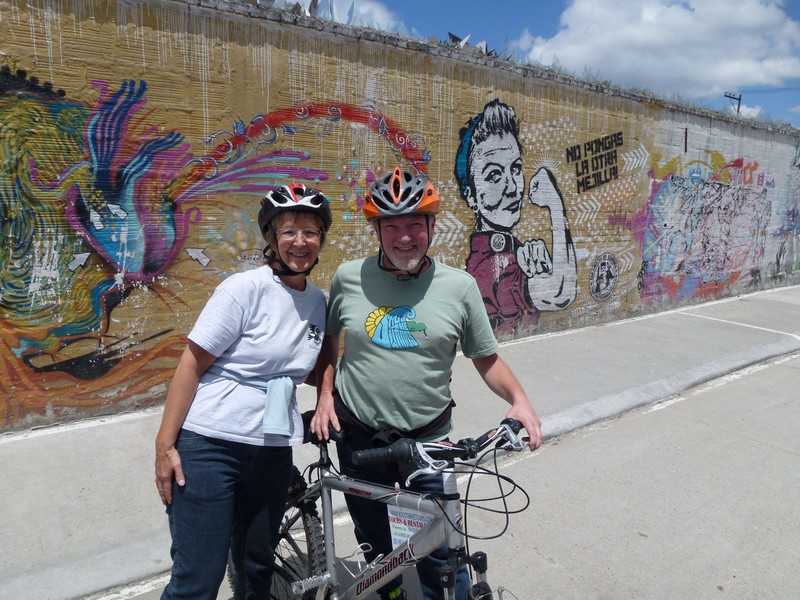
Here we are looking less fit!
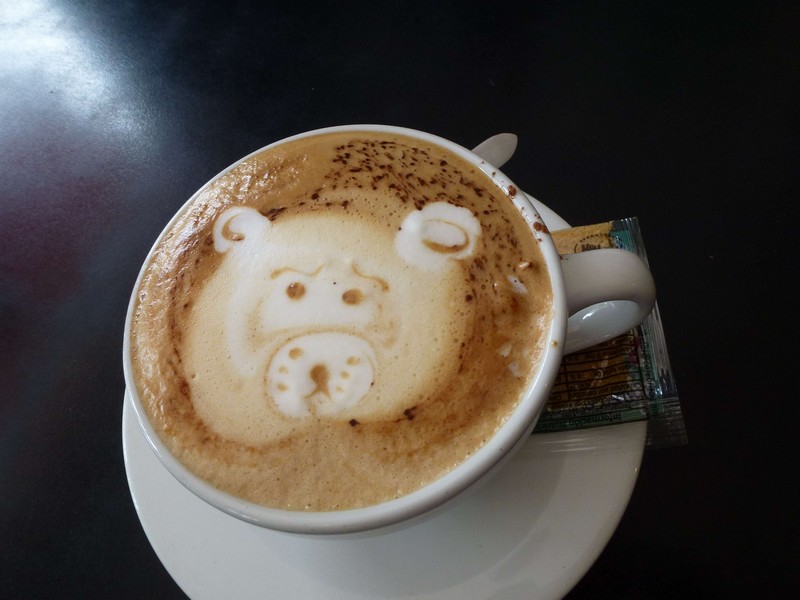
We finish up with coffee of course, and the barista is an artist!
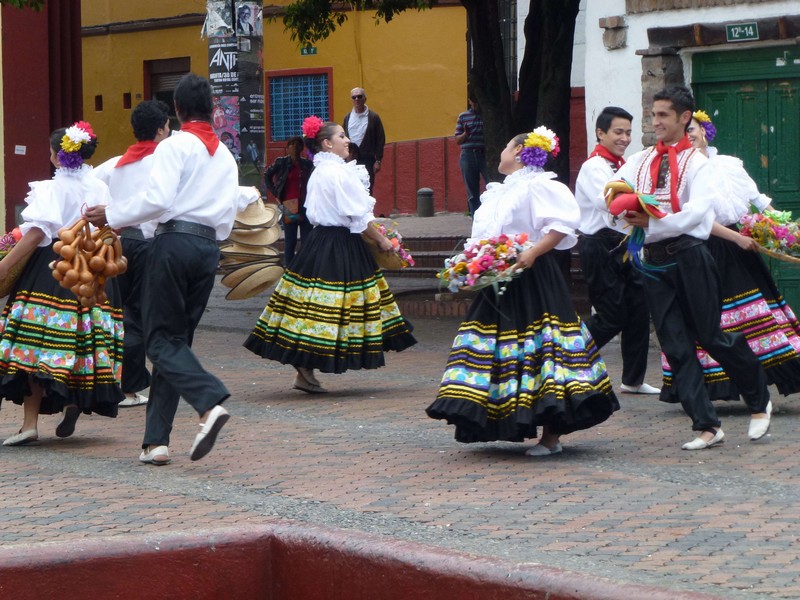
On our last day in Bogota we decide to walk further around town. We come across this set of dancers being filmed, and they must be professionals as they’re smiling a lot and appear cool in the blazing sunshine.
We walk along Septimazo, the main street, which is closed to traffic as it’s Sunday (good idea – why can’t we do this in the UK?) The whole area is a mass of pedestrians, cyclists and rollerbladers in addition to the usual people selling anything you can imagine from memory sticks to emeralds! Here’s a great example of the locals enjoying their day of leisure.
The Sunday flea market was selling everything from clothes to gas masks, plus all the sweet confections the Colombians love. We reckon we need to restrict our time here or we’ll put on far too much weight and have to buy new clothes, maybe from the flea market!
All in all, a great week in the capital city – off to the country for a rest.
We turn up early to the bus station in San Jose and get one of the few seats in the waiting room. The 11pm bus leaves only two minutes late, we are nice and comfy courtesy of Ticabus blankets and pillows and soon snooze off. We arrive at the border crossing about 3.45am and queue up expectantly at the office which, according to the guidebook, is open 24 hours – ha, don’t believe everything you read! At 5.30am the toilet attendant arrives (just as well!) and confidently tells us the officials will be here at 6am. Finally about 7.30am we are speeding on our way again, good roads and lush scenery, and we arrive in the melee of Allbrook bus terminal in Panama City about 4pm, just a tad tired. We learn later that it’s manic on the buses as today is the first day of a five-day holiday for their national Carnaval, the four days leading up to Ash Wednesday.

We are still about 3 miles or so from our hotel, but we manage to negotiate the taxi fare down to a reasonable price. Although we’ve been staying in budget hotels most of the time we had trouble making a reservation here, so we’ve stepped up a grade – a very comfy bed and pillows, soft towels, little tubes of shampoo, and no ants ! It also has a functioning cable television, so we can continue our attempt to watch ”The Mummy III: Tomb of the Dragon Emperor”, dubbed into Spanish, in every country in Latin America. If we watch it long enough, we may even understand it.
The following day is the first day of Carnaval, so we walk down to the waterfront to see what’s occurring. We’re vastly early, it’s only midday, so mostly there are thousands of policemen checking the perimeter, and people setting up beer and food stalls. The music is already loud, the sun is hot, hot, hot and the smallish crowd is being cooled by torrents of water sprayed by large hoses from water tankers.
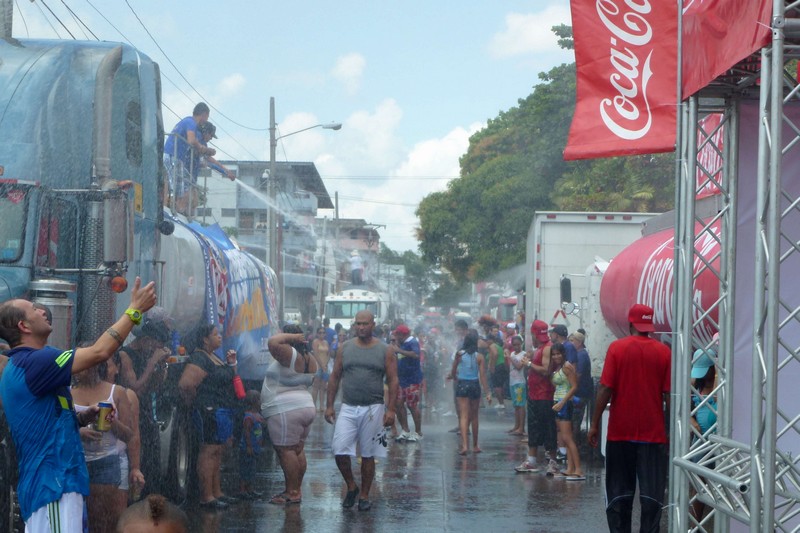
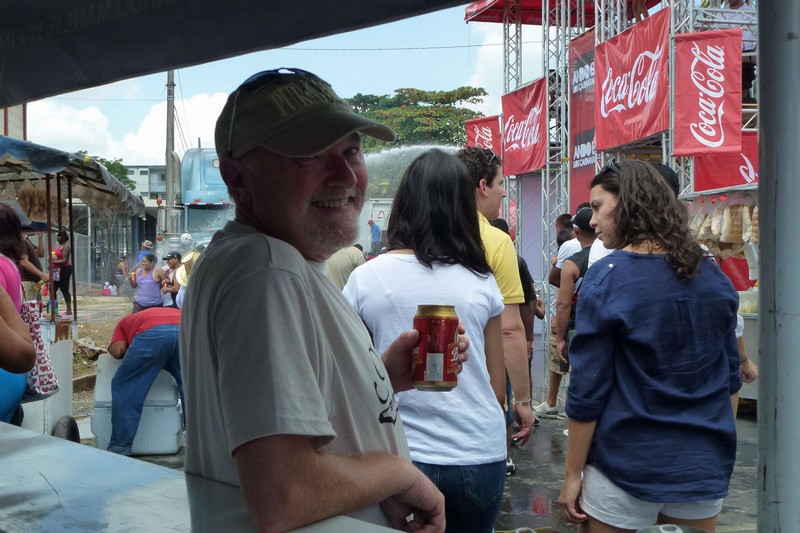
We’re just standing around innocently when a family standing nearby decide to empty a bag of confetti down our shirts, inside and out. This is common during Carnaval, when you can be sprayed with foam or water, or coated in paper at any moment. Shortly thereafter, we’re sitting on a grass verge when we are approached by two photographers and what proves to be a reporter, from the national paper, Prensa. They “interview” us, tricky as our Spanish is improving but not really tippy-top yet. We are surprised to find we are actually in the paper the following day, billed as Pablo and Diana Davies. Here’s a picture of me holding a can of Balboa.
The following day, we decide to tour Casco Viejo, the old town of Panama City. This suffered decades of neglect, and is still attached to a rather sketchy neighbourhood, but is gradually being restored. It’s on a promontory which gives a good view of the not-so-old part of Panama City, which has many skyscrapers.
The restored parts are really quite spectacular: this bit below could easily be in Italy somewhere. Unfortunately, all of the museums and the like are closed because it’s Carnaval, so after a while we walk back along the sea wall towards the largest concentration of beer vendors in the country, past the fish market. Here we pause briefly to have ceviche, possibly our favourite Latin American dish: fish marinated in lime juice, basically, but with variations from place to place.
Again, we’re a wee bit early for the main action, but we do spot this guy.
We hang around for a while again, but there’s still not much happening, so we resolve to come back later. In the event, we don’t make it. On our way out of the hotel at about 6 that evening we run into a couple we met on the bus, and they report that there are only about 5 floats in the main procession, and they didn’t roll up til late, so we scrap the idea and head instead for the Istmo Brew Pub. This holds the prospect of a drink of a beer other than lager, and in fact it is so. It’s still a bit fizzy, but their Amber Ale is nice. They also do hookah pipes, according to the sign below. Perhaps they should get them in the Bell in Bath.

There’s only one thing left to do in Panama City: visit the Canal. You have to do this while ships are actually passing through, otherwise it’s a tad boring, so we join the queue to get in at 9:15am, and watch the Sunshine Express enter the first lock, Miraflores. Vessels which pass through are charged according to length, so old Sunshine here will pay a great deal, perhaps many tens of thousands of dollars, to travel the fifty miles between the Atlantic and the Pacific. The smallest amount ever paid was $0.36, by Richard Halliburton, who swam through, while the most expensive regular toll to date was to the cruise ship Coral Princess, which paid $380,500.

The little trains keep the ship in the centre of the canal, as there is only 24 inches clearance on either side. The size of ships around the world is influenced by the width of the Panama Canal: the largest size which can pass through is called Panamax. They’re building a new set of locks which will be able to accommodate even wider ships in the future.
There’s a cinema as well, showing a film about the building of the canal. The French had a go, lost many thousands of workers to malaria and yellow fever, and gave up, then the job was finished by the Americans, who ran the canal and the zone around it for decades. It was finally signed over to Panama by President Carter in 1977. So, a final night in Panama City, and then we’re flying off to Bogota, Colombia, and South America.
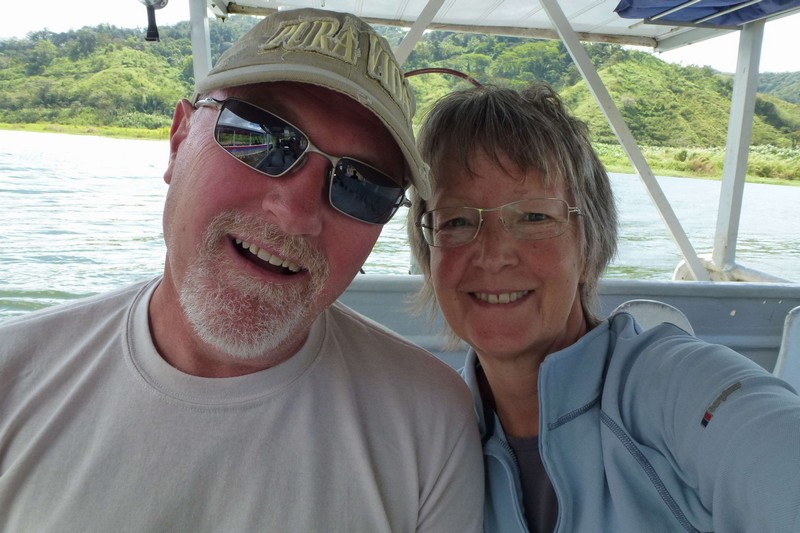
We decided to take the adventurous-sounding jeep-boat-jeep transfer to La Fortuna, our next destination, combining a trip through the mountains with a boat journey. In actuality, it was way less rugged than it sounded: microbus-boat-microbus, in fact, as it’s very popular these days. The mountain landscape is wonderful, though, resembling Switzerland, and even more so when we get to Lago Arenal, under the volcano. We were unable to take pictures as the road is a bit sketchy, so here’s another annoying two-head shot on the boat section. Pura Vida !
The microbus drops us at the Hotel Dorothy, near the La Fortuna bullring. Doesn’t look much, but it’s cheap and has a communal kitchen. It’s sign also advertises Hot Water, which is a rarity in this price bracket. This usually doesn’t matter, because we’re in the tropics and it’s ridiculously hot most of the time, and so a cold water shower is quite refreshing. They also have ants, but that isn’t on the sign.
Dorothy is also close to the local supermarket, where we are able to buy bread and, glory be, cheese ! This enables the construction of a cheese sandwich for lunch, and we’re happy bunnies. Later, we wander round town, which is as touristy as Blackpool, though without the tower. It’s full of high-class restaurants with menus priced in dollars, zip-line and white-water rafting places, and coffee shops. It’s pricey, too, but that’s true of Costa Rica generally, which is quite comparable with the UK for food, beer and the like.
A big local attraction which you can see without being a) on a horse, b) in a raft, c) on a zip-line or d) bankrupt, is La Catarata de Fortuna, a waterfall which runs near the volcano. As we have had little exercise for some while, we decide to walk there, to mild consternation from the hotel staff. It’s about five kilometers, uphill, in the sun, so it isn’t a walk in the park, but we make it, stopping only for a massive smoothie at a newly-opened restaurant and dog-rescue place. There aren’t many people walking, that’s for sure.
It’s nice when we get there, but the round trip takes us about four hours, broken only by cheese sandwiches by the falls.
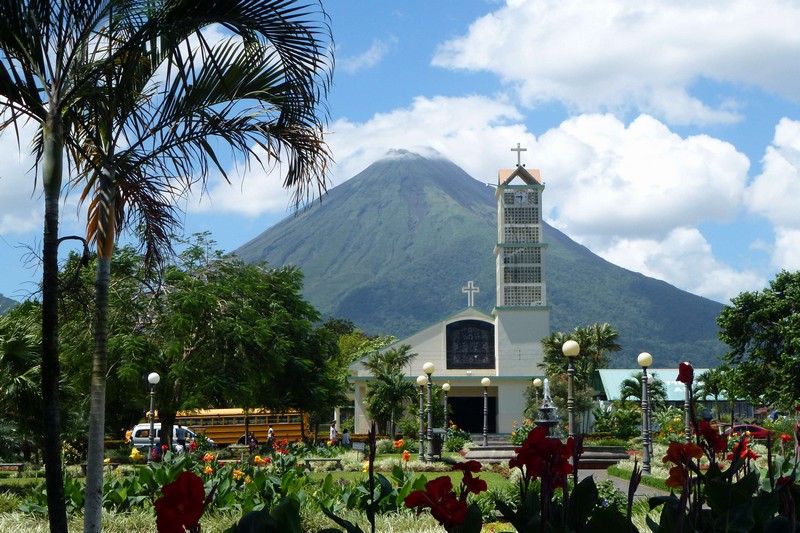
Later that evening we get a take-away pizza, and are eating it at Dorothy when we get to chatting with our neighbour, from Austria. After the usual “where have you been, where are you going” chat, she opens the batting on a game of ”well, of course, it’s not safe there”. This involves telling the other party about some place they’re in or will be going to which isn’t safe, either because they’ve been robbed there or they’ve heard of someone being robbed there, and advising them on security measures to take. I usually try not to engage too much because I don’t want to admit to carrying some money in my shoe in case I’m robbed. Anyway, here’s a picture of the main square and the volcano, looking nice and peaceful and safe. The volcano used to be active, but it’s been quiet for a year or so, which has put a crimp in their volcano trips.
The following morning we left on the public bus for San Jose, changing in Ciudad Quesada, and arriving about five hours later. We try to get a taxi from the bus station to our hotel, but the teachers are marching through town and the taxis can’t get there. So we walk, which is warm indeed. We’re staying at the Hotel Ritzli, a Swiss-run establishment, as it is my birthday today. It’s near a church called La Merced, and this statue.
We’re off to Panama City tomorrow, though not until 11pm, on the overnight bus. The trip is a wopping 17 hours, with a border crossing at about 6am. Oh joy. By the way, Panama City, it’s not safe there, apparently.
We’d heard terrible things about the border crossing between Nicaragua and Costa Rica: hours spent waiting to get into the correct queue, so on and so forth, so we were mentally prepared for the worst. One of the advantages, though, of travelling with a long-distance operator like Tica Bus is that they ease the crossing: they know the process. They collected our passports before we arrived at the Nicaraguan exit, and dealt with that without us at all. Here we are hanging around: there are many stalls selling food and drinks, as well as an endless supply of money-changers. We had a coffee and got rid of our Nicaraguan money at a pretty poor rate.

After they had handed the passports back, we drove to the Costa Rican side, where we queued to get in. Fortunately for us, they are remodelling the building, and so have no facilities for inspecting luggage ! So, a short wait to have our passports stamped, the bags remained on the bus, and then we were off. This was followed by six hours of tedium, scarcely alleviated by watching the movies on the overhead screens: Never Back Down, followed by Never Back Down 2. In Spanish. I got the plot for the first: troubled teenager discovers mixed martial arts, beats living hell out of his enemy, gets the girl. I hadn’t a clue what was going on in the second, but there was lots of fighting. We arrived in San Jose, capital of Costa Rica, at about 5pm, a ten-hour trip. The San Jose Tica Bus terminal is sophisticated: it has a baggage handing area, to which all the bags are conveyed so they can be reclaimed. This is perhaps the most inefficient process I’ve ever seen. The two guys from the bus unload all the bags and then pile them into a big heap, literally a big heap, while passengers crowd around the counter and shout “Señor, Señor, la mochila azul, la mochila azul”, or similar, until their bag is handed over. In practice, you have to wait until you can actually see your bag or bags: ours were off first, but they rapidly disappeared under other bags, so I had to wait until they resurfaced. Then we hopped into a taxi and proceeded to our hostel, Casa Ridgway.
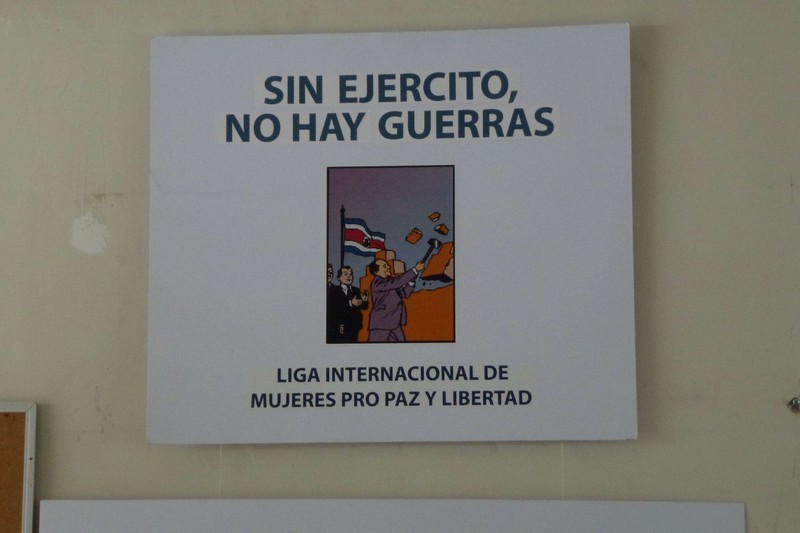
This is a combination hostel and peace centre, with each room themed for a different peace campaigner, with a big painting on the wall. As the photo on the right points out, if you don’t have an army, you can’t have a war, and Costa Rica has no army.
We have a couple of days here, so we wander around town. In one of the main squares, we come across a familiar sight: an Apple dealership. The name made me chuckle. The ice cream shop next door was good, though.
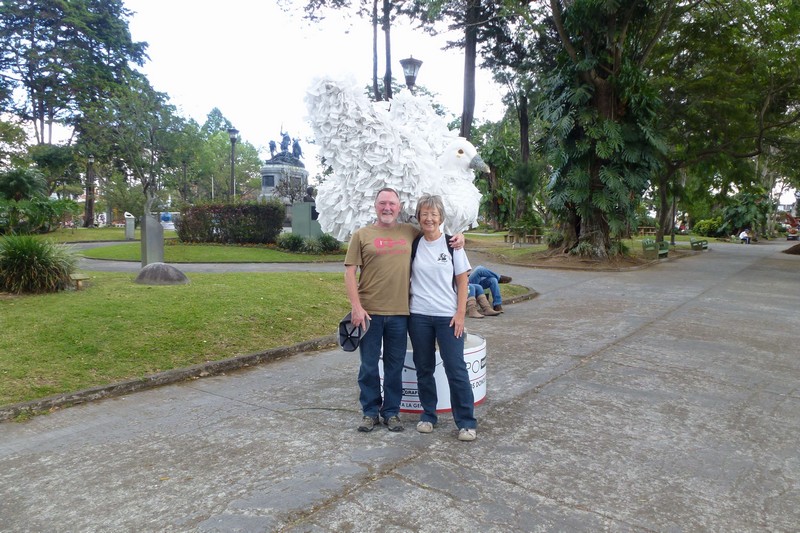
Costa Rica seems to be much more prosperous than most of the countries we’ve travelled through so far. They have good roads, lots of cars and big glass buildings. There’s still poverty, but less of it, it seems. We walked round town with another Ridgway resident, so here’s a picture of us together standing next to a dove of peace, part of a big sculpture project which is spread all over town. Looks more like a chicken of peace to me.
After a couple of days, we went to the town of Santa Elena, in the Monteverde area of the Costa Rican highlands. The town reminds me of a French ski resort in the summer: it’s at the top of a hill, has lots of concrete building and a supermarket, tons of restaurants and bars, and huge numbers of places selling zipwire canopy tours, mountain biking trips, and transfers to other tourist places. The big draw here is the cloud forest, so we tour the reserves. In the background here, with it’s head in the clouds, is Volcano Arenal, where we’ll be in a couple of days. We’re standing on an observation tower which sticks up above the forest canopy.
Amongst other things, we go on a guided night walk in the forest. As well as a two-fingered sloth, a pit viper, leaf-cutter ants and an armadillo, we spot this tarantula.
And we wrap it all up with a visit to the Frog Pond to look at the tree frogs. Here’s one on the glass of it’s terrarium: it’s about an inch or so long.
Anyway, it’s moderately cold, wet and windy here, as you might expect in a cloud forest, so we’re off back to the flat lands tomorrow.
We’re taking the public bus from Leon to Granada via Managua: we have to change at UCA, the terminal next to the University of Central America. On the first bus, we chat to a local guy who has a house in Los Angeles, and when we arrive we need to change to the express to Granada. There’s no trouble finding it, or indeed them, as the buses round here have conductors whose job it is to shout out the name of the destination, in this case “GranadaGranadaGranadaGranadaGranada” with accompanying “come over here” arm movements. I walk past the first one to the second so as not to seem too easy, and our bags disappear onto the roof.
It’s full-ish when we pull out of UCA, which in Central America means that all the seats are full and there are about ten people standing. After five minutes or so, a ten-year old boy gets on, carrying a small guitar, not in a case. He twangs it a few times and then launches into song. He does three traditional-sounding numbers, heavy on the “mi madre” and “mi corazon”, and then shuffles over to each seat in turn, waving one hand, in a fist, towards each of the sitters at chest level. It’s like he isn’t expecting anyone to give him any money, his hand isn’t even open, and in fact nobody does. Then he gets off at the next stop. We’ve seen many children begging, or in this case busking, but never on a bus before.
In Granada, we see a sign for our hostel, Oasis, and leap off at a totally chaotic road junction. After checking in, I go hunting for a haircut, as it’s totally out of control now. I get the job done in Barberia 007. It’s short, but as that was the only word I spoke to the barber, I guess it’s what I should have expected.
We’re staying in Granada for a night and then moving to Lago Apoyo, a lake in a volcanic crater, for a couple of days. We stay in the Paradiso hostel on Apoyo. It’s lovely and peaceful, with hummingbirds, squirrels and howler monkeys, which we heard but didn’t see. Here we’re looking down from the terrace to the lakeside: the bar is just down there on the right 🙂
There isn’t much to do here: swim, lounge about, read, but we enjoy it. We catch up on a bit of TV, watching episode 2 of Sherlock on iTunes : very good J Back in Granada, we stay at Amigo’s hostel rather than Oasis. We decide to change after a night, as it’s just a bit too far down the scale for us. (By the way, we pay about $20 a night for a double room in a hostel in Nicaragua, but what you get for that varies a lot). Here’s our room, which is on the roof.

We move instead to the Hotel Jerico, which is a bit more expensive but much better: for example, the light switches have all their wires connected and are attached to the wall, and the bathroom floor is generally dry. It’s also on the main tourist street, which is packed with restaurants, bars (including an Irish Pub), and vendors selling jewellery. We have a drink in one of the bars during happy hour as the drinks are really quite cheap, but all the goods come to you: cigarettes, chewing gum, and hammocks. Many hammocks. I probably declined to buy a hammock every five minutes or so. Here’s the main church near Parque Central at a quiet time. Normally you can’t see it for hammocks.

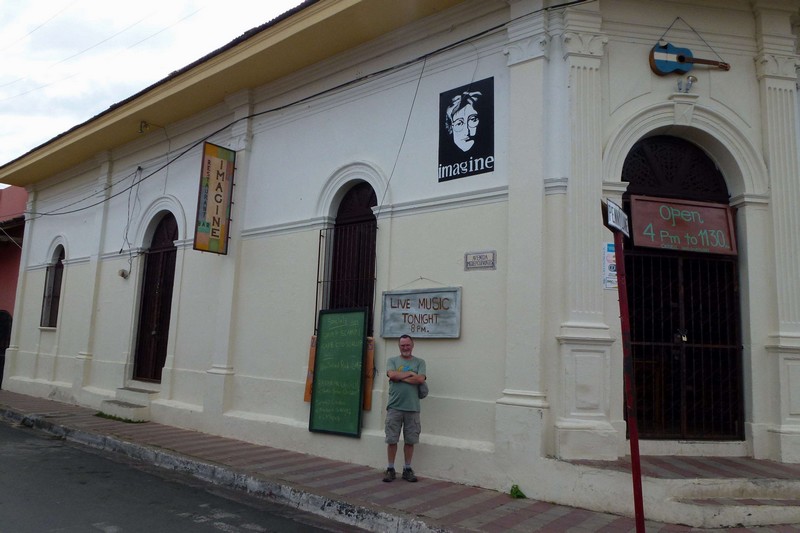
Just off here to the left is an Arts Academy where they have music events, one of which takes place while we’re here. Groups from the school play to whatever audience is passing by in the square, so we listen to a few numbers. One group (three guitars, drums, vocals) gets up there and plays “Wish you were here” by Pink Floyd. There’s a restaurant around the corner called Imagine, with a picture of John Lennon outside, and also fake road signs saying “Abbey Road” and “Penny Lane”. They also have a band on while we’re there, a reggae/jazz combo (two violins, bass, guitar, cajon), and they play a recognisable version of Afro Blue by John Coltrane, as well as some reggae tunes.
While we’re here, we decide to go on a kayaking trip on Lake Nicaragua with a local guide. This is great: we start early to avoid the major heat of the day, although I still get massively sunburnt. Here we are.
We wind in and out of the little islands in the lake for about four hours, eventually winding up at Mono Island, a small islet with some monkeys on it.
We also see many birds, as well as bats which rest up under the trees over the water during the day. Excuse the blurry photo, they were quite a way away.
Anyway, we had a great time, although I got bitten to death by insects. We liked Granada. Off to Costa Rica, the most expensive country in Central America, on the Tica Bus again.
|
|





























Recent Comments