|
|
So, we left Copan Ruinas by the Hedman Alas luxury bus service to San Pedro Sula (SPS), where we will stay overnight and then catch the 5am Tica Bus service to Leon, Nicaragua, a 12-hour journey. The trip to SPS was fine, though late, and we were met off the bus by our hostel owner, Rocky, who transported us to our accommodation, inside a gated compound protected by armed guards. He also took us off for something to eat in the evening, and then transported us at 4am to catch our bus. All in all, pretty safe, which is what we were after, given SPS’ reputation as the most dangerous city in the world (though who said so, I know not), although it’s apparently only really dangerous if you are a gang member. Here’s the bus, anyway, our home for 12 hours.

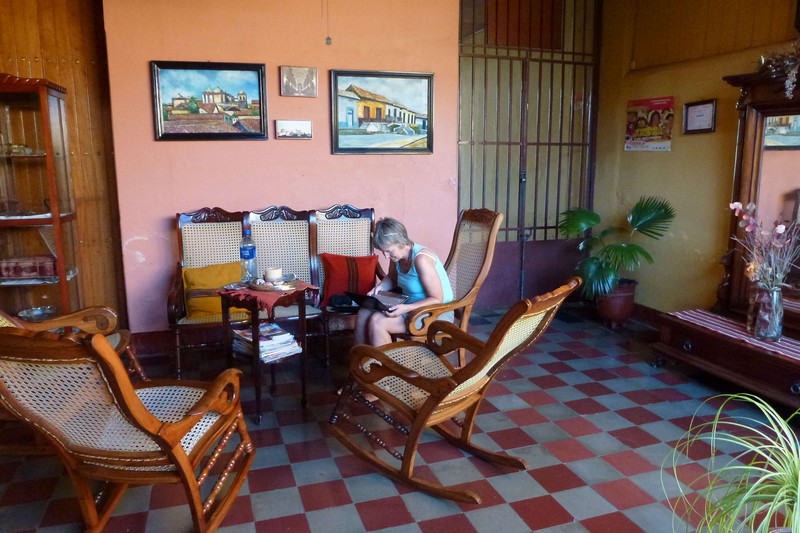
The journey was fine, though late, as it took us a while to cross the border, as per usual. Eventually, we were dropped off at a petrol station outside Leon, Nicaragua, and took a taxi into town. We’re staying at the Casona Colonial, which is lovely. Here’s Diane sitting in the open-air lounge.
It’s a nice town on the standard Spanish colonial model, so there’s a Parque Central with a church on one side and the government offices on the other. Here’s the cathedral, which looks kind of tatty on the outside, and is superb on the inside. It’s the largest in Central America: there’s a legend that it was destined for Lima, Peru, but that the architect became upset with the Lima authorities and switched the plans for a smaller one.
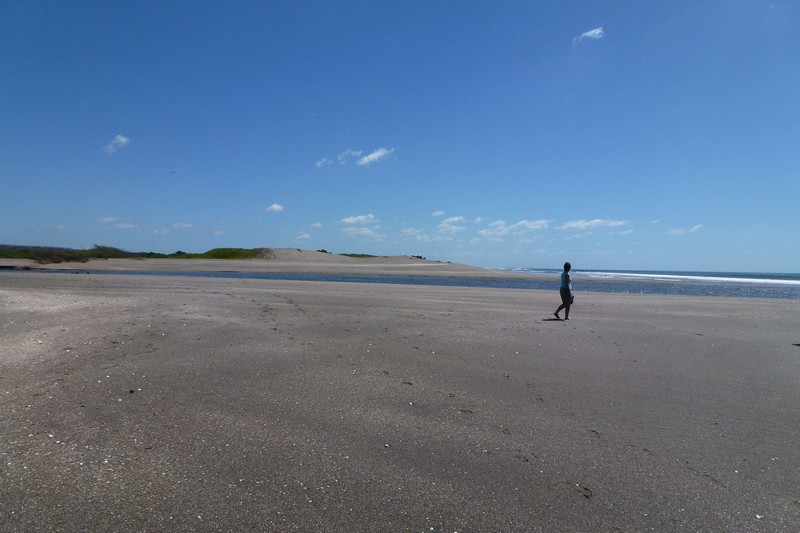
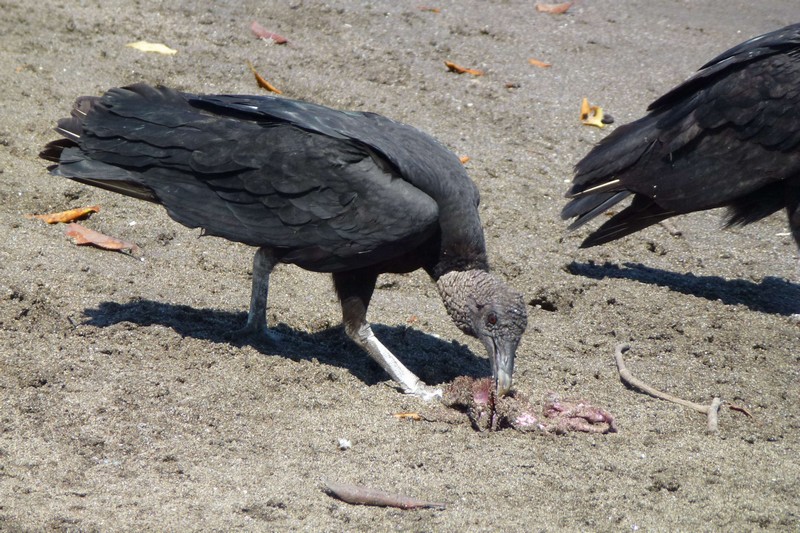
We also visit the Pacific Ocean, nearby, with some friends whom we met in Yucatan (how long ago that seems). They’ve been home and then back again on another holiday, and we just happen to be in the same town on the same day. The beach is great, though hot, and there are lots of vultures around eating dead fish.
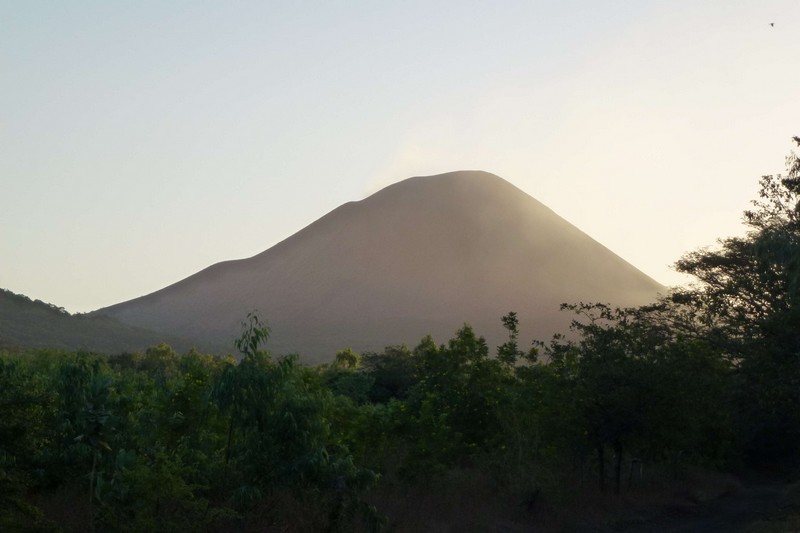
The highlight of our visit here, though, is walking up Telica, an active-ish volcano near Leon. We are picked up at our hotel at 5:30am, and start walking at about 7am. Here’s the lump in question in the early-morning light. We’re not walking all the way up, only to the little indentation on the left slope. The top bit is too crumbly and dangerous.
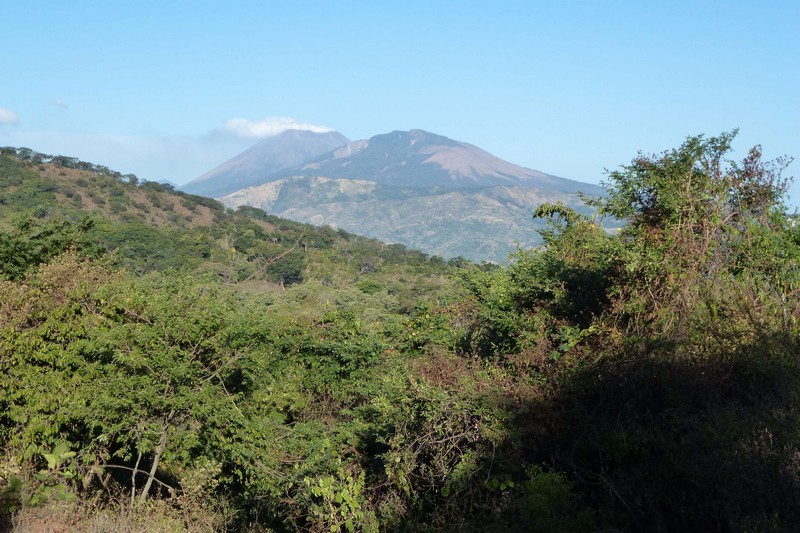
It’s a couple of hours to the top, and the views become better and better. Here we’re looking towards a more active volcano, San Cristobal, which puffs out fumes regularly.
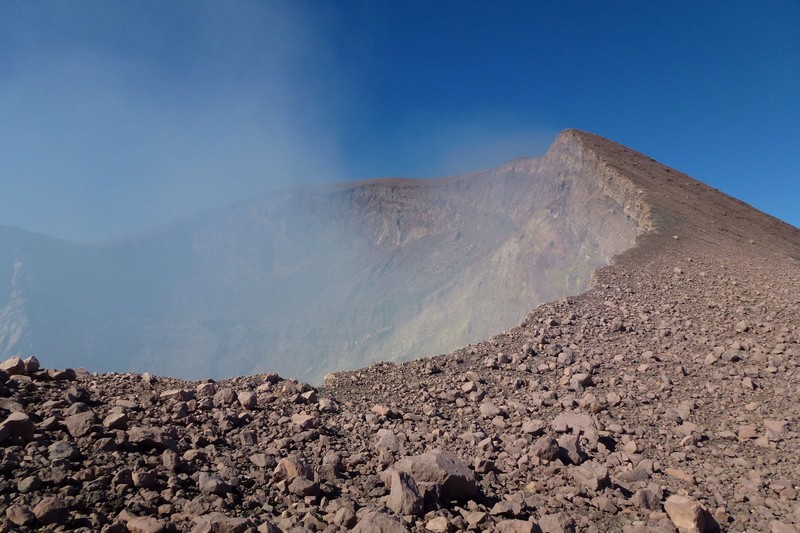
Eventually we crest the ridge, and catch a whiff of the sulphur fumes coming out of the crater.
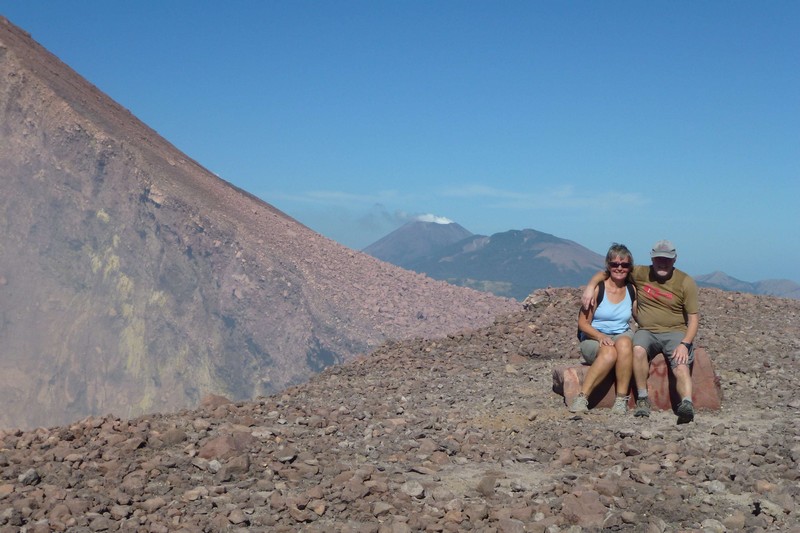
Here we are together, for a change, taken by the guide.
Then we have a long walk down, through a forest and round another extinct volcano to some hot springs.
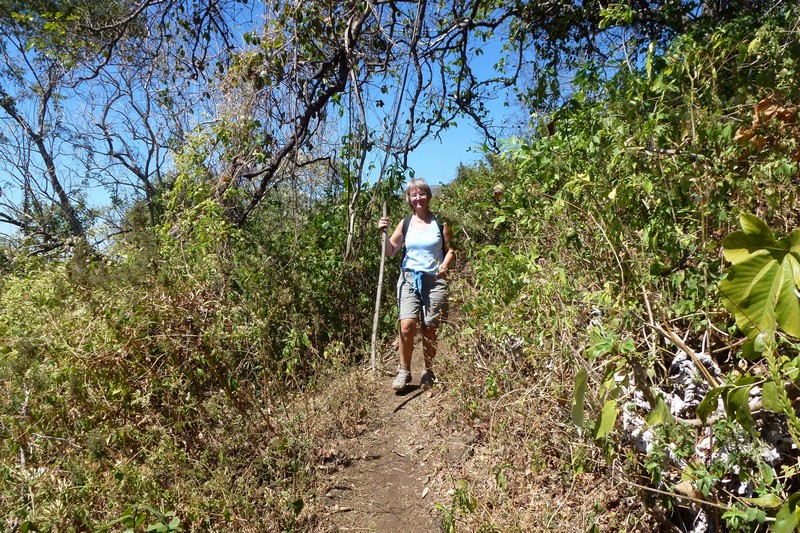
And here’s Diane with her trusty stick.
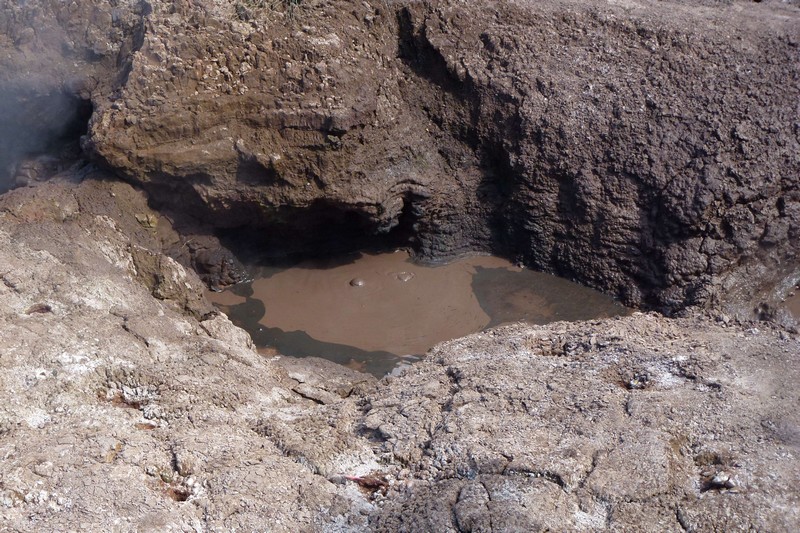
The hot springs are gloopy and foul-smelling, as one might expect. They use them here to generate electricity.
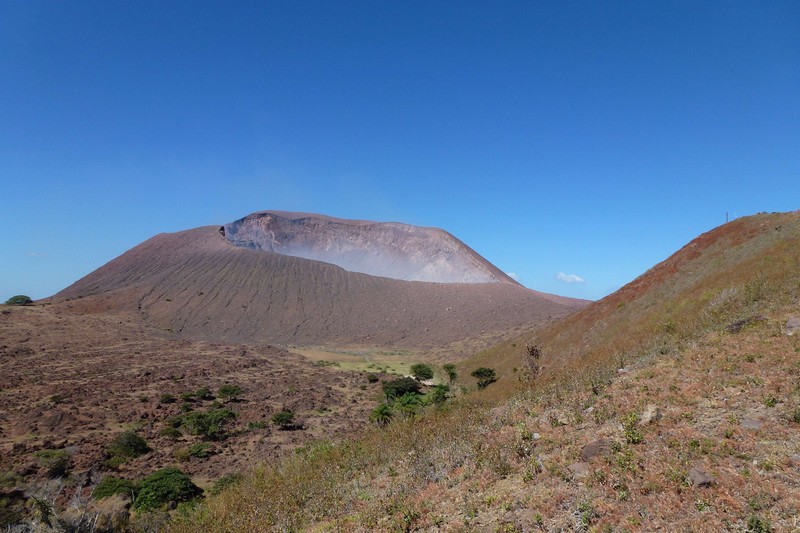
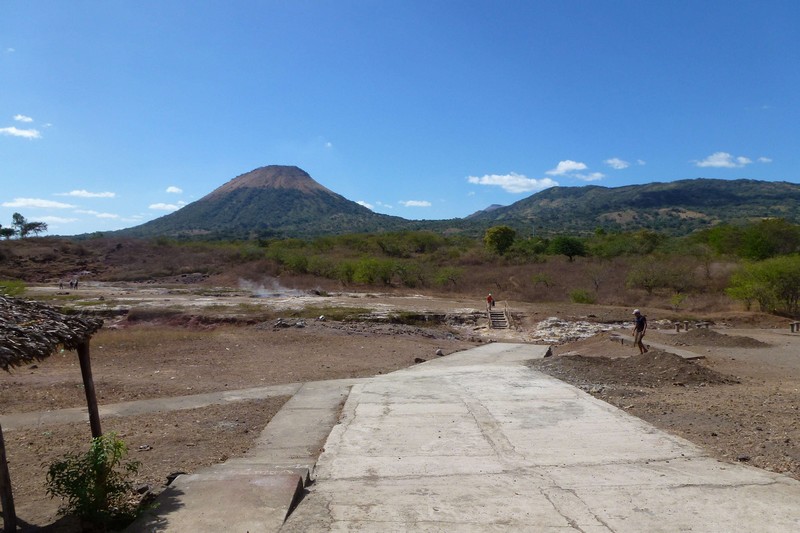
And here’s a final view, looking back over our route. Telica is the little sticky-up bit in the gap between the volcano on the left and the hills on the right. The gps said we walked about eight miles in straight-line distance, not counting the ups and downs, and we finished at about 2pm, so we were all pretty hot by the end.
Off to Granada tomorrow, about 168 miles, by public bus through Managua, the nation’s capital !
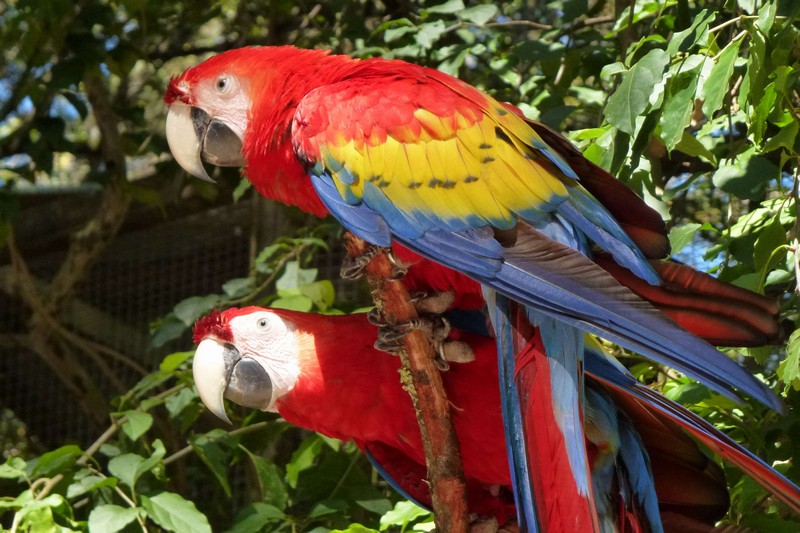
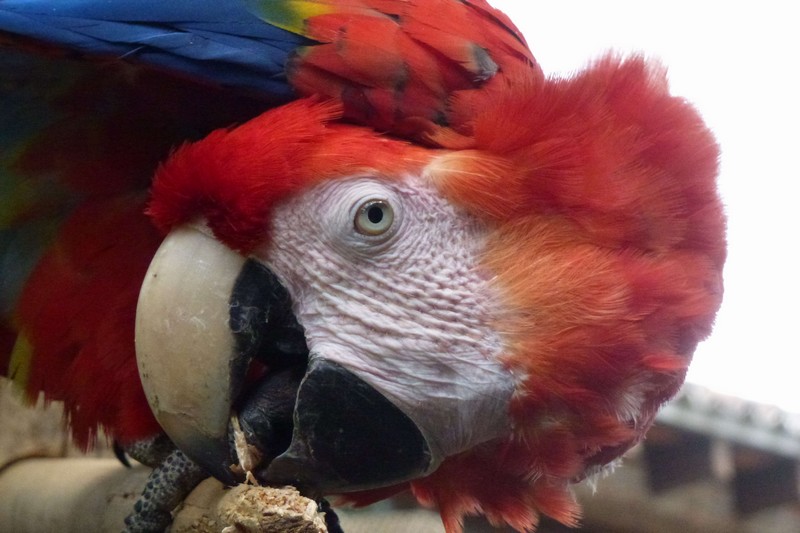
Well, we set off for Honduras by shuttle bus from Guatemala. This was scheduled to take about 6 hours, and “shuttle bus” is usually code for “a small, rather cramped minibus in a dubious state of repair”. And so it was: we all piled on, and arrived in Copan Ruinas, Honduras, seven and a half hours later, feeling somewhat frazzled. We repaired to our hotel, and after a few drinks and a meal at a local bar, slept very well. The following day, we did pretty much nothing, including spending the afternoon hours in hammocks on the roof of the hotel, reading and trying to do the crossword in the local paper. After this, though, we got on the case, and went to Macaw Mountain, a local charity which rescues Macaws and other birds which were once pets. They are spectacular. These are Scarlet Macaws.
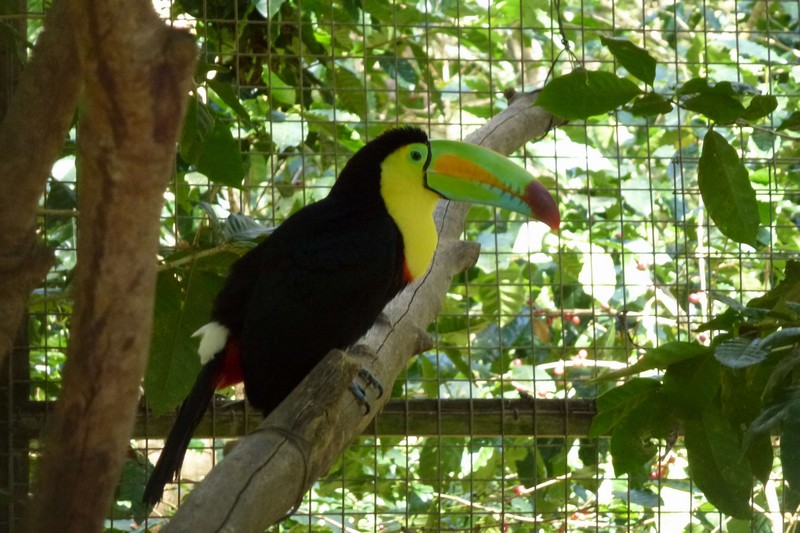
And a Toucan, a la Guinness. A lot of the birds are in huge cages because they were pets, and so cannot find food themselves. They do breed in captivity, though, and the young birds are released into the wild.
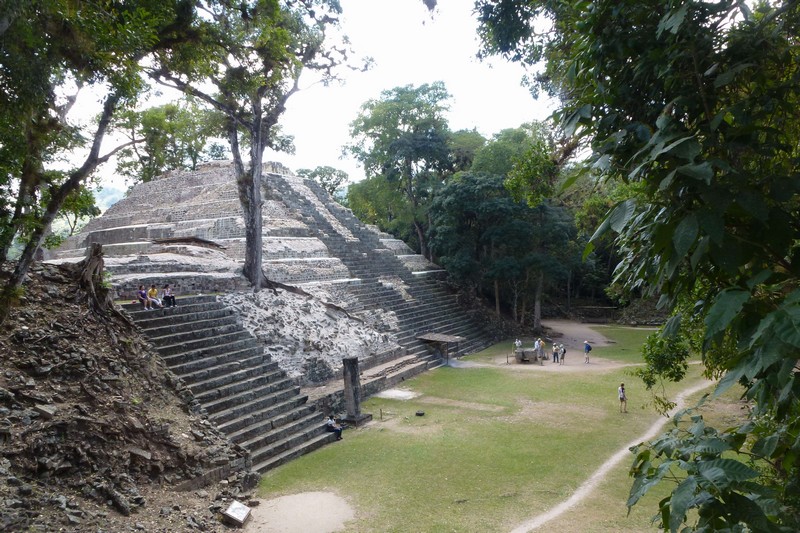
The trip was bracketed by a rather interesting tuc-tuc ride: the roads around here are pretty shocking. Anyway, next day, we walk out to the Mayan Ruins of Copan which give Copan Ruinas half it’s name (the other half being the Copan river). These are marvellous, in a better state of repair than many other Mayan ruins.
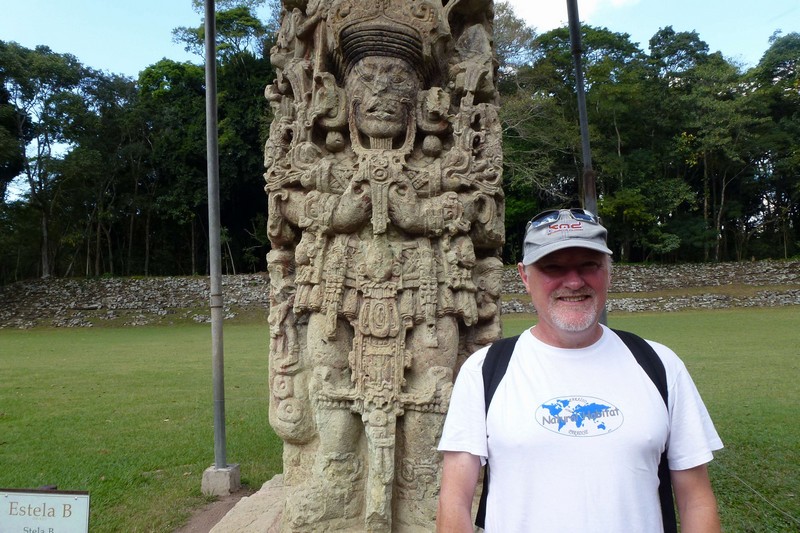
Here I am looking slightly wooden next to an estela, a large carving, depicting one of the Mayan kings (18 Rabbit, 695AD) who was a bit of a warrior but was beheaded in 738.
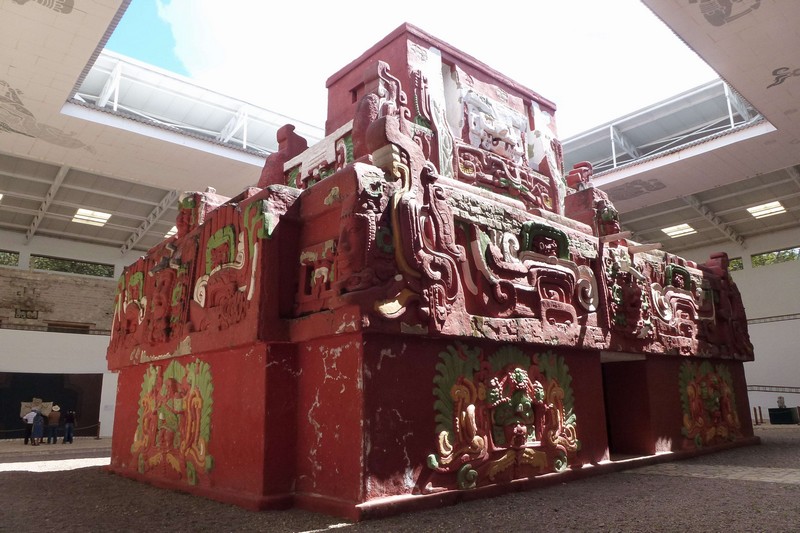
There’s also a large museum which contains in it’s centre a reconstruction of a tomb which is buried under one of the main temples.
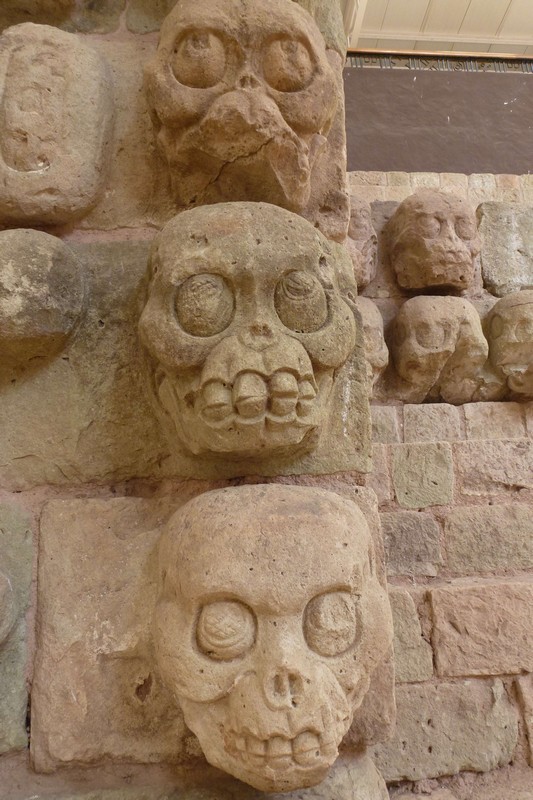
The Mayans were, it is well-known, as cheerful as anything, and here’s a few carvings which show this well.
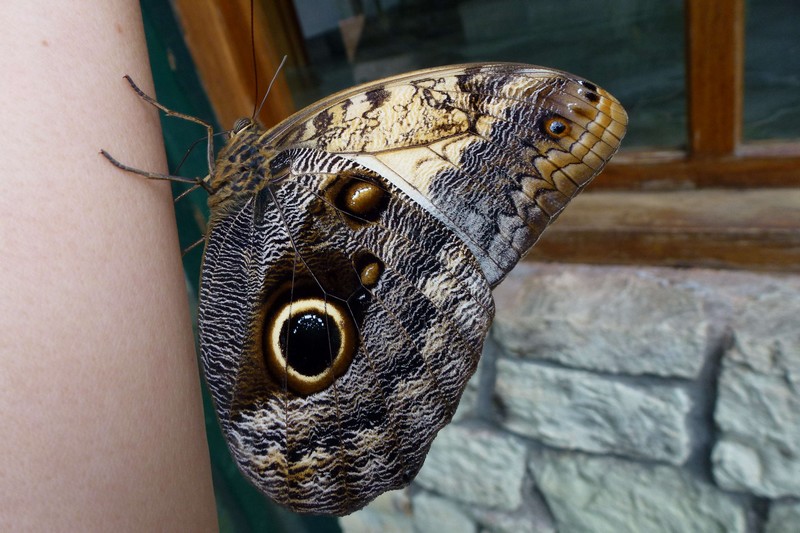
It’s pretty warm when we finish our tour, so we spend the afternoon drinking fruit smoothies (called licuados round here) and swinging in our hammocks. Another day, another trip, and we’re off to a slightly rundown butterfly project near the town. Here they’ve just had a lot of giant Owl Butterflies hatch. These pretend to be the eyes of owls to protect themselves. This one is sitting on Diane’s arm: it’s about six inches wingtip to wingtip, and about three inches long.
And this is a smaller butterfly, species unknown, feeding.
9 
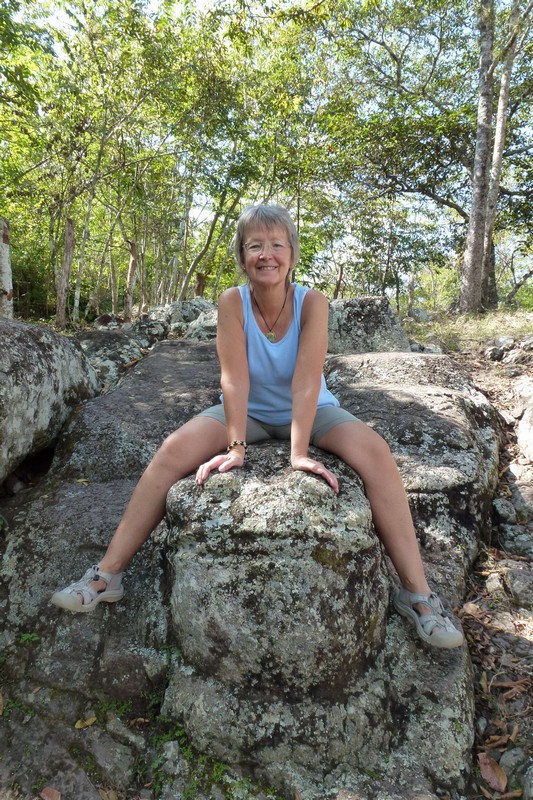
It pretty warm when we finish, so I imagine you can guess what we did in the afternoon. Indeed, licuados and hammocks again. To end our time here, we walk to a collection of toad carvings on the other side of the river. Here’s Diane sitting on one.
Off to Nicaragua tomorrow, via San Pedro Sula, apparently the most dangerous town in Central America. Should be exciting, eh ?
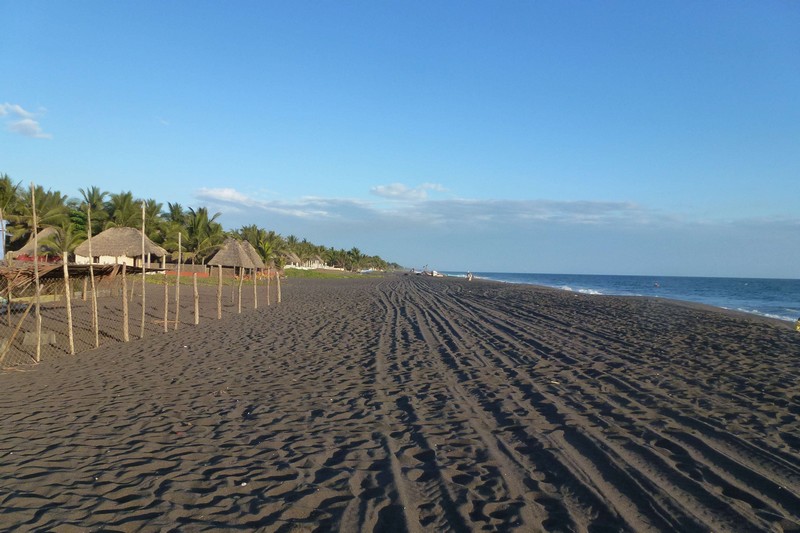
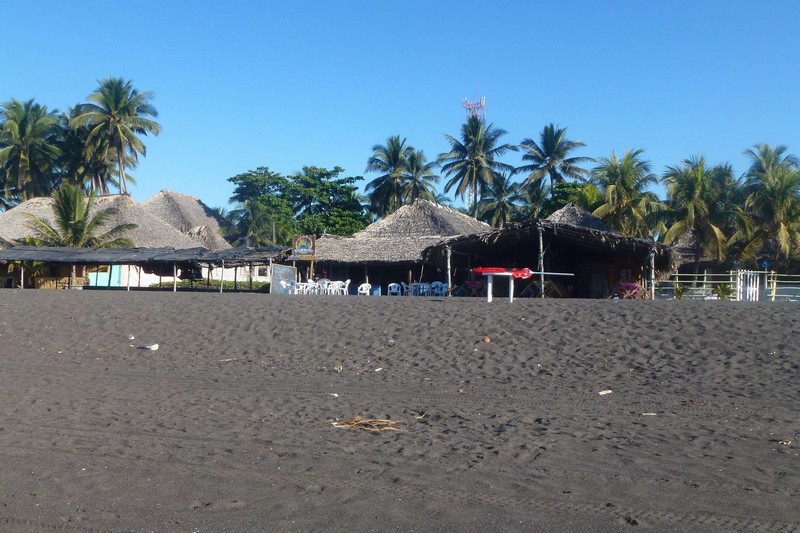
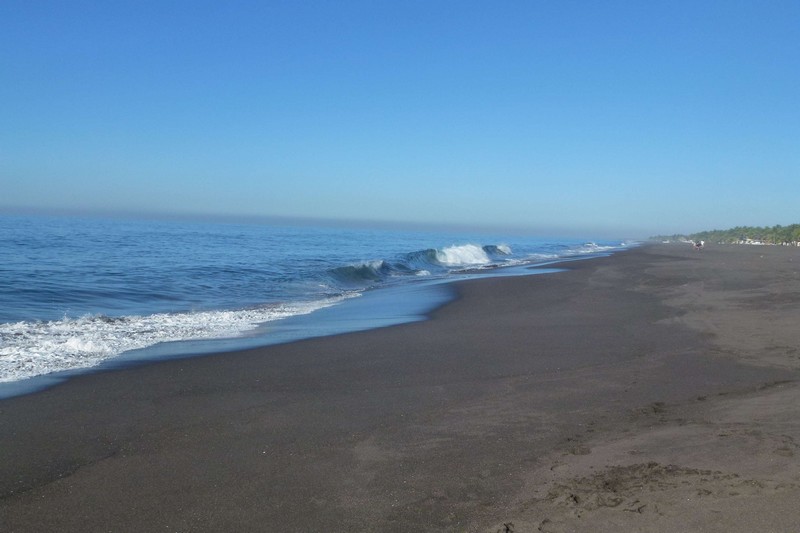
We’d been wanting a look at the Pacific Ocean before we left Guatemala, so we hopped the shuttle to Monterrico, a tiny little village on the coast. We fancied a few days of hammocks and sea, and this seemed to fit the bill. This being a volcanic area, the beaches are black, so when the sun gets on them, the sand can physically burn your feet. Other than that, as you can see, it’s lovely. And very hot.
We spent the first afternoon and evening lounging about, reading, in the hammocks at our hotel, the Delfin, which is right on the beach.
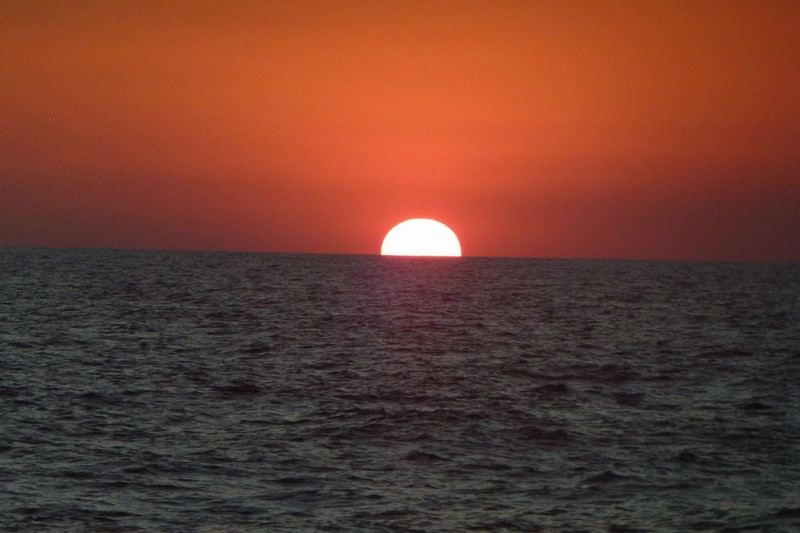
We broke off at sunset to take photographs, of course. We’re in the tropics here so it pops down quickly.
The next morning, we continue with our program of lounging about and reading, and mighty pleasant it is too. It’s really too hot to do much from about midday to 4-ish, just sit in the shade, in the breeze. A number of humpback whales swam past, though, jumping out of the water and sending up spouts, although they were too far away for us to photograph them. Instead, here’s a picture of the mural from the local school, which has just about every animal found around here apart from the whale.
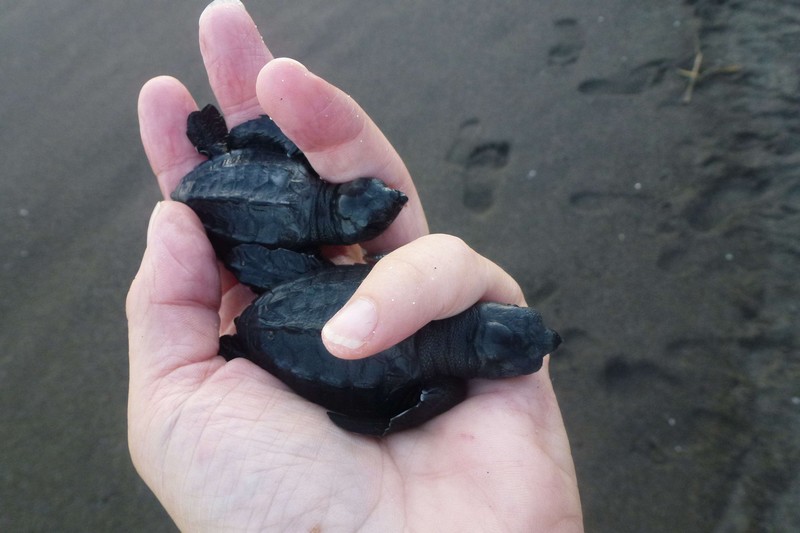
Diane, though, decided to take a trip to the local sea turtle conservation project, the Tortugario. Here they release newly hatched turtles into the wild to give them a better chance of survival: they are, of course, endangered. You can help with this, which happens at sunset on days they have hatchlings. These are tiny leatherback turtles.
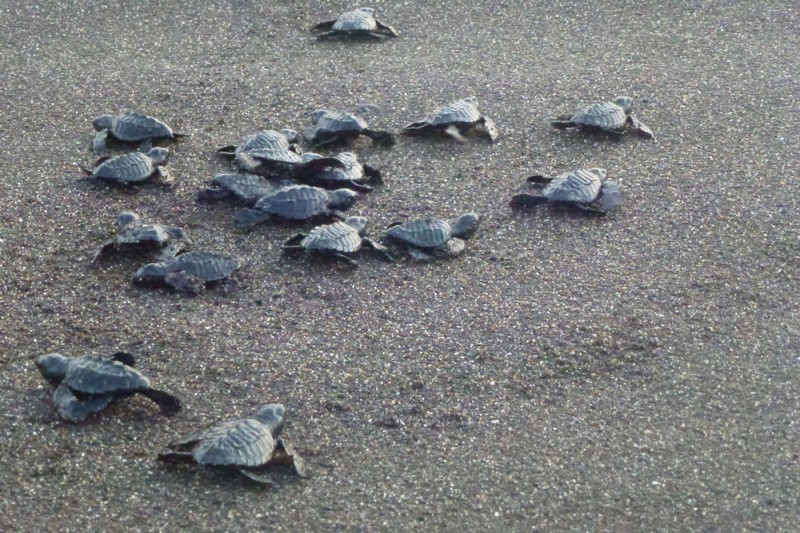
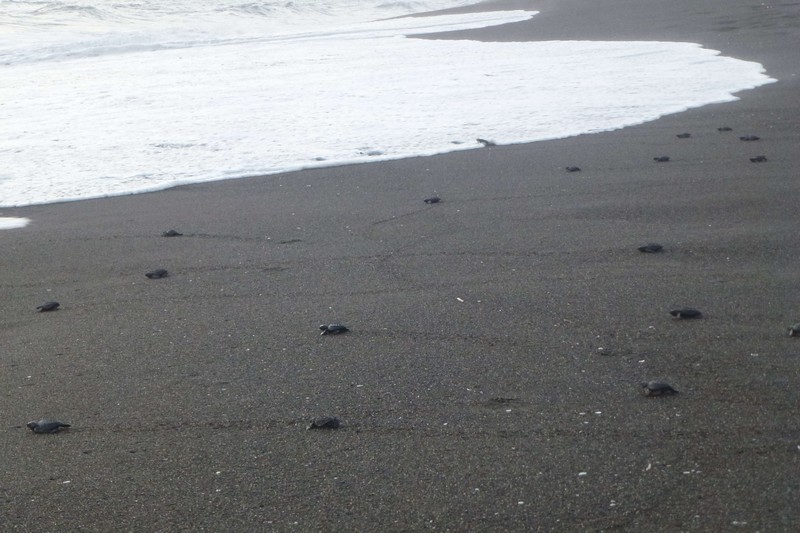
They are kept for a few hours after hatching to allow them to build a little strength before they take on the mighty Pacific. Here they go towards the sea. The beach is very steep here, so they have to brave six-foot dumping surf.
Big sea, little turtles.
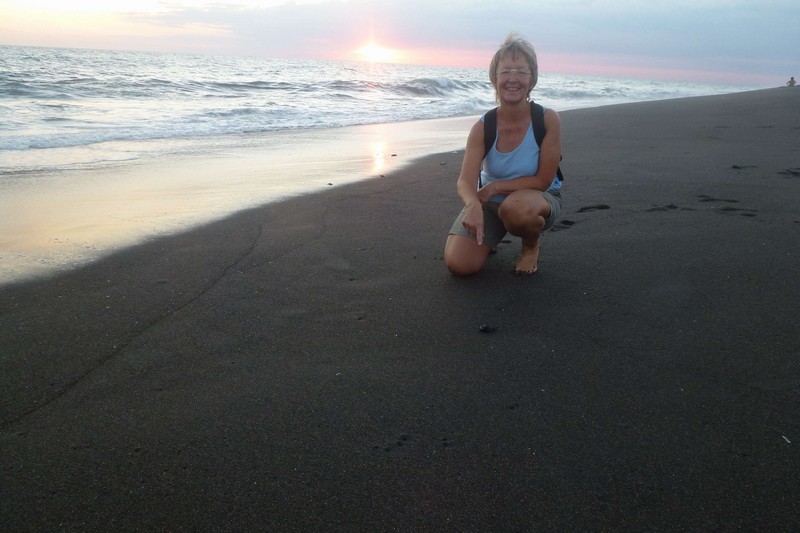
Here’s Diane pointing at her releases, two turtles which she named Felice and Fuerte. No, really.
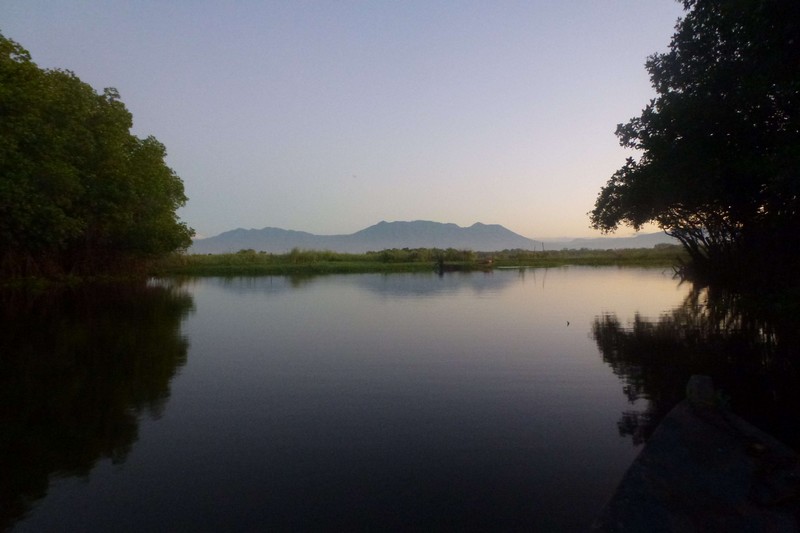
Monterrico is on a mangrove swamp, and the next morning we quit the slacking and get up at 5am for a dawn tour. The mangroves are marvellous in the dawn light: so much life everywhere. Birds of many types, fish (including the slightly weird four-eyed fish), and people fishing. Plus the odd car on a ferry.
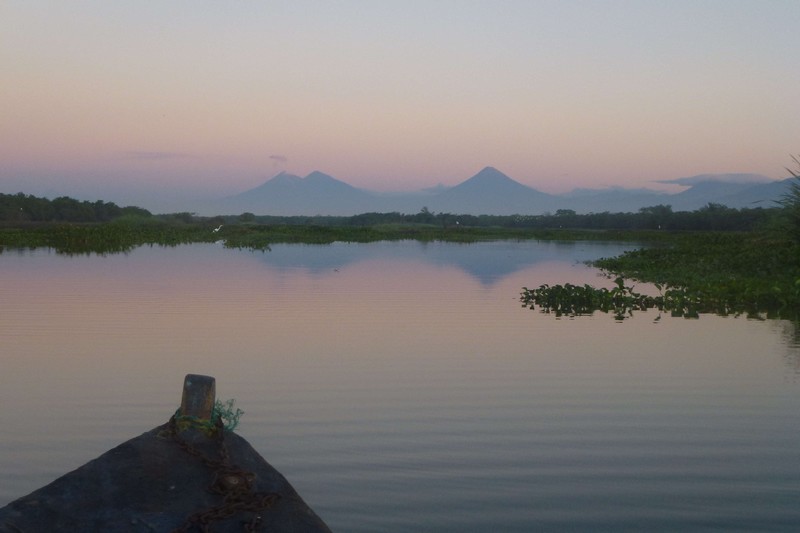
Volcanos in the distance.
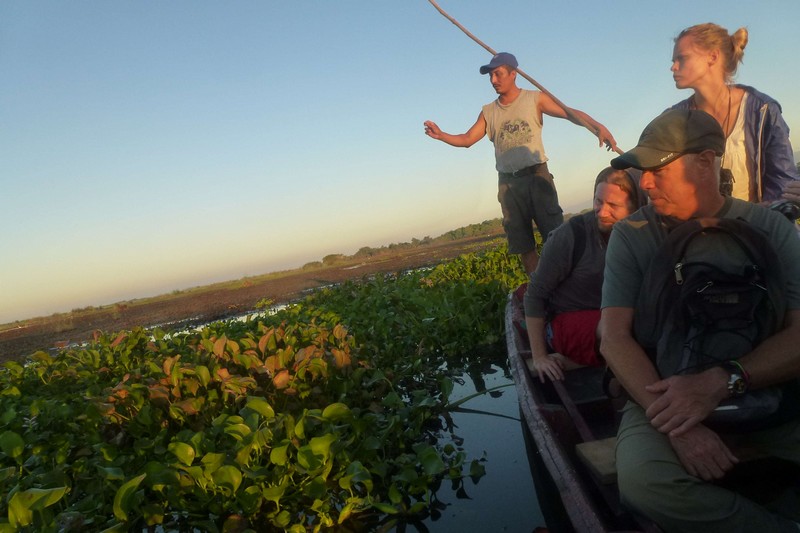
The guides tells us about the lilies which we’re floating in. He poled us the whole way round, like a gondolier in Venice, using a pole made from mangrove.
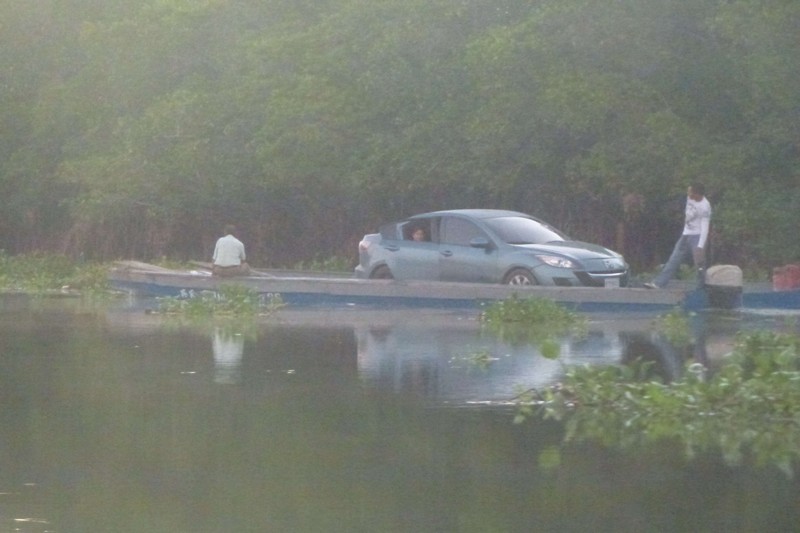
And yes, there’s a car ferry over the mangroves to a nearby town.
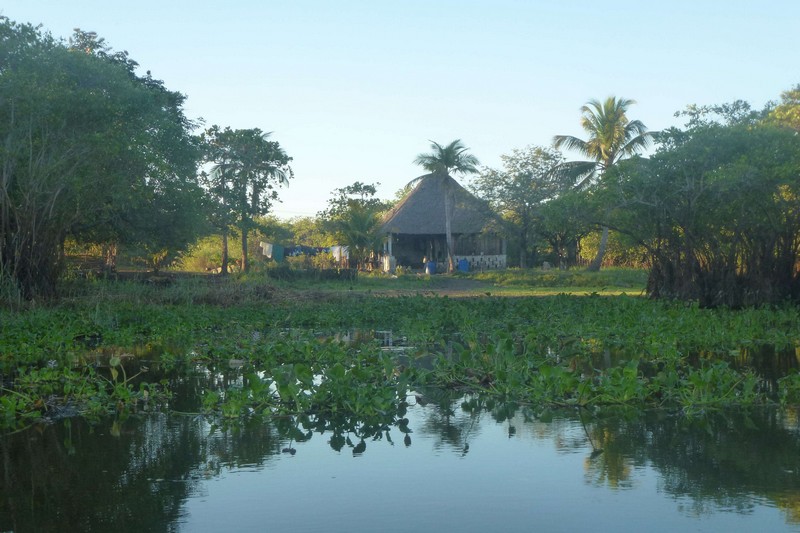
A house by the water !
Anyway, we were tired out after that so we spent the day lounging about, and the next day returned to Antigua. Here’s a final view of the beach. The stars at night were fantastic.
Off to Honduras !
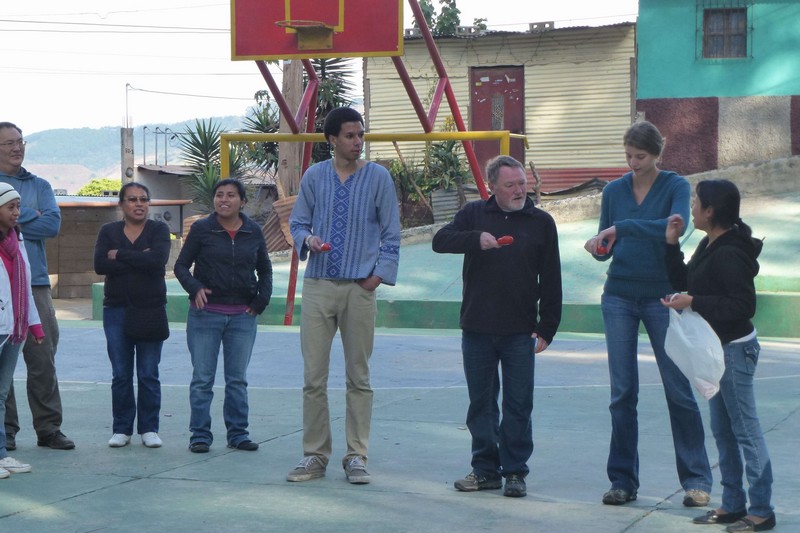
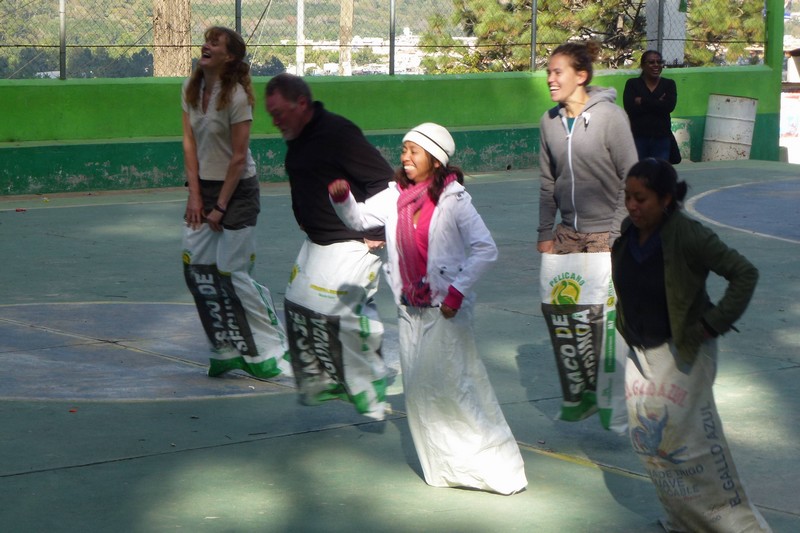
No public holiday on 2nd January for the Guatemaltecans, so we were back to Spanish lessons. They started to get a bit more complicated as we progressed onto the varieties of the past tense. I went for a haircut, eek, not quite the same as at home but a quarter the price! We went with the school to a macadamia farm where I had a face massage with the nut oil said to make you look 20 years younger, see later it didn’t work :'( Another, more participative excursion was the Activity Morning up at the local basketball court on the hill where there were several games to counter the cold morning. Here are a couple of piccies of Paul entering into the spirit.
The tomato and spoon race (no eggs – are they perceived to be dangerous here!?)
And the sack race.
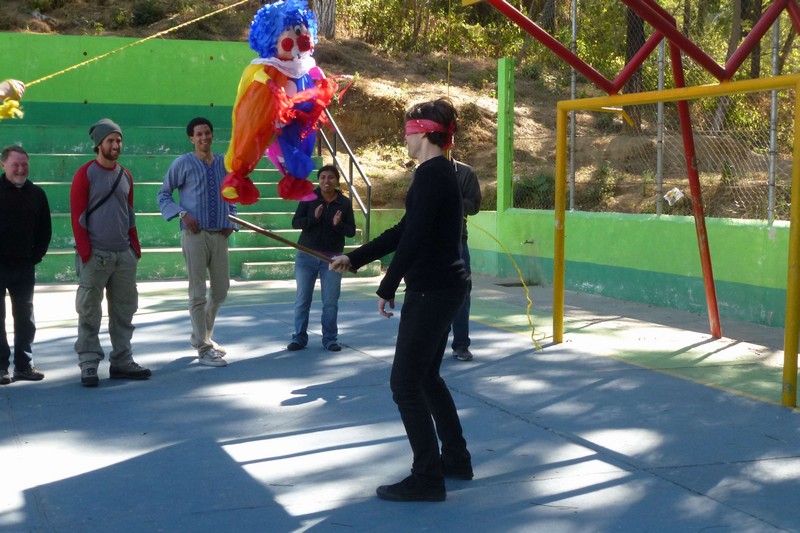
Then anyone with a birthday in January was invited to whack the pants (literally) off the clown (pinata), out of which falls sweets!
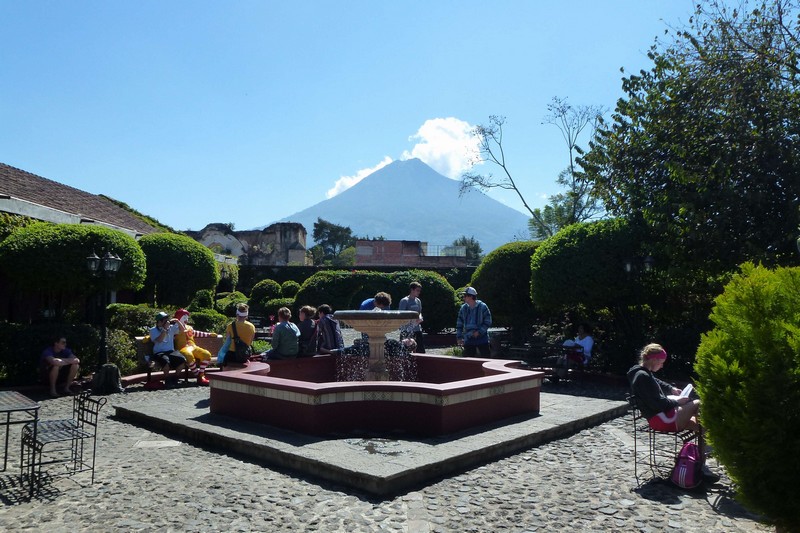
A day or two later we took a recommendation from our teachers and went to McDonalds for coffee, perhaps the most beautiful location and restoration of any of the Maccas in the world !
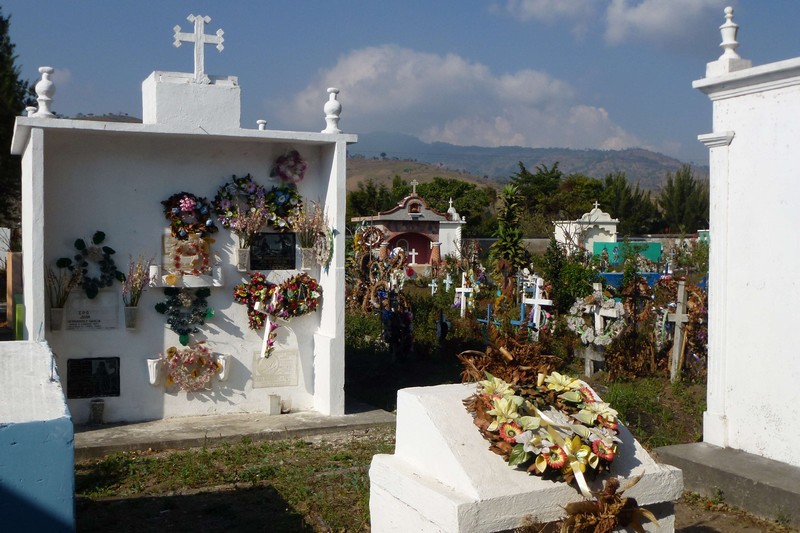
A visit to Ciudad Vieja was next – this was the first Spanish capital city of Guatemala, before it was destroyed by a massive flood from the caldera of Volcan Agua. The cemetery was amazing, as was the story from our guide who said that if you don’t pay your annual fee your remains are removed, possibly into the trash !
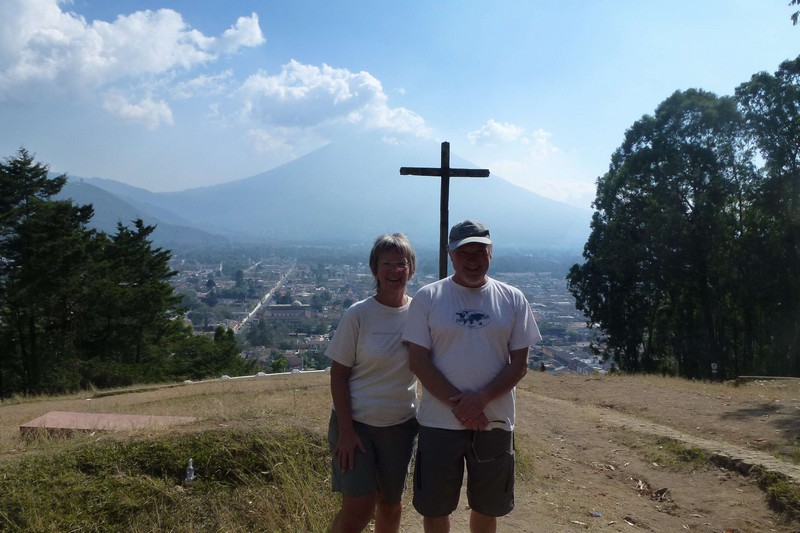
There is a neat viewpoint of Antigua called Cerro del Cruz, but tourists are warned not to visit independently – stories of muggings and robberies, and we knew that three people had been robbed at gunpoint recently. So, the only way to go was to go with the school trip – actually it was only about 20 minutes walk up hill, here we are, safe and sound!
A new tourist in town, a target for the locals!
A more familiar tourist inside La Merced.
And a friendly local.
Last day in our apartment in Antigua, we tidied the place up and I went to a chocolate-making workshop, yum yum (or as the Guatematecans say: yumpe yumpe).
Off to the south coast of Guatemala next for a glimpse of the sea.
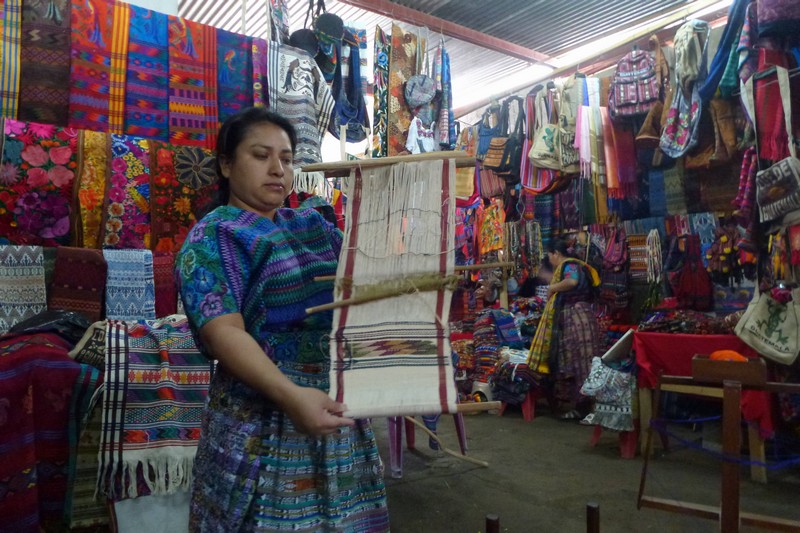
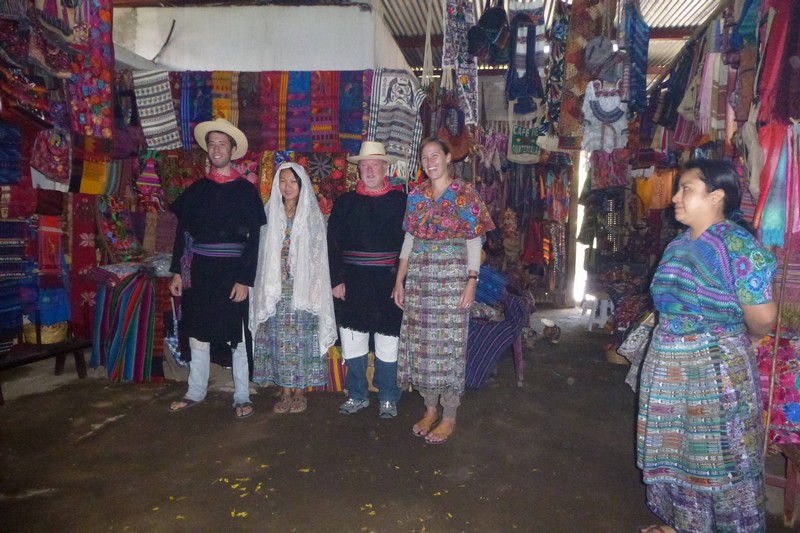
We’re back at a Spanish language school again, and to give their students’ brains a change from classroom learning, they organize activities where the teachers accompany the students out into the local community to practise Spanish and learn a bit about the local customs. We go along to a craft center in a nearby town to find out about weddings, local costume, and the local cuisine. We set off on a chicken bus from the local bus station. These are ex-US school buses, some of which are repainted, as below, and some of which still say School Bus on the side. They are pretty comfy when empty-ish, and for short distances, but it’s a full-contact sport in the rush hour. Seats are expected to carry at least three passengers, and occasionally the proverbial chicken. I like them, though. 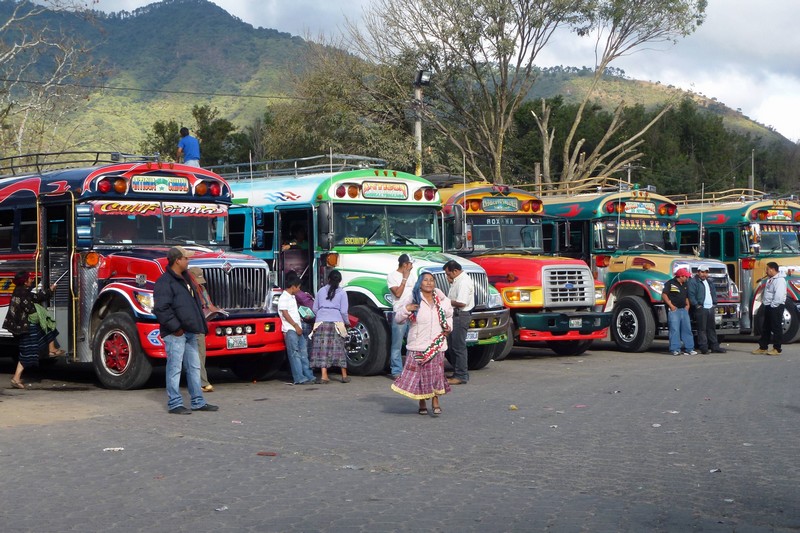 At the village, we visit the craft centre where one of the local women explains how weaving is done. She’s holding work done by a child: they start really young and progress by the age of 14 or 15 to full-on pieces which have patterns on both sides, a local specialty.
She also explains the local marriage customs, which involves much weaving of clothing by the bride. Members of our group were selected to be the bride and groom, and the bride’s parents. I’m the father on account of my advanced age. Here we are wearing the wedding day clothes, complete with sombrero.
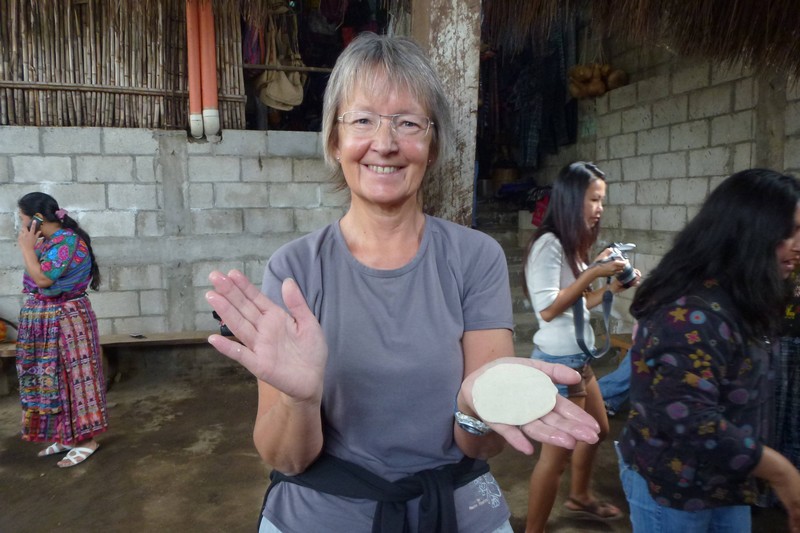
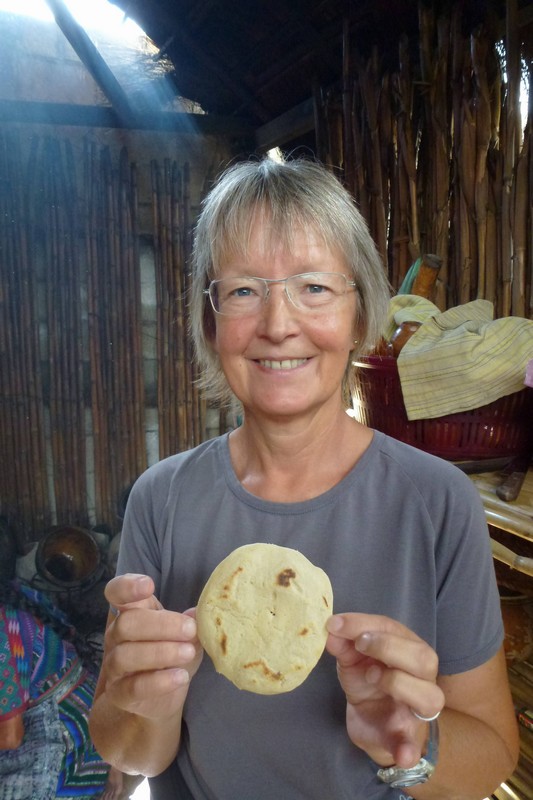
After this and a wee bit of dancing (I have pictures, but not here to spare my blushes), we try our hand at making tortillas. This proves easier than we thought, as we’ve tried it in the UK and got into a terrible mess. Diane does particularly well, producing one which is pretty much circular, and proved very edible. Mine was shaped more like the Iberian peninsula, although it still tasted good.
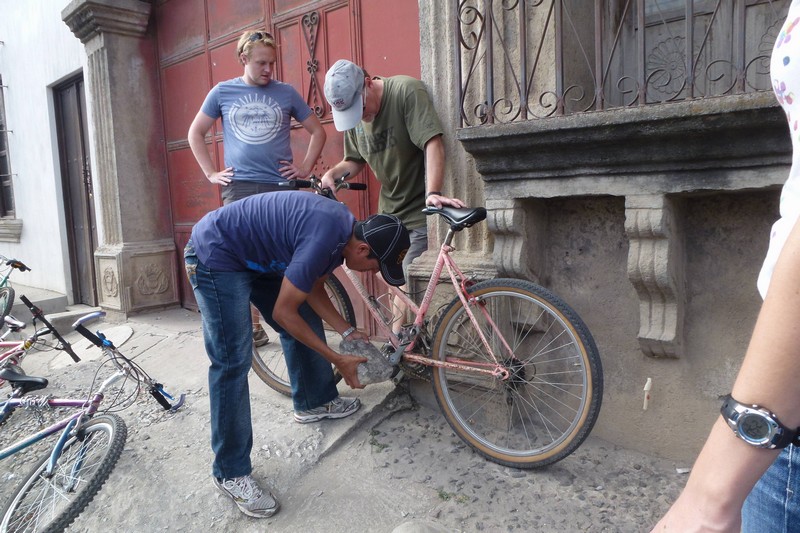
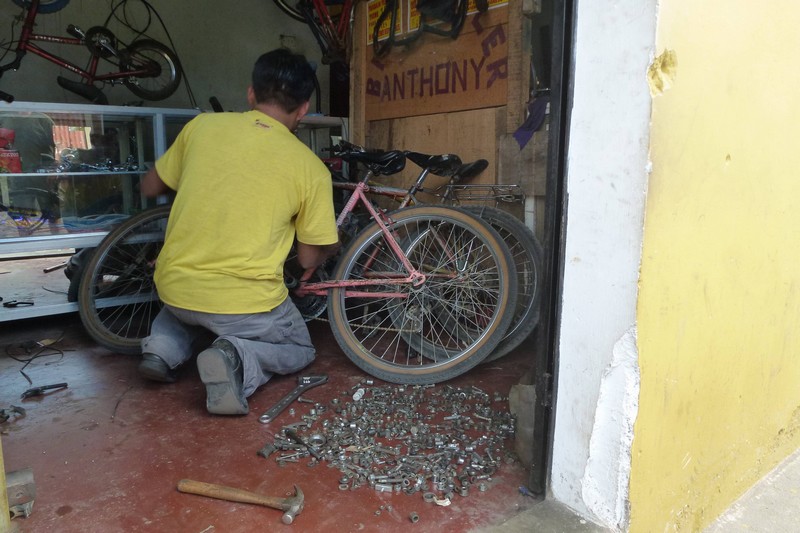
A few days later, and we’re off on a cycling trip to a few local villages with one of the school guides. The roads in and around Antigua are cobbled, which is tough on bikes: there are tracks on Exmoor which are smoother than the roads in the town. After about 20 minutes, it all proves too much for one bike and the crank falls off. Being a bike mechanic of sorts, I recommended hitting it with a big rock, which we did.
Enquiries, though, produced a bike shop not 100 yards away, and he fixes it properly, using a spanner and stuff.
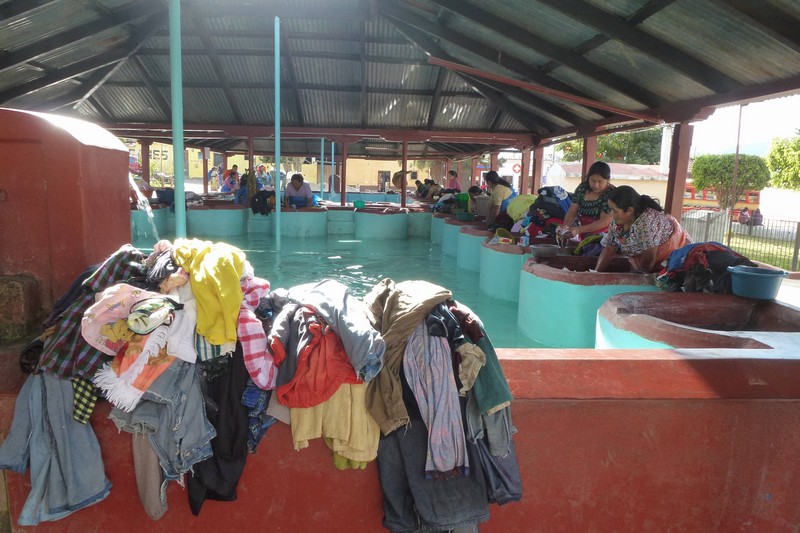
We stop in the main square to admire the tanque, which is the the local water supply and washing facility.
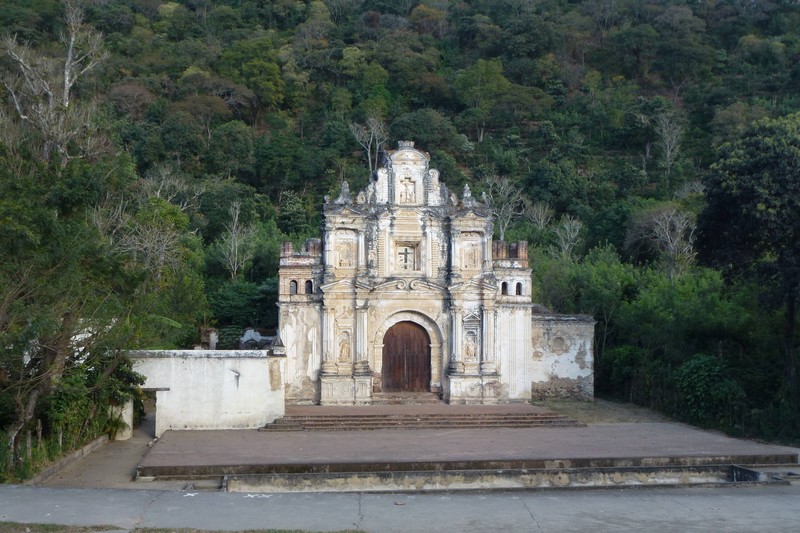
We pass the church of Santa Cruz on the trip back, which passes without incident. This is more or less the first exercise I’ve done in a number of weeks, aside from walking everywhere.
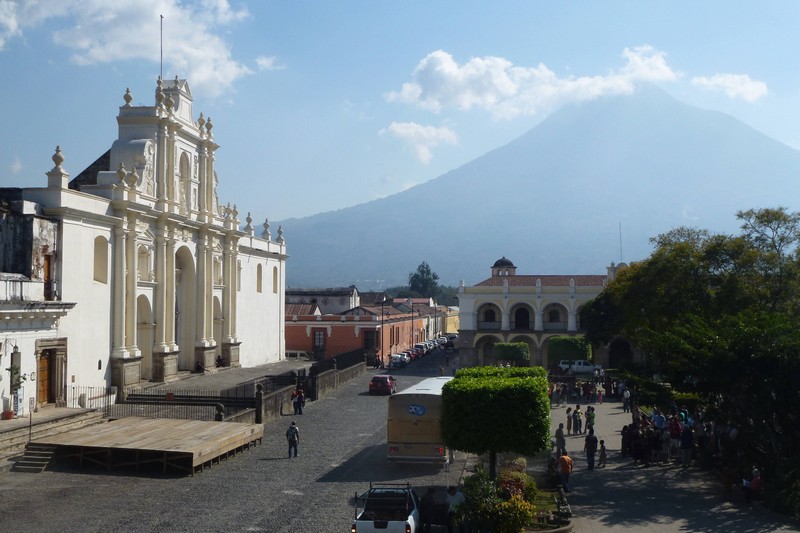
New Year’s eve dawns fair but cold, so we catch a few rays in the square. The Cathedral is on the left, looking towards Volcan Agua.
There’s a full schedule of events from about 4pm onwards, so we fortify ourselves with some food from the shop on the corner near our apartment.
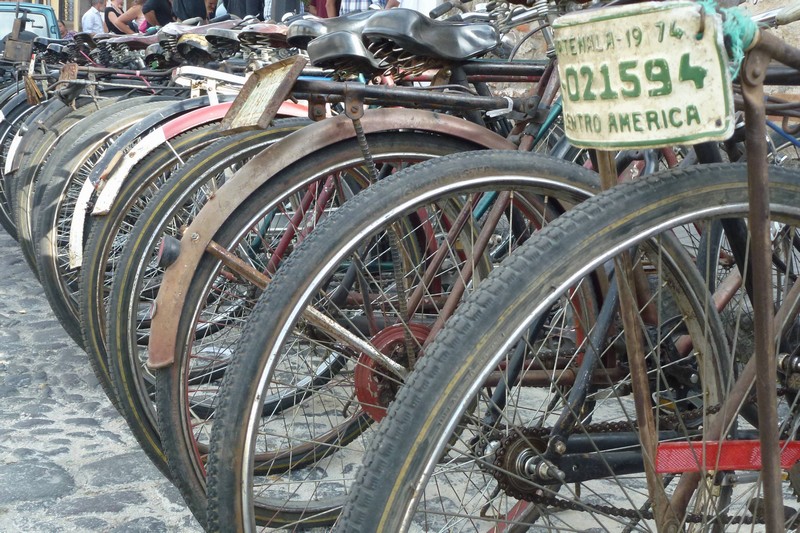
Pausing later for a pizza, there’s a lot of truly ancient bikes outside the restaurant. They look functional, so maybe there’s a large cycling group somewhere.
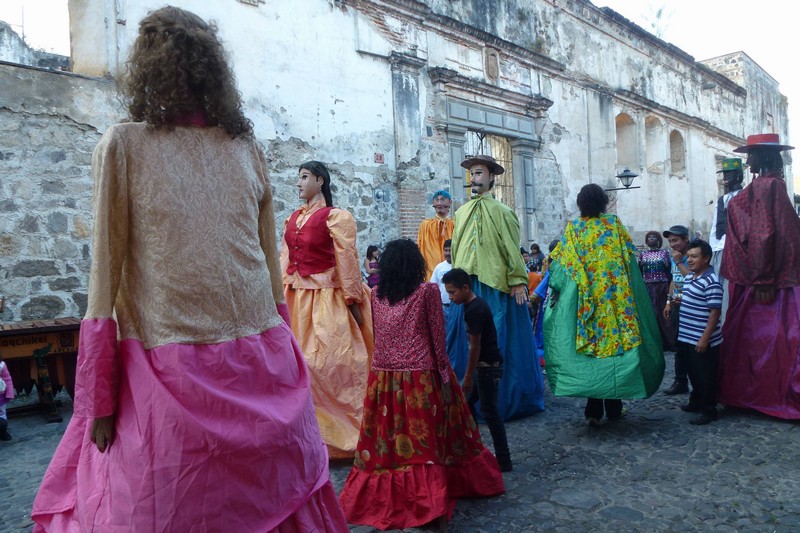
The fun starts with los gigantes, big giant people, dancing to the marimba.
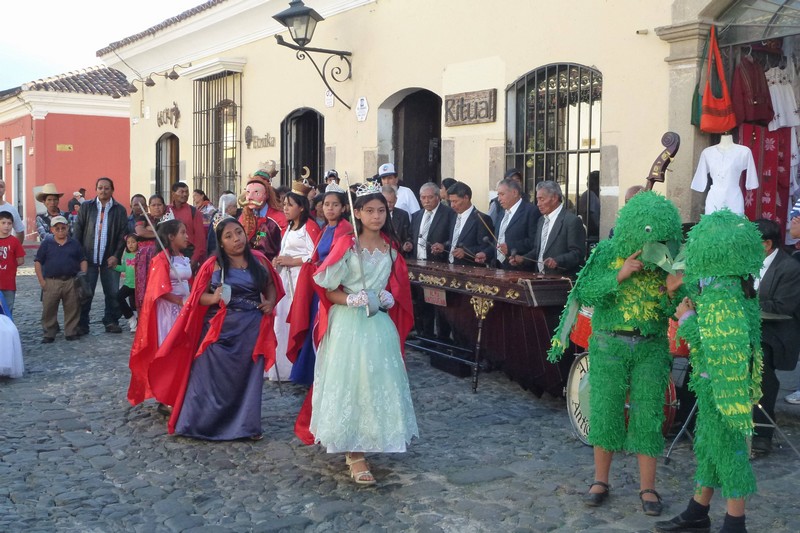
There are also little tableaux being enacted in music and dance, but about what we know not.
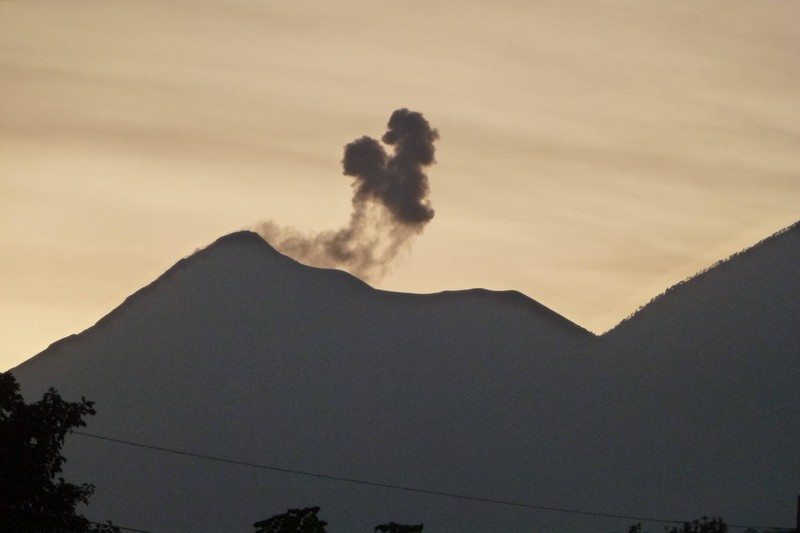
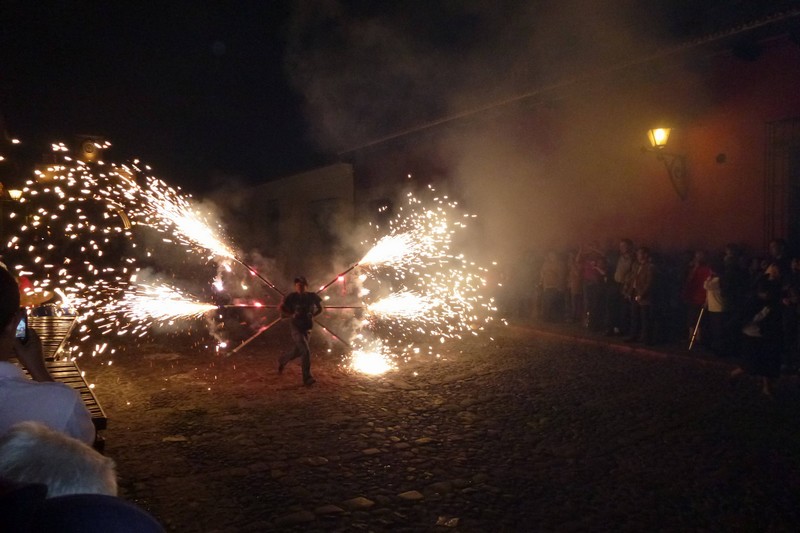
In anticipation of the evening’s fireworks, Volcan Fuego lets off a puff, although to be fair, it does this most days. After darkness falls, the fireworks begin. This guy is running around in the crowd with a large rack of them strapped to his back. I started cowering not long after this.
The local kids love a firework or a light, like these guys.
So then we bunkered down and waited for midnight. There was an official firework display at about 10pm, and then the local populace just let their own small ones off in the street and in the park until midnight, when they let off their own large ones. Very large ones. The noise was ridiculous, and the park was packed by then, so we didn’t leave until about 12:30. We slept late the following morning, although the bangs didn’t stop for several days. Anyway, bienvenidos 2012, and a Happy New Year to you all.
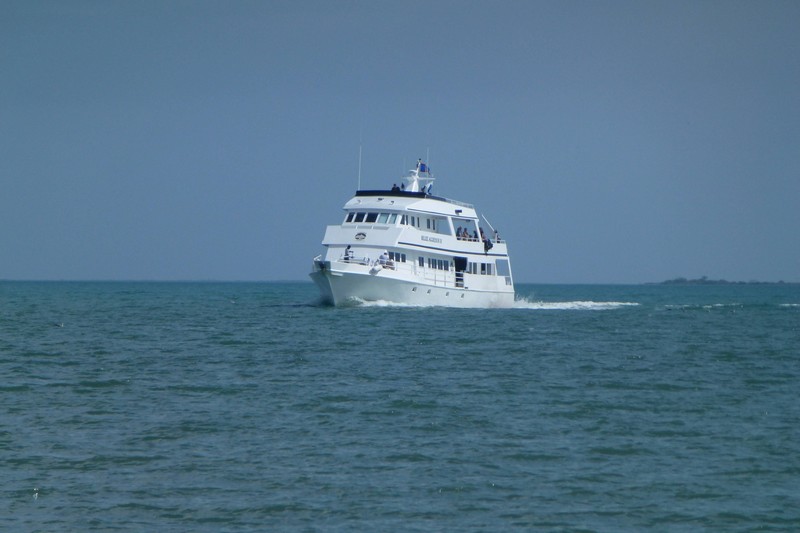
Well, the diving in Belize, mostly on Lighthouse Reef, was very good: the reefs are in very good condition. We dived the Blue Hole, which I found a slight disappointment. It’s billed as being the dive of a lifetime, but when we were there the visibility wasn’t good, so there wasn’t much to see. We dropped down to 43m to see the stalactites which were discovered by Jacques Cousteau: they are very impressive, being huge, but that was about it. The rest of the diving was marvellous: lots of reefs with fish in abundance, turtles, eagle rays and even the odd shark. Unfortunately, I have no photos of the trip, as I left my underwater camera at home rather than drag it round Central America, but here’s a picture of us arriving back in Belize City on the luxurious Belize Aggressor III – Diane was waiting on the quayside with the camera.
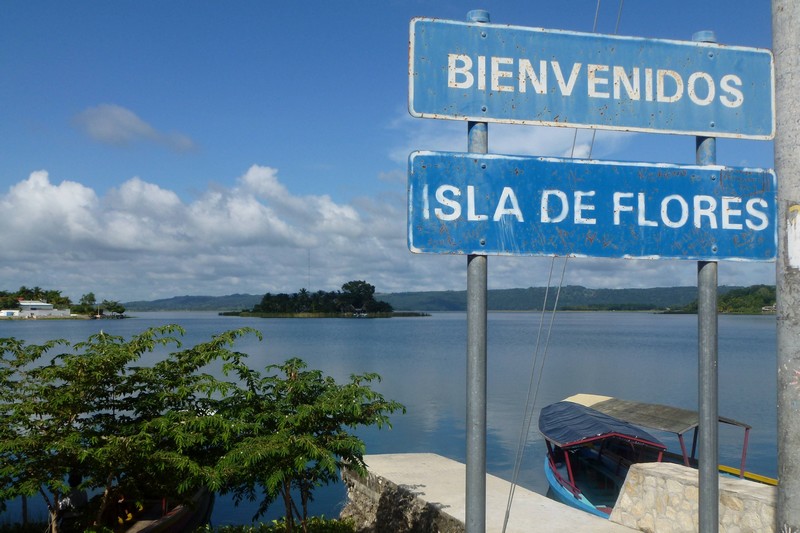
We all parted on Saturday morning: the rest of the group to the airport for their flights back to the UK, and Diane and I by bus to Flores in Guatemala. The trip was interesting, on an old bus through the ramshackle border at Melchor. We disembarked to clear customs, and ended up being scammed again for a few quetzales by the border guards. I can’t decide whether this is very annoying (I mean gosh, I’m English, this doesn’t happen in our country, it isn’t right) or whether I don’t care (a couple of quid, yes, whatever). Anyway, loads more people pile on after the border and we proceed to Flores. This is a lovely little town on an island, where we plan to change buses to go to Guatemala City and on to Antigua. We will stay here a couple of days though, to chill out – not literally though, as the weather is toasty!
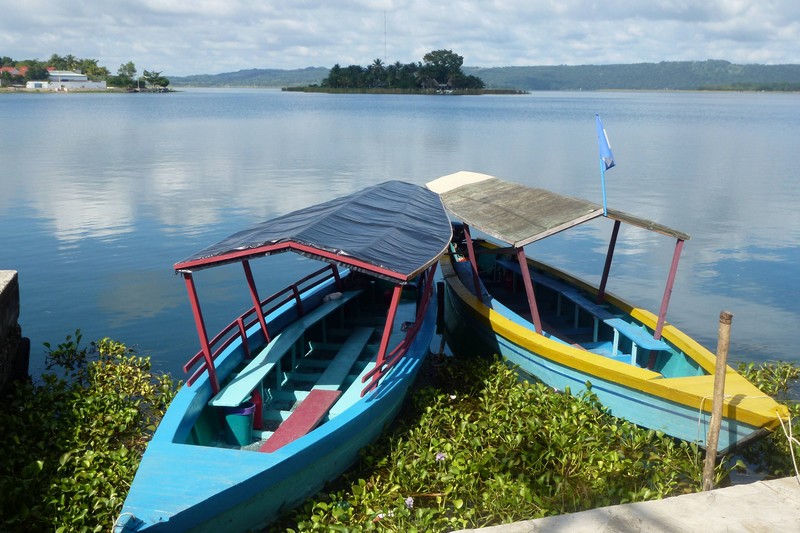
Boats are popular here with tourists and locals for trips around the lake, and as ferries across to smaller villages.
Flores is on an island, attached to another town called Santa Elena, which is where the work gets done. We venture over there looking for an ATM. Nobody in Guatemala wears a helmet on a motorbike, not even the police. It’s family transport: we often saw Dad, Mum and the two kids on one Honda CG125. Sometimes Mum was pregnant also, or using the phone, or carrying pans.
We ate tacos from the local street vendors on a couple of evenings – they were very good, as was the chocolate cake!
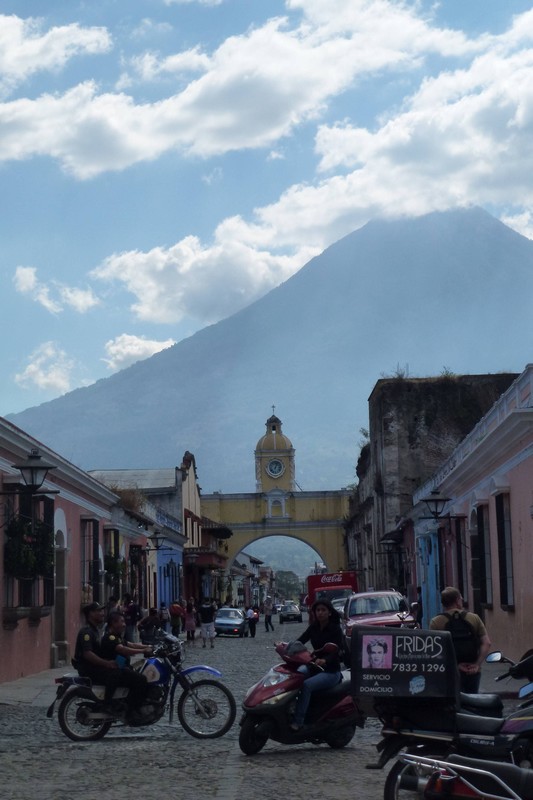
After a nice layover, we took the night bus to Guatemala City, leaving at 9pm and arriving at 6am. We booked on Maya de Oro, which has big seats which more or less fold down into beds, so we get some sleep. We’re met at the bus station by a minibus which takes us (and 12 other people) to Antigua, where we arrive at about 8am. We’re going to do more Spanish lessons, and we’ve arranged to rent a little apartment through the school. Here’s a couple of Antigua’s more famous sights: the volcano of Agua, and El Arco. I suppose Frida’s bar is a bit famous also. (Still no helmets for the motorcyclists, even the policemen!)
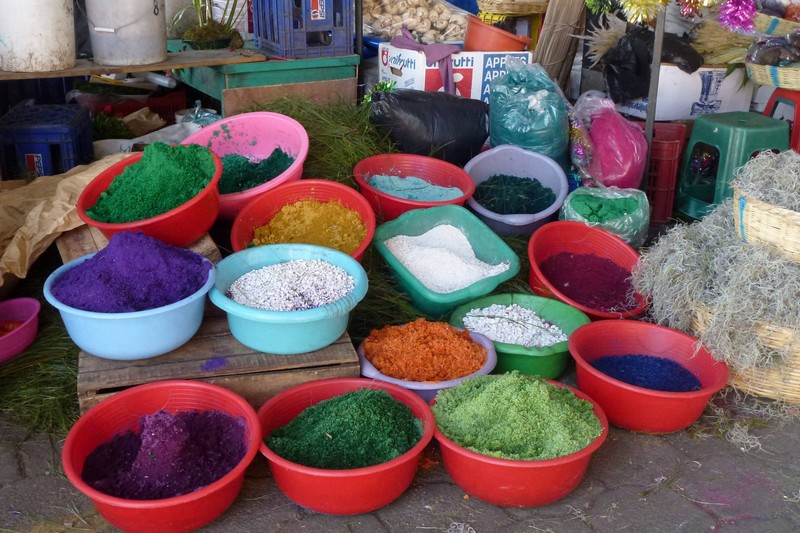
After a refreshing night’s sleep, we venture into the local mercado to buy supplies. These are spices and colourings for food, and also importantly at this time of year for the nativity scenes which are in abundance in the magnificent churches here.
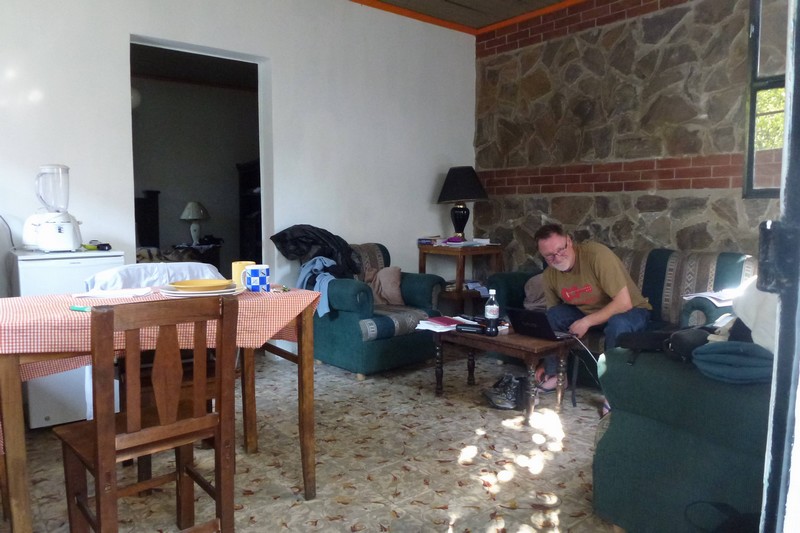
Our apartment is small, but quiet. We enter through an ice-cream shop next to the Spanish school and through another locked door into a courtyard, and then into our rooms. The parents of the guy who runs the school live next door. Here we are, anyway.
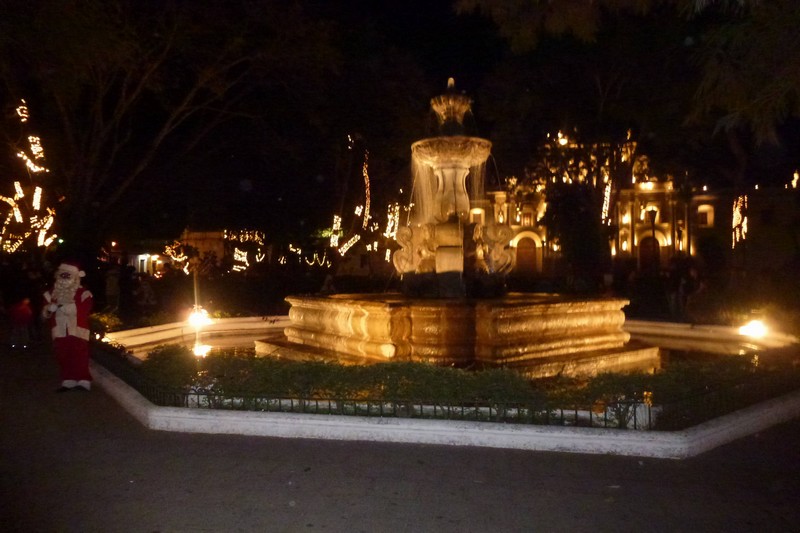
Being a Spanish colonial town, Antigua is built around a central square with a fountain. Here’s a slightly blurry photograph of the fountain, and Father Christmas.
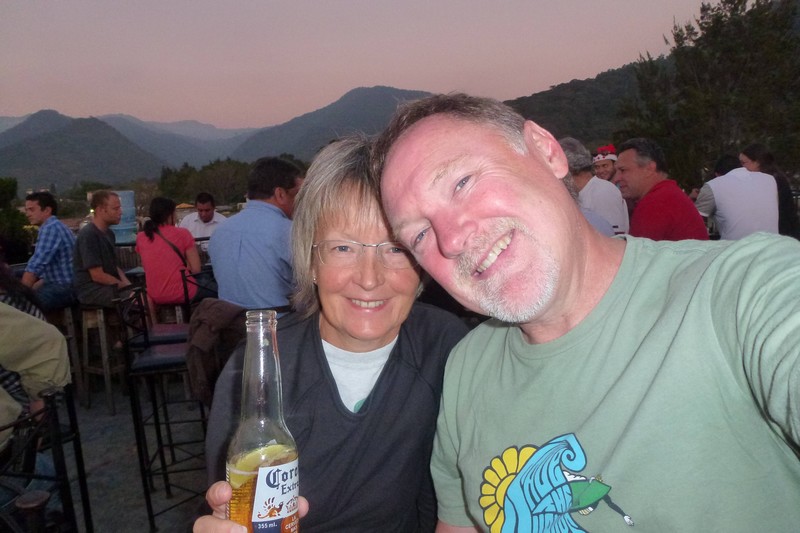
The Sky bar is a nice place to pass the sunset hour. The table behind us were a company having their office Xmas party, and enjoying it hugely, con mucho tequila 🙂
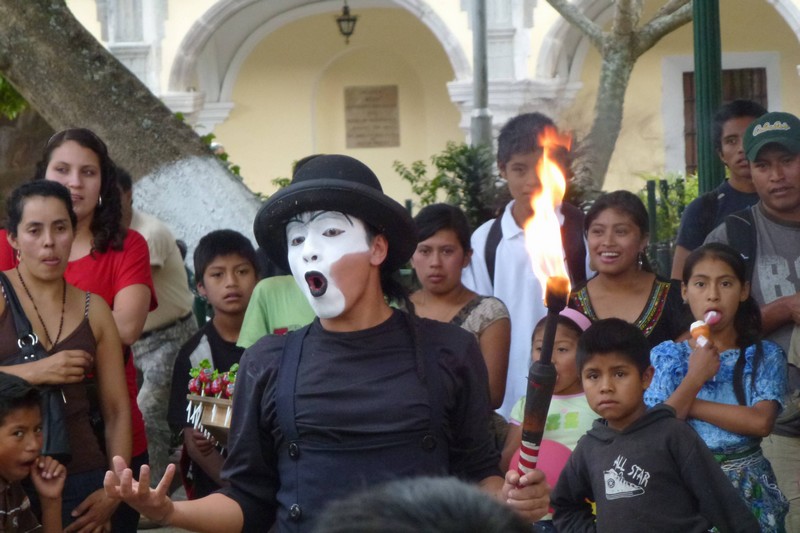
The square is very popular with tourists, both foreign and Guatemalan (lots of them come here for weekends to escape Guatemala City). Hence there are many street vendors, and also artists such as this mime.
On Christmas eve, we buy supplies for Christmas day. The market is very crowded, but Diane buys some vegetables to go with the supermarket chicken and bacon. So, we can have a bacon sandwich on Xmas morning, then a meal in the evening, kind of like at home.
The Guatemaltecos are extremely fond of fireworks, especially bombas, which make very loud bangs. These go off all night, often at 6 in the mornings also, and really are loud: can’t hear the television-type loud. Christmas eve is a massive bomba-fest, and then on Christmas morning, at midday, they all go off together all over the town, and indeed the country. We are told, though, that this is nothing compared to New Year’s Eve, when they get really serious about it. Watch this space.
Anyway, there was our Christmas. Back to the Spanish lessons next week, and then New Year next weekend.
Hi, Diane again. No doubt Paul will resume more normal service in the near future when he gets his head above water for long enough. Not much chance of an internet connection down with those sharks!
We got the overnight comfy ADO bus from Playa del Carmen (Mexico). After a snooze we arrived at the checkpoint to leave Mexico where a grumpy official insisted we each pay 20 US dollars exit fee. Despite many complaints he insisted and wasn’t letting us go anywhere so, like everyone else in the line, we paid up. Then on to Belize immigration – hauling your luggage out of the bus, across a car park and around a couple of buildings in the middle of the night wasn’t the best experience, but soon we were on our way to Belize City. Luckily for us the bus ran late and we arrived at 8.30am, so at least it was light and we could see to walk into town.
We knew the neighbourhood wouldn’t be great but the walk was short. Belize is primarily English speaking, so easy-peasy we thought, let’s just find a bank. The first ATM wouldn’t give us any money, and the guard outside was trying to be helpful and was apparently speaking English – however, we couldn’t understand a word and resorted to sign language. Finally Paul found another bank and some money.
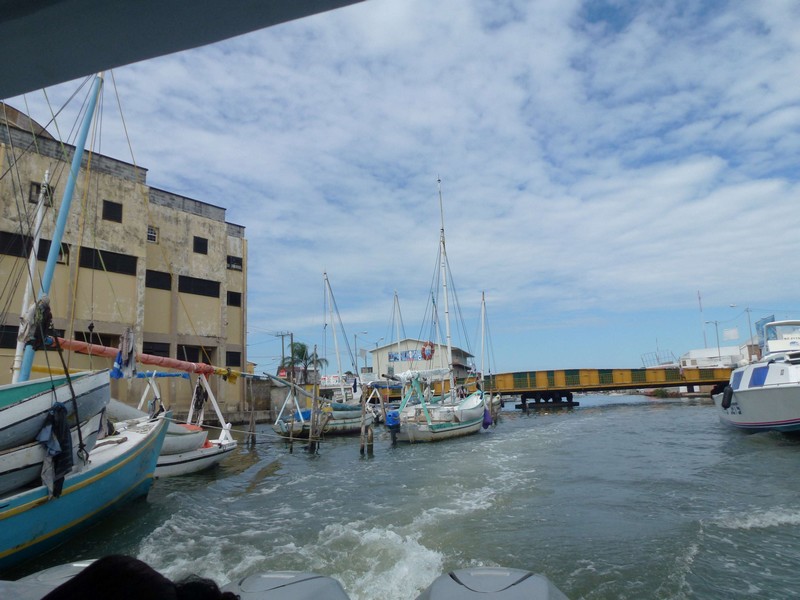
Wallet now full of Belizean dollars we found the water taxi terminal and had a well deserved breakfast – Paul had been out of range of Mexican food for at least 12 hours so obviously chose a burrito! I said goodbye to Paul as he was going diving again – this time for a week, one of those dive/eat/dive/eat etc etc routines. I left the city on the water taxi to Caye Caulker (pronounced Key Corker) – here’s the Swing Bridge which apparently is the only working bridge of its type in the world and was built in Liverpool in 1923. It’s one of the more picturesque sights in the area.
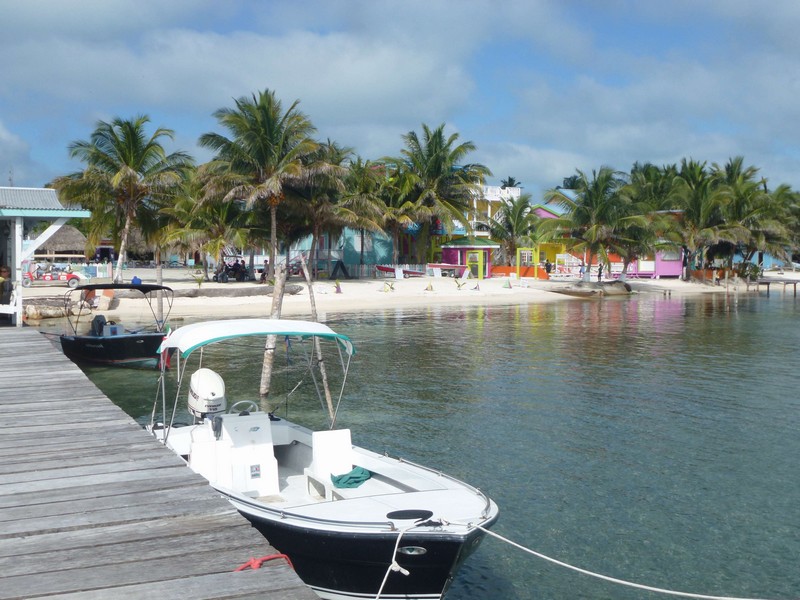
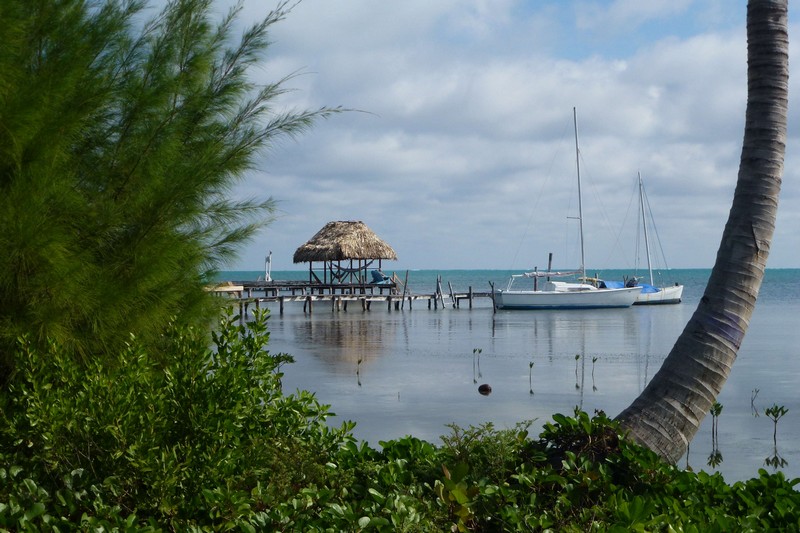
We arrived at the dock at Caye Caulker which is tiny, like the island. The weather was warm and sunny, nice!
I had booked into Yuma’s Guesthouse all of about 100 yards from the dock, a place with lots of lounging around space and comfy hammocks – an easy place to hang around and relax. Bunk rooms fine and the showers a nice degree or so off completely cold, but the friendly atmosphere, location and people made it a great place to stay. The place was full every night I was there, but then at about £8/night no wonder.
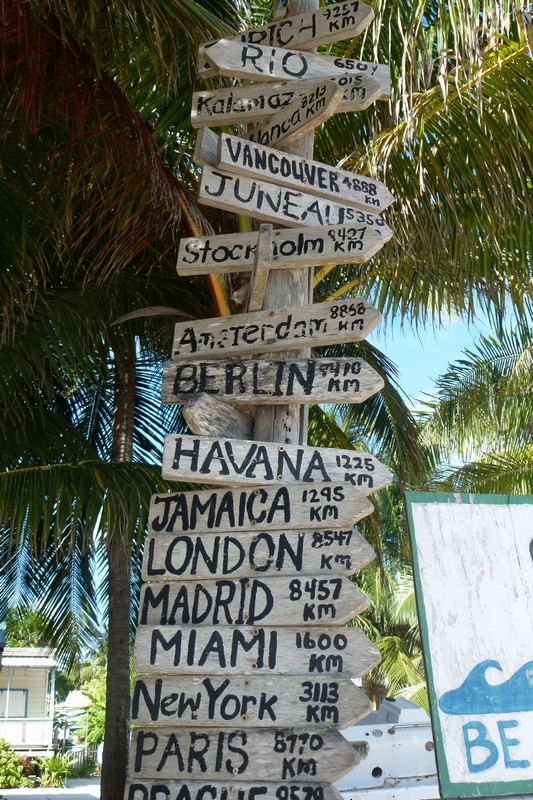
I went for a walk that afternoon, and was reminded I’m a long way from London!
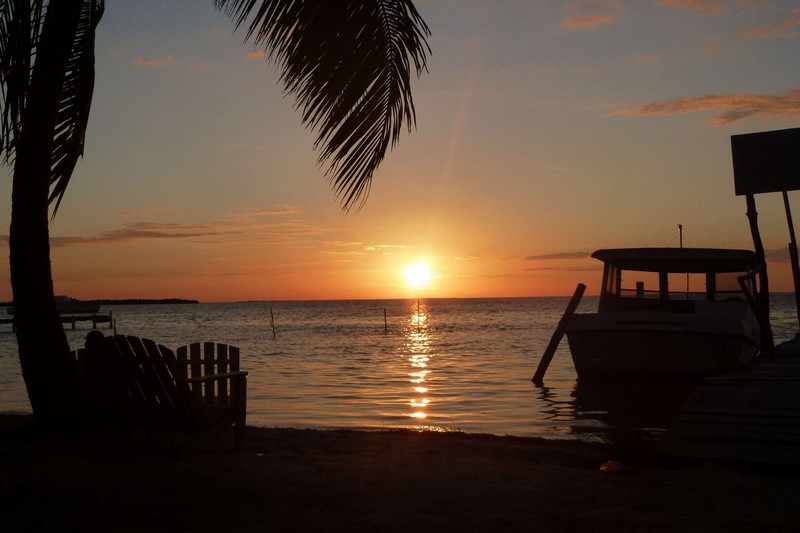
Sat watching the fabulous sunset wondering where Paul had got to and how many sharks he had seen already.
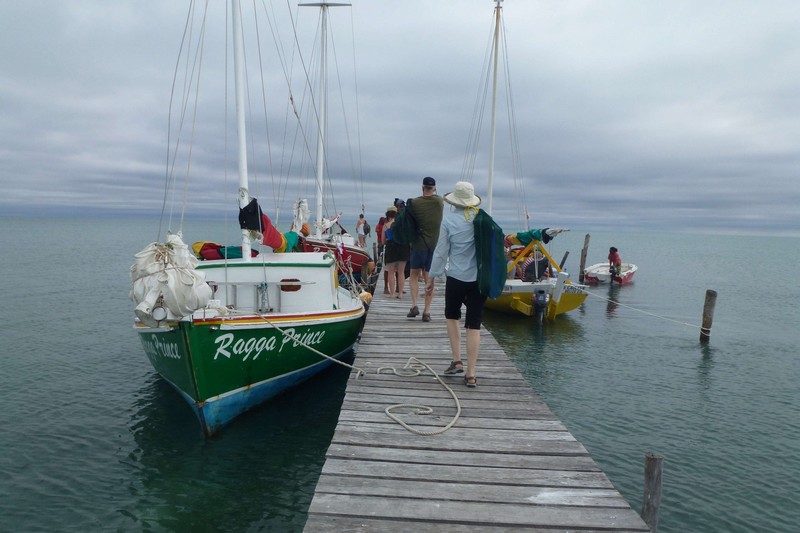
I went on a snorkelling trip with Ragamuffin Tours to the Hol Chan Marine Reserve, including stops at the local reef and Shark Ray Alley. Here’s the boat we were on.
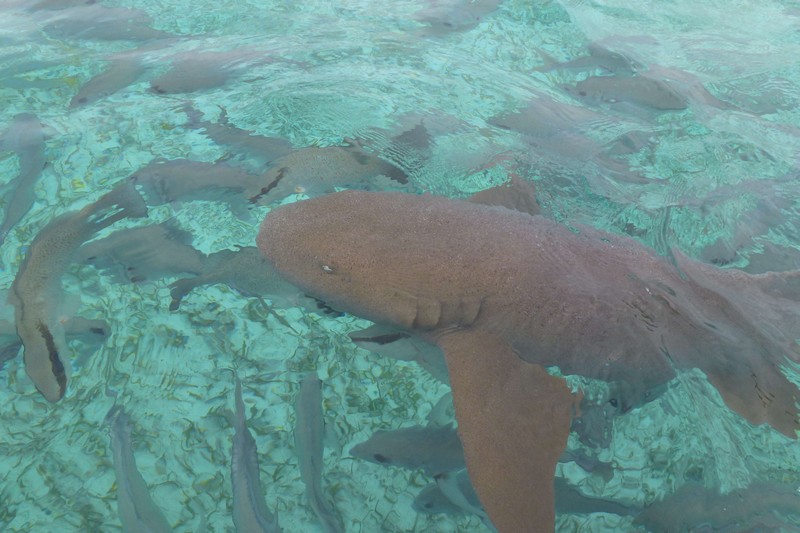
After a first dip in the water at the local Coral Gardens to try out our snorkelling skills we stopped at Shark Ray Alley – yes, you guess it, both Nurse Sharks and Southern Stingrays are there in abundance, plus large groupers and various other beautifully coloured fish. We don’t have a waterproof camera, so here’s a picture of the sharks taken from above water. But, after being assured that nurse sharks are harmless, we did get into the water and very close to them all – it was awesome and they are huge!
We made a final stop at Hol Chan – ‘little channel’ in the Mayan language. No fishing is allowed in the marine reserve and we saw huge numbers of fish. Quite spectacular were the large eagle rays, the green moray eels and the amazing coral. Somewhere in the excitement we made time for lunch, then late afternoon cocktails and ceviche – a great day!
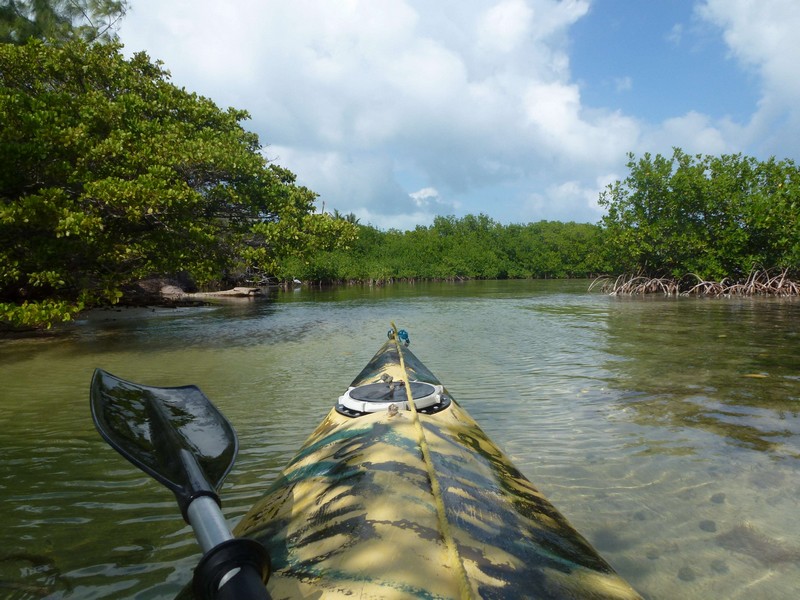
Caye Caulker was split into two islands a few years ago by a hurricane. The north island has only a few houses and is now a nature reserve. I went kayaking there amongst the mangroves and spotted kingfishers, ibis and on land came across significant numbers of wandering hermit crabs.
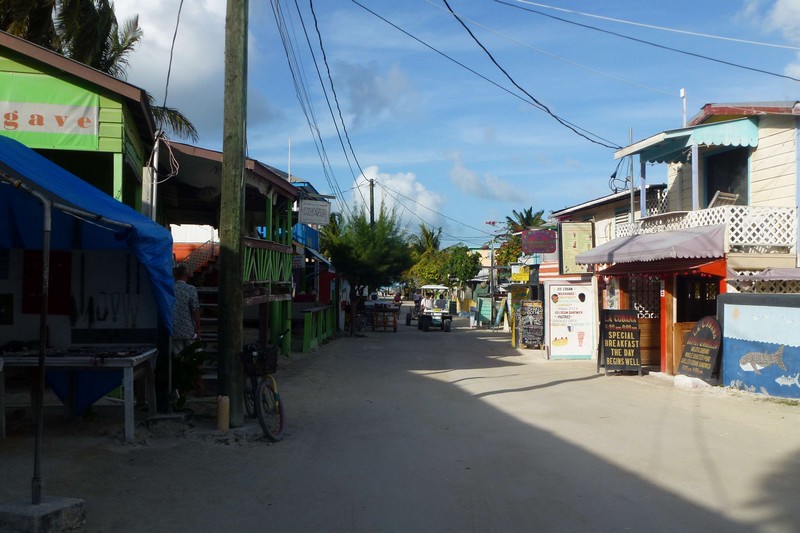
The main south island is where visitors arrive – it has no cars, just golf carts and bicycles. Most people just stroll around – it’s too hot to hurry, and in any case there’s nothing to hurry for, you’re on Belize time. Here’s a photo of the main street.
After a chatty morning with people in the hostel it was time for a very lazy afternoon.
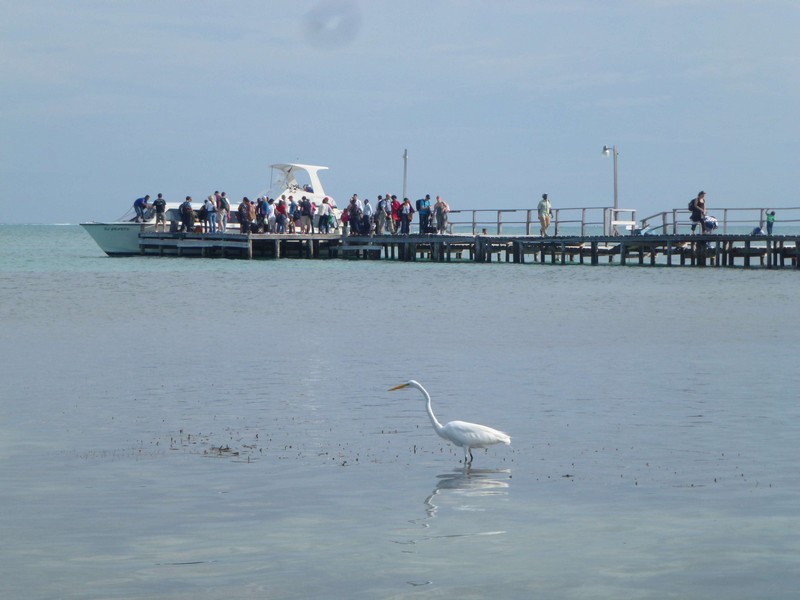
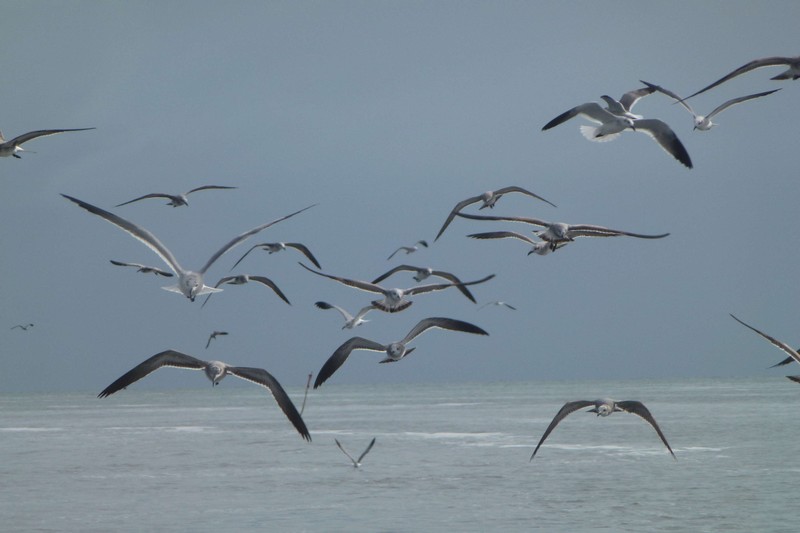
Then fresh fish grilled at a stall on the shorefront for my evening meal. Do I really want to leave paradise? Well the time came, and I sped back to Belize City a day earlier than Paul was due back from the dive trip to do some sightseeing. It was a bit of a shock to see cars and so many people after quiet Caye Caulker. Just one bird picture this time, taken as we arrive back at the ferry dock.
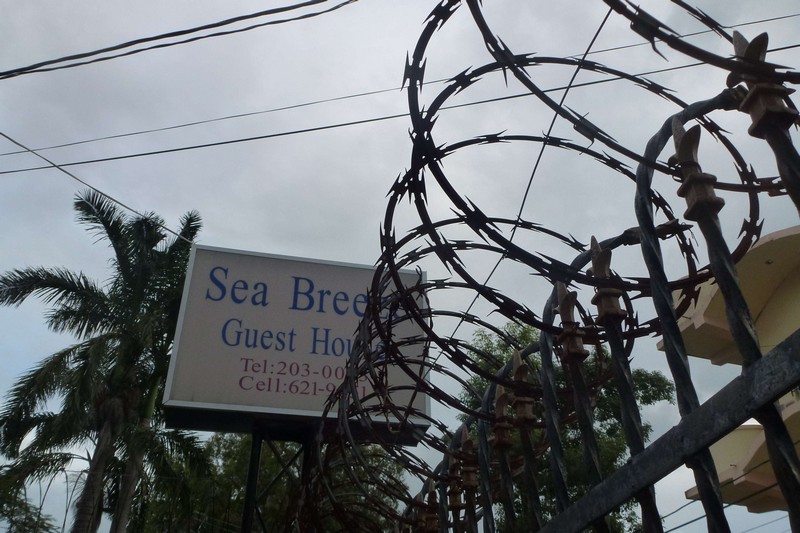
I booked into Sea Breeze Guest House which was recommended as a safe place to stay – well, I guess this is one way of securing a property!
I met another woman and we both wanted to do something different – we fancied taking a day trip to the Mayan site of Lamanai by boat. No help from the hotel staff, but whilst walking around we managed to find a tour company rep and arranged to join their tour the next day (for a nicely discounted price!). We had a good evening meal of pork stew and local Belikin beer. It was nice to have a big double bed and a room all to myself after a few days of sharing with others.
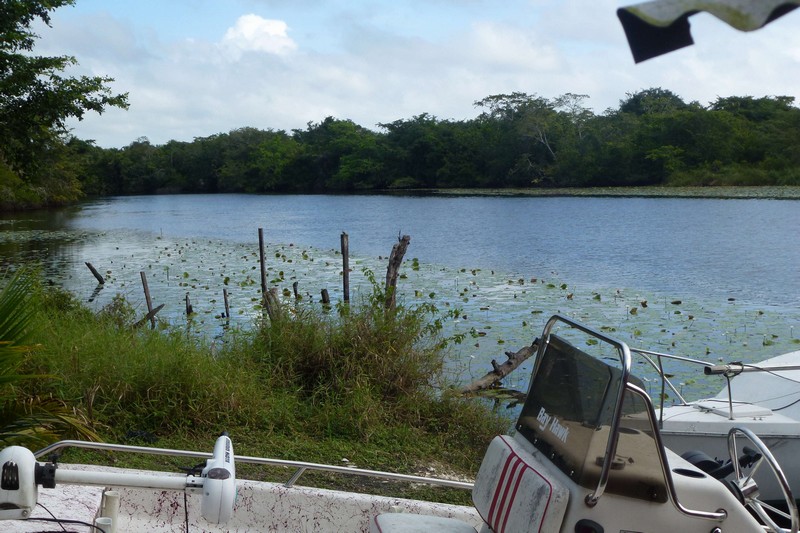
The next day we had to be up early and after an hour’s drive we transferred onto a speedy motor boat to zip up the river to the Lamanai (which means submerged crocodile).
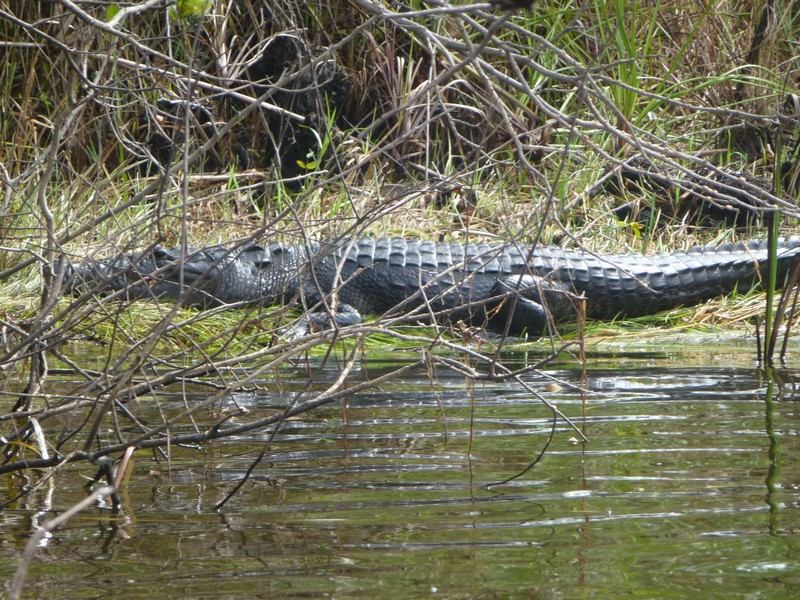
It was a wide river, with herons, kingfishers, ospreys and a few large termite nests in the trees. A few minutes into the trip the driver stopped suddenly and declared there was a large crocodile on the bank. We had hoped to see one and here it was, we were lucky. Only afterwards did we wonder whether it was real or not – I doubt you can tell from the photo, and I’m not sure why we doubted the guide, however, he didn’t stop anywhere else, for anything at all!
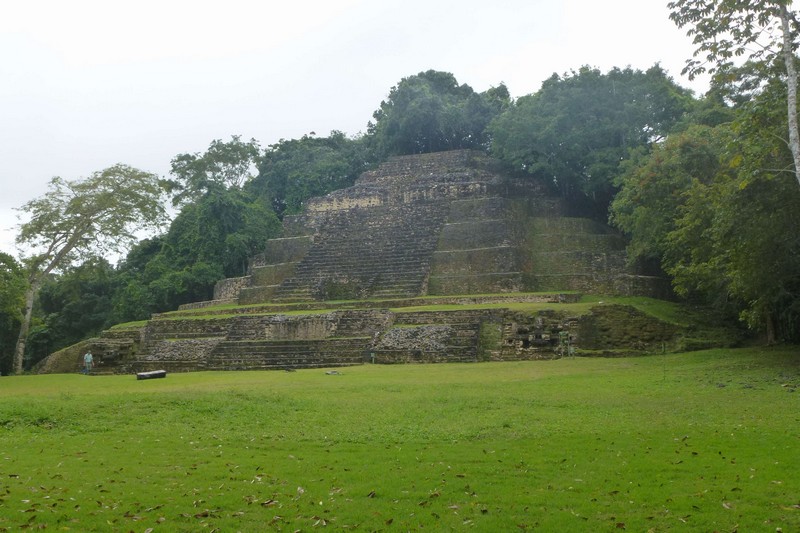
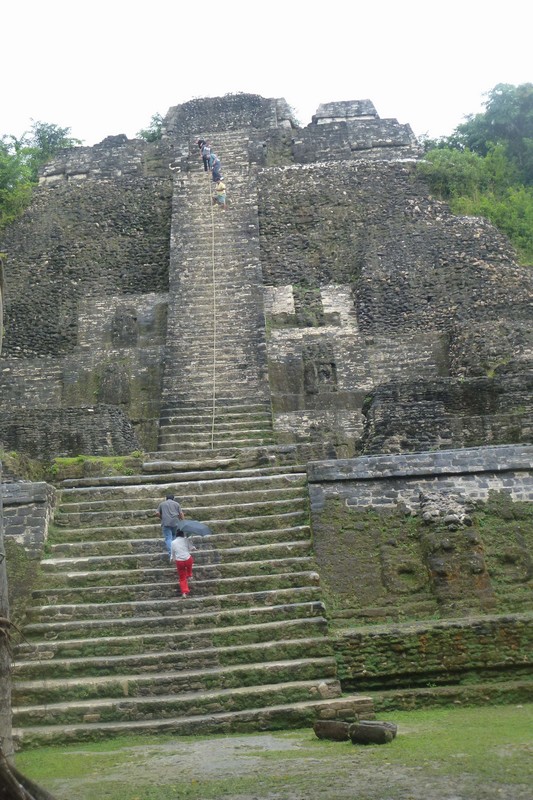
At Lamanai we walked into the deep undergrowth, lush palms, muddy and slippy underfoot, few people about. Very few of the original structures have been excavated and it was quite overgrown. The few we saw were pretty impressive, and here;s a photo of one. Note the man on the left-hand size of the picture, which shows the size of the thing. By now it was raining quite hard.
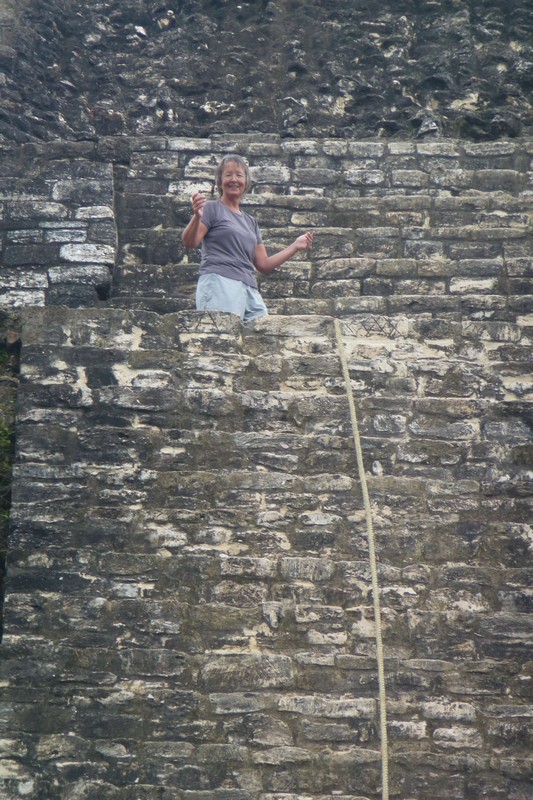
From the top of the highest temple you can look out over the jungle canopy. I climbed up, but didn’t take the camera as the steps were very slippy and I didn’t want to drop it!
Here’s some evidence I was there, although my designated photographer missed noting I’d reached the top L
BTW I look skankier than usual as it had been pouring down with rain for quite some time, and my waterproof is on a dive boat somewhere off the shore!
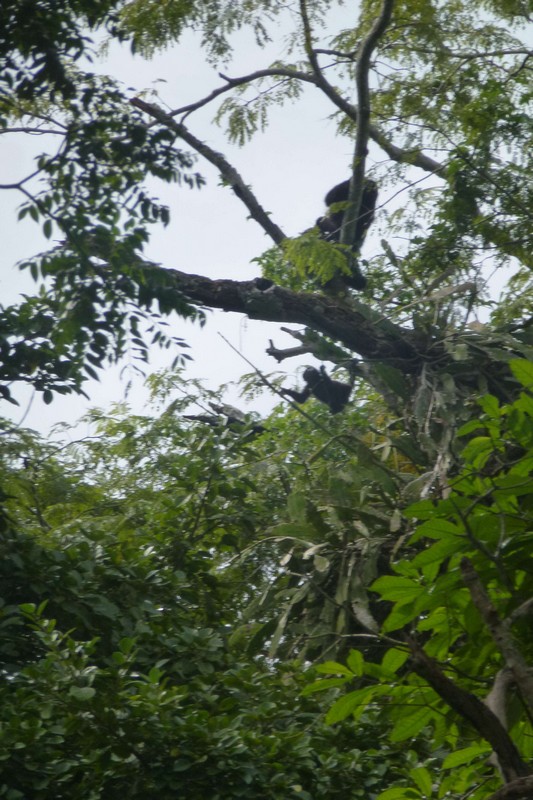
Feeling happy to get up and down without any trauma we were on our way back to the boat when we spotted a mother and baby monkey, tricky to spot in this photo – the mother is leaning with her back on a branch and the baby is playing around just below her. Howler monkeys we think – the guide was rushing back to the boat so wasn’t much help.
Back in Belize City it was raining again – very very very heavily!
Hi, Diane writing this for a change. Paul has been *so* busy diving he has delegated this section to me!
Whilst he was busy I took more Spanish lessons, but I’m still not much good. I went snorkelling with turtles and rays, got bored with sunbathing and took far too many photos of birds on the beach.
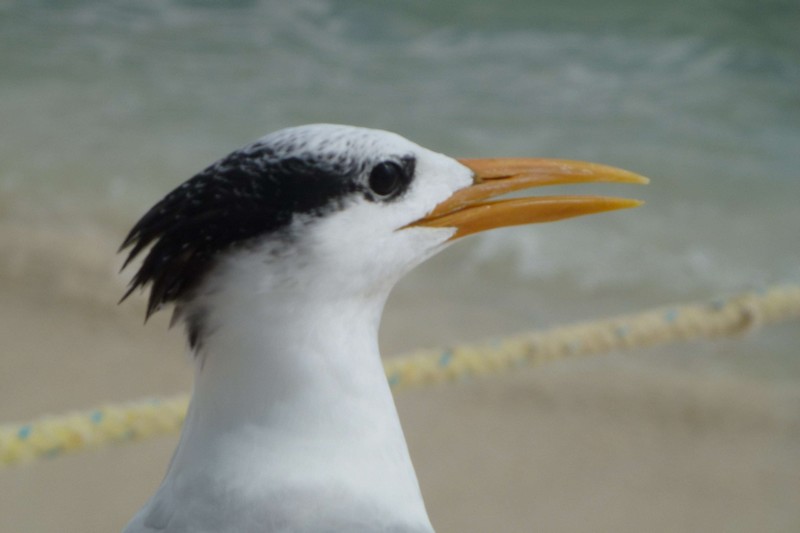
I think this is a Royal Tern – unless anyone knows better?
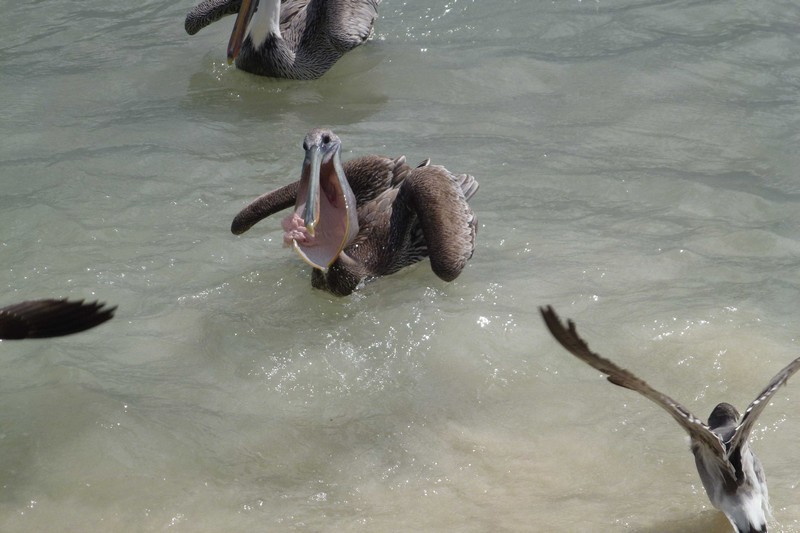
I love pelicans – what a huge beak!
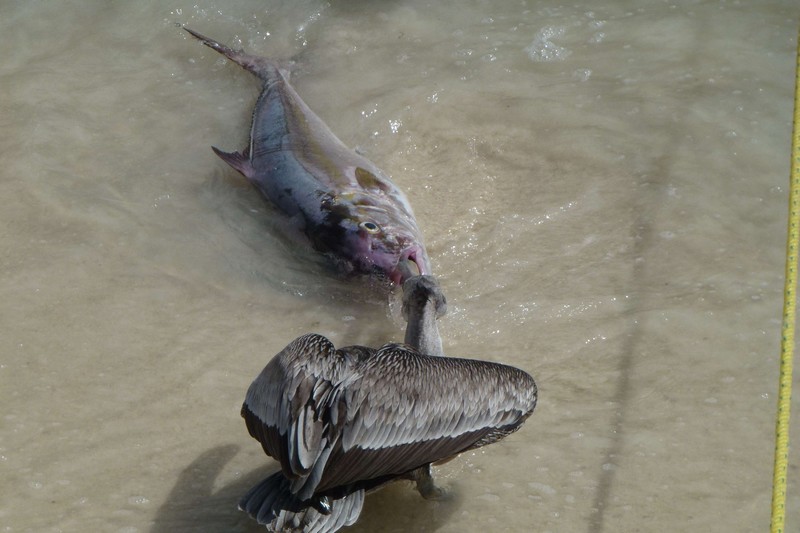
The fisherman had just thrown this amberjack towards the beach and the pelican fancied his chances, but he was chased off by an angry fisherman!
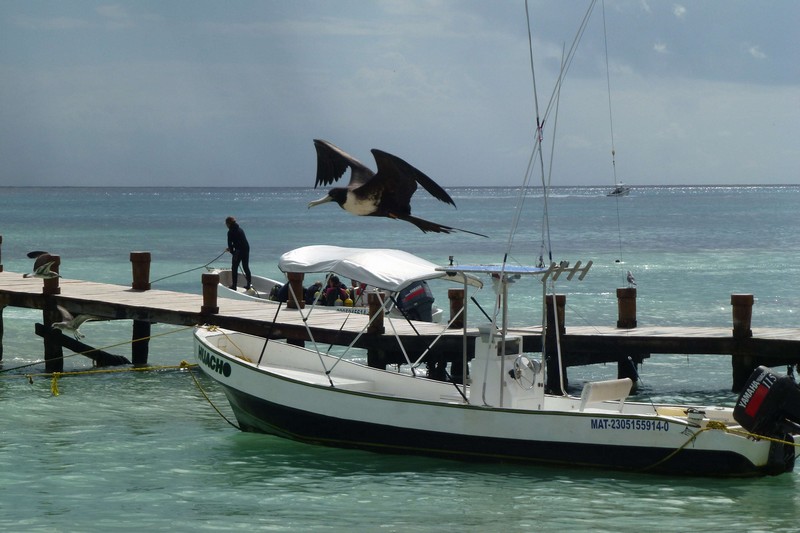
These Great Frigatebirds are huge – here’s a female.
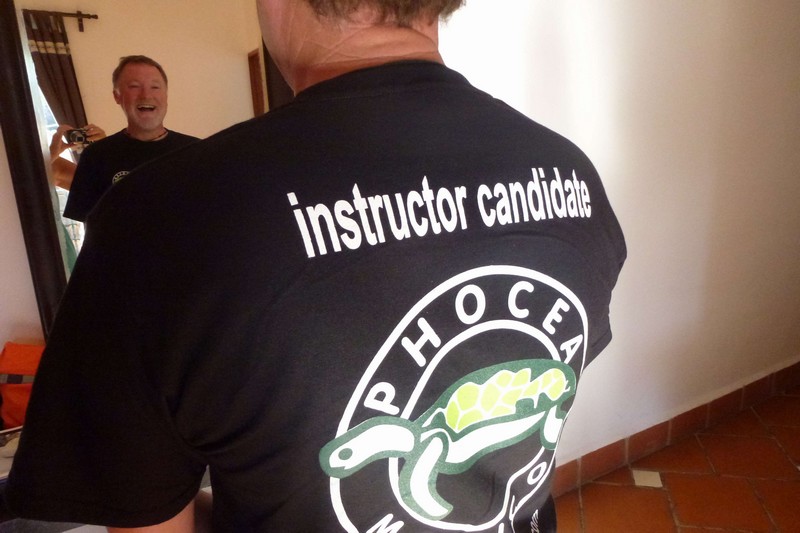
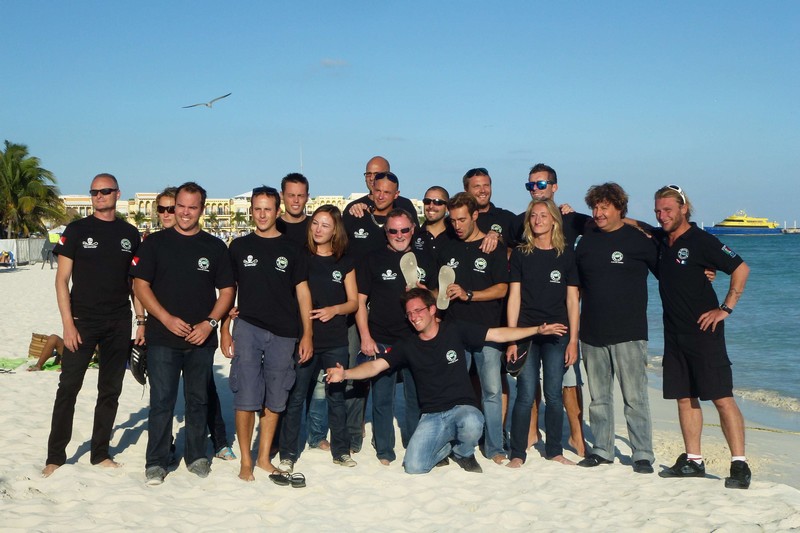
The weekend of Paul’s exams loomed, and everyone on the course was getting tired and very nervous. They had been working from 8am to 7pm for 12 days on the trot. To cheer them all up they were given special t-shirts!
And they went down to the beach for a pre-exam photo.
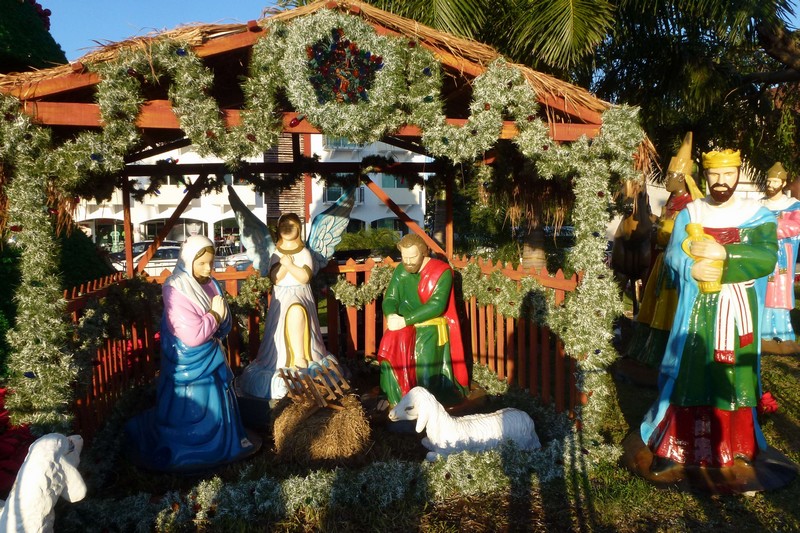
We had found a great place to drink margaritas, which came in handy when celebrating Paul achieving his Instructor qualification. In the following few days he supplemented that with a few other technical specialisms whilst I mooched around town and realised it’s not far off Christmas! Just out of sight to the right of the three wise men was an elephant.
On our last day in Playa del Carmen Paul and his diving group spent an hour or two spearing Lion Fish which apparently are a big danger to the ecosystem here. The hotel restaurant prepared ceviche, which is a particular favourite of ours and so tasty! We filled our boots with our final excellent Mexican fare and waited until 11.45pm for the overnight bus to Belize. We are finally heading south and starting to travel!
Whenever we walk to Siempre (also known as Walmart) to buy some stuff, we pass the Palacio Municipal. Occasionally, they light it up rather attractively. Recently, I’ve been buying watches in Walmart, as I need to time things underwater when I’m teaching students. The first one cost 140 pesos, about £7. It lasted about a week. I’m on my second now, also for £7, so stay posted.
Outside our language school is a restaurant called Byblos. The owner runs an charity which takes in stray dogs and cats, of which there are more than a few round here, let me tell you. Diane offers to spend a morning walking dogs to help out.
As I’m tied up in diving school all day, Diane takes a trip to Tulum, about half an hour away, where there are more Mayan ruins. And a Coati Mundi, in fact.
There’s iguanas everywhere round here, also.
Anyhoo, here she is at the ruins, which are by the lovely Caribbean sea.
There’s a demonstration of that thing the Mayans do where they dangle by ropes from a big pole.
As regular readers will know, I’ve been engaged on a PADI instructor course for the last couple of weeks, here in Playa del Carmen. This involves a lot of classroom and swimming pool work, but eventually we make it out to the sea. Here we are assembling our equipment prior to teaching a few skills in the open water. I’m in the hat, as it was pretty hot.
Our boat pulls away, we travel about 200 yards and then we stop. Six metres depth on sand. Just like diving in Sennen Cove J
Anyway, after the working bit of the dive, demonstrating various skills, we pop off for a real dive, and run into bull sharks ! Result !! There’s a picture the course director took during the dive on my Facebook page.
Meanwhile, Diane’s been lurking on the beach at sundown. The thing like a lighthouse is, in fact, a bar called Wicky’s. We’re staying in a hotel about 50 yards from there.
Meanwhile, back at the dug-up road, they’ve really got going. Now they’re digging wonking big trenches with a giant ham slicer. I get the feeling that, were I to return in six months, the road would be much the same as now.
Meanwhile, it’s approaching Christmas, I believe. They have a giant tree in the square next to the Palacio Municipal.
They’re also into jigging here. This, I believe, is fishing without a rod, but just jigging the line up and down. They do this for Amberjack, and catch some pretty big ones.
Good eating, apparently, as they’re barbecuing them. I have my Instructor Examination at the weekend, and then we’re moving on to Belize so that I can go, er, diving. More soon.
Going to Spanish lessons gives us a bit of a shape to our day. We normally get up for about 7:30am, have breakfast and then pop over to the school for 9:30. We finish at 1:30, and then have lunch at one of a number of taco places along the road. After a quick trip home, we go to the beach for a couple of hours, pop home for a shower and a beer, and then eat out somewhere, often another taco place. This is Sandra’s, one of our favourites.
In fact, we eat in a lot of taco places, because the food is cheap and usually excellent and tasty. A meal of guacamole, chips and tacos for the two of us is usually about $100 pesos or so, less than £5. Beer and soft drinks are the same price, about a quid, although Sandra’s doesn’t do beer anyway. Here’s another favourite, El Fogon. The large kebab-looking thing is called el trompo (the top, as in spinning top). Actually, it’s lots of pork steaks on a big skewer, flavoured with spices which give it it’s colour. It’s very tasty.

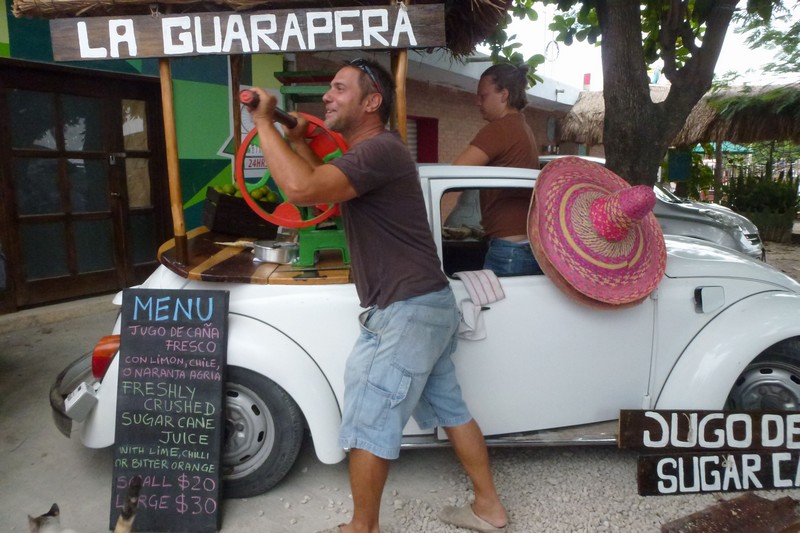
We’ve arranged a trip to Chichen Itza, a big local tourist attraction. Our trip will take us to Chichen, then to a cenote for a swim, then toValladolid, an old Spanish colonial town. Lunch is chucked in also. We leave at 7:30am and should return by 7:30pm: it’s a three-hour drive to Chichen Itza from Playa, so it’s a long day. On the way there, we stop for a break, and find La Guarapera, selling crushed cane sugar juice. With a bit of lime juice to offset the sweetness, this is delicious. The gentleman turning the handle is Italian: he worked for London Underground for 16 years, and now he’s selling cane sugar juice from a converted VW beetle in Mexico.
After a long drive, we arrive at Chichen Itza. Here’s the main temple, to give you an idea of the place. It is pretty hot. Lucky Diane and I have bought big hats. Fetching, huh ? I don’t care if it keeps the sun off my head.

 
We have an English-speaking guide who tells us about the Maya. They were able to predict eclipses and so forth with startling accuracy, and their rulers used this to show the masses how powerful they were. They would stand at the top of the pyramid and say “it’s going to get dark shortly”, and lo, it would. The room on top is designed to amplify sound, so they could be heard by the thousands of people assembled in front of it. Sure enough, if you stand in front of it, even where I took the photo from, and clap your hands, the sound is amplified back at you and is clearly audible from all over the square. Remarkable. There are a lot of buildings here, including some which pre-date the temple. The one which looks like an observatory is, in fact, an observatory, used to predict the movements of the stars and planets.

After walking around the site for an hour or so, and avoiding buying anything from the vendors (“one dollar, one dollar, almost free”), we set off for lunch. I’m sure the hand-made, hand-coloured masks aren’t almost free, but our guide reckons that a lot of it is made in China, like a lot of stuff in the world today.
During lunch, some local dancers do a show where they dance while balancing a tray of glasses on their heads.
And then finally, we go to Valladolid. This is laid out on the Spanish colonial model: a large Catholic church on a square, with the Governor’s offices to the left, and a fine central park. We have a quick look round before it goes dark and we have to leave before we are eaten alive by insects (it happened anyway).
A couple of days off now until I start the pre-course for my instructor course, where they assess what you’ve forgotten of what you should already know. We’ll spend some of it at the beach, where Diane is making leaps and bounds in her snorkelling, of which more later.
|
|








Recent Comments