|
|
We leave Puno on an early bus and the Andean scenery is just as impressive and even more rural, with locals herding llamas, sheep and pigs against the backdrop of the huge snowy mountains and Lake Titicaca. Little did Paul know, but he’s left his really quite expensive pair of Oakley sunglasses in the hotel room. Prat. We arrive at the border with Bolivia.
Simple formalities and we are quickly on our way to Copacabana (not the one from the song!). As we’re waiting in line to get our luggage from the bus we are met by our hotel host and whizzed up the hill in a minibus, saving us a 5 minute puff uphill (we’re at 3600m). We have a nice room with a great view of Lake Titicaca, but it’s still cold at this altitude.

Copacabana is a tiny town, with most of its tourists only staying a couple of days to visit the islands in the Lake. In fact, it’s difficult to see how you can stay much longer unless you carry wads of ready cash, since there is only one ATM and rarely does it dispense any money ! Fortunately for Paul, street vendors sell things which look like sunglasses for about two quid, so he buys some. We spend a leisurely couple of days here seeking out warm cafes, sitting in the sun and eating trout: it’s good here as it’s farmed nearby in the lake. The next morning after breakfast we talk to our host, expecting to visit the Isla del Sol, but we are really confused when he says it’s too late to go today – apparently we should have adjusted the time on our watches two days ago when we entered Bolivia, and we’ve missed the boat ! Anyway, in the interests of keeping warm we went for a long scenic walk along the peninsula through the eucalyptus forests and alongside the lakeshore and floating islands.
Next day we wake up at the right time for our trip and the boat drops us at the north of the Isla del Sol for a beautiful ridge walk about three hours to the south. The highest point was 4000m and somewhat hard work on the undulating sections. Here’s Paul with some beach pigs and a donkey.
It’s a stupendously beautiful lake, the highest navigable lake in the world.
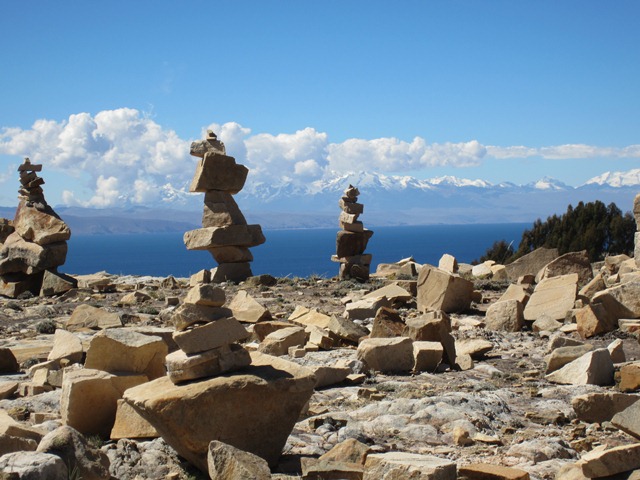
People like to pile rocks here, for some reason. We are lucky to have such great views of the snowy mountains.
Back in Copacabana, Paul is in his two quid glasses, and having a beer in the sun to celebrate a grand day out!
Tomorrow we’re off to La Paz, the big city and governmental capital of Bolivia.
We’re finally leaving Cusco, and we get fond farewells and hugs from our hostel staff. The bus trip to Puno is a mere seven hours and the mountain scenery is outstanding. We pass herds of llamas and alpacas, blue lakes and snowy mountains.
And finally we arrive at the town of Puno on Lake Titicaca.
Puno is a small town with some low key tourist activities, and so more to our liking than Cusco. It’s sunny and warm in the day but freezing cold at night. We find a warm bar playing all types of rock music and more importantly for Diane they mix a mean pisco sour! So far we’ve purposely avoided two of the most famous of Peruvian foods, but this is our last chance and we plump for cuy (guinea pig) and alpaca. Luckily the guinea pig isn’t served whole but there isn’t much meat on it and Paul was soon tucking into Diane’s tasty alpaca dish (sort of like lamb with redcurrant sauce, yum!). We are now at about 3800m and the hostals regularly provide coca tea, a nice drink anytime of day but exceptionally good accompanied with chocolate.
We visit the Yavari, a ship commissioned and transported in pieces from the UK in the 1850s around Cape Horn to Arica, then by railroad for some miles, and then finally by mule to Puno. The trip took six years, and is an amazing story of logistics, including the fact that when they finally put it all together they realised there was no coal locally to feed the engine therefore it was hastily converted to run on llama droppings! The ship has been carefully renovated over the last 15 years and they even do B&B. As we leave the boat we pass some grassland, see wild guinea pigs running around and Paul feels a little sorry about last night’s dinner.
Here’s the guide reminding us how far Lake Titicaca is from the Pacific Ocean.
Happy Captain Paul.
Next day we board a boat for a tour on the Lake. The nearest communities live on “floating” islands made of reeds and tethered by several stakes into the bed of the lake.
The houses are neat with thick dried reed floors and simple furnishings, even TV and radio thanks to solar panels. However, due to sanitation problems recently they now have to take a boat trip to a separate designated toilet area – not so convenient we think.
We take a traditional boat ride in between the islands, rowed by two local chaps.
Then off to visit a more traditional island, Taquile, over two hours motoring away, first through the remaining reeds and then out into the lake proper. We spend the whole time on the top deck, wrapped up warm in our down jackets and swapping tales with other travellers.
A short walk across the island, and lunch: trout, which is pretty much the staple round here, as well as being farmed commercially in the lake.
After this, we’re leaving Peru for Bolivia, country 11 of our trip: we’re stopping for a few days at Copacabana. This is an even smaller town on Titicaca where we’ll break the journey to La Paz.
For us the visit to Machu Picchu is a essential part of our travels, although we aren’t doing the famous 4-day Inca Trail as you need to book that some months in advance (and we hear it’s also very hard work!). So, on a spare day in Cusco we research our options: we are prepared for the high entrance fee to the world famous site, but are amazed at the exorbitant price of the return train journey. So, we are persuaded with a cheaper option marketed to backpackers which involves a bus journey through the Sacred Valley (and you know how much we like bus journeys). All sounds good and we set off in a minibus crammed in with several other travellers early one morning, unfortunately missing most of the fantastic scenery due to heavy cloud and then torrential rain. However, we are pleased we haven’t taken the 30km downhill cycling option – those guys look exceedingly cold ! After lunch and a briefing in Spanish from the guide who wouldn’t slow down or simplify his speech for us (ps readers: we really didn’t like him) we arrive at Hidro, the last train station on the line, a large hydroelectric power installation. There is an option to take the train forty minutes to Aguas Calientes, the tourist town just below Machu Picchu. But, with the rest of the group, we stick to the backpackers’ plan and walk ten kilometres along the train tracks.

Er, should we be here?
For a while the scenery is good, it stops raining and only one train whizzes past us. Who’s the fat bloke ?
After this the sun sets and we need to get our head torches out for the last hour or so. Finally we arrive at Aguas Calientes, find our all-inclusive hotel (hmm, yes as you may have guessed it was far from luxurious), have dinner and are given our tickets and instructions for the next day. Time for a beer and early to bed for us.
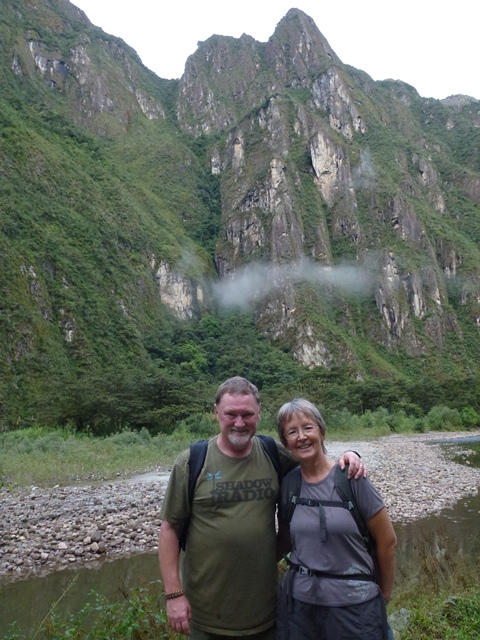
Next morning we are up at 5am and on one of the first buses up to Machu Picchu, taking about 30 minutes up a pretty steep winding road reminiscent of an alpine resort. Some of our group decide to walk up and they all look pretty exhausted when they arrive. We have a short time to wait until the ticket office opens at 6am, but we are quickly through the formalities. This must be the only place in the world where every single visitor going through the turnstiles has their original passport with them (yes, original, they insist upon it, although we don’t know why, what easy pickings for any thieves!). We have a few minutes to look around before we join our tour. Machu Picchu has just celebrated 100 years since it was found by American Hiram Bingham in 1911, or rather, shown to him by locals, who of course knew it was there. We are told that only about three generations of Quechua lived here before it was abandoned, and the entry routes destroyed, to stop the Spanish invaders finding it: the spent years trying. The architecture is truly remarkable and we spend five enjoyable hours mooching about. It’s pretty cold and cloudy first thing, hence we have all our layers on in this photo.
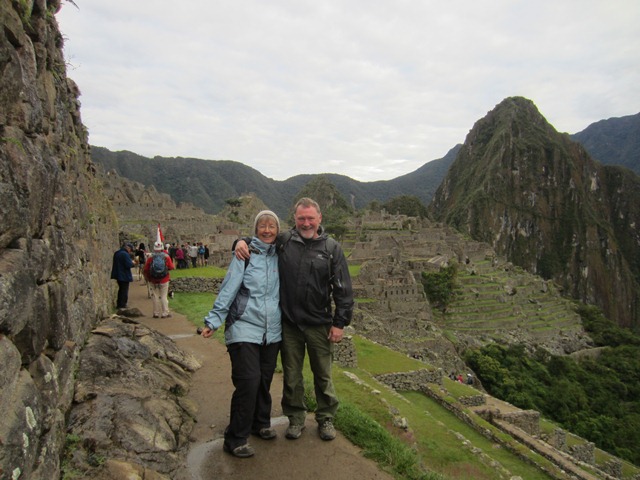
Some other guys can better withstand the cold.
We only have 8 people in our tour group and our guide is enthusiastic so we really enjoy it. The scale of the site and the terraces is overwhelming. The terraces were made for farming, with successive layers of rock, gravel and soil. The soil was carried from Cusco along the Inca Trail. We also learn that there was only one Inca: this is what their king was called. The people he ruled over were simply Quechua.
We start to warm up a couple of hours later as the sun starts to shine and we start our walk up the famous Inca Trail to the Sun Gate, the entry point for all the real trekkers.
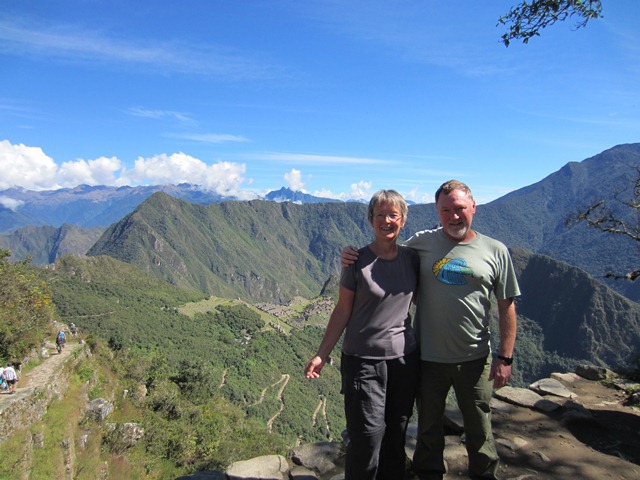
As we retrace our steps towards the main complex the sun is out and the temperature hot. Here’s our version of the famous Machu Picchu vista, beloved of a thousand travel adverts.
We leave at about 11.30am, over the moon with our visit and our early start to avoid the hordes of visitors who are just arriving. Our return journey starts at 1.30pm with the train ride from Aguas Calientes to Hidro. We’re happy not to be walking this long section again.
Our return bus journey is much more scenic in the sunshine, with views of the steep sided ravines and the snowy mountains. Whichever way you do it it’s a long day, but so worth it! We get off the bus earlier than others at a small village called Ollantaytambo where we spend the night. Lucky decision, as the next day we hear that anyone travelling here by late bus transfer had a convoluted journey due to road works. The next morning we have a lie in then walk around the cobbled streets in the tiny town. Not much to hold us, so we walk down to the train terminal and share a bus ride back to Cusco with another couple of travellers. Fantastic scenery on the way.
Back in Cusco we relax a bit and take in some good coffee. Off to Puno, on Lake Titicaca, next, before we head off to Bolivia.
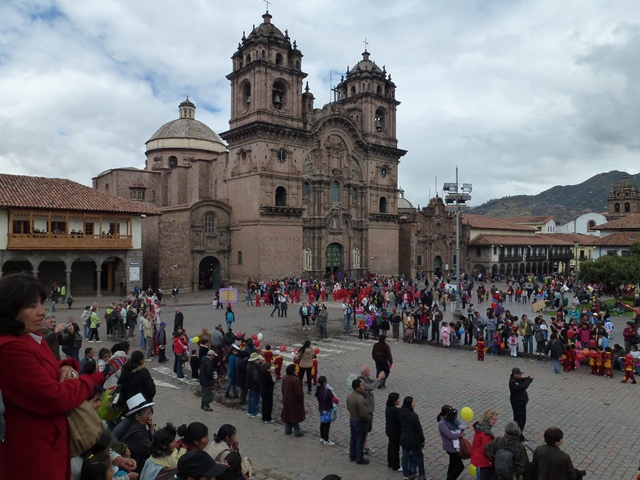
We spend a few days in Cusco between our jungle and Machu Picchu trips. It’s convenient, although exceedingly touristy: everywhere you go in the centre, you are asked if you’d like to buy a painting or a llama hat, or take a picture of a local woman with a baby llama. We are at an altitude of 3300 metres, and although we hear stories from other acquaintances about feeling unwell, or even having altitude sickness, we seem to adjust fairly easily (it must be all those long bus journeys!). Nice and peaceful as our convent hostel is, we occasionally feel the need to venture into town – here’s Paul from the Starbucks balcony which overlooks the main square, the Plaza de Armas. Our excuse is using their wifi, but it sucks, so we just drink coffee.
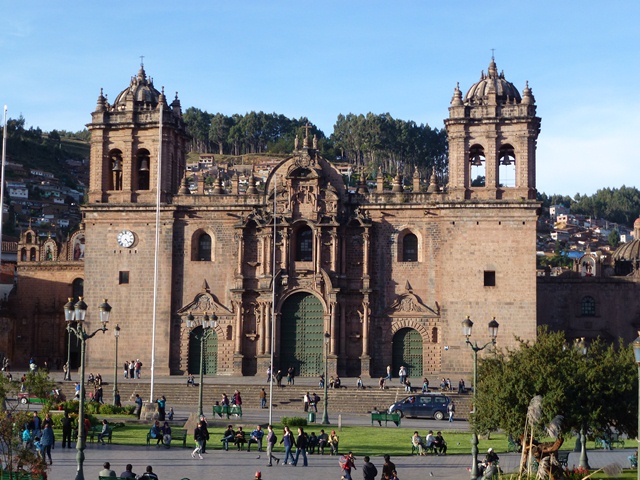
There are some beautiful buildings of course: this is the cathedral on the main square.
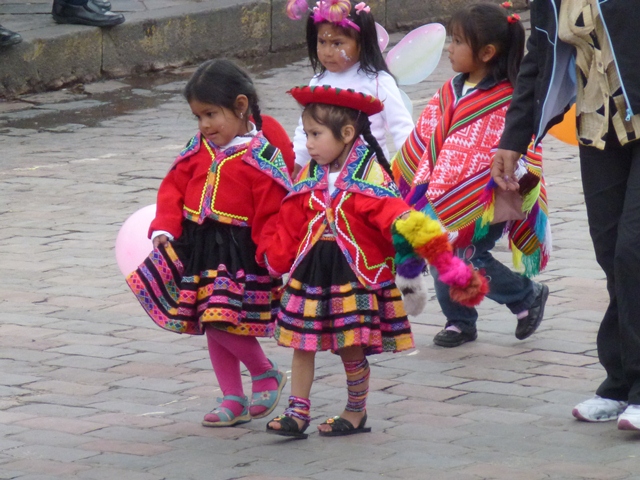
We’re in town during an Arts Festival, which includes lots of typical music and dancing. Here are some of the locals in their traditional costume.
Any excuse and the Cusquenans are quick to join in the parade. This day they even rope in the local pre-school children, dressed in traditional costume or as animals, flowers, and cartoon characters.
We wander around and venture up the extremely steep streets, needing to catch our breath on the way and reminded of the altitude.
Looking forward to our planned trip to Machu Picchu!
We arrived in Cusco at 5am on the overnight bus. A short taxi journey took us to our hostel, which is attached to a convent, and part of the same building is a girl’s school. They were not at all phased by us checking in at 5:45am, so we went to bed for a couple of hours and then had breakfast. Afterwards we went for a walk around Tourist Central, or Cusco as the locals call it. It’s odd: in some places I’m disconcerted by the absence of other tourists, but here I’m disconcerted by their presence. Often, when we’re travelling, there are just a few other obvious tourists, if any, so you have to interact with the local population on their terms: speaking Spanish, asking how things are done, working things out. Here, there are so many tourists that the balance has swung the other way: if you stick to the central part of town, you can speak English all the time, drink in an English pub (The Cross Keys) or an Irish Bar (Paddy’s Bar, the highest Irish-owned bar in the world), buy coffee at Starbucks, and eat pizza. There are so many pizzerias here it is untrue. The climate is normally sunny and warm in the day but very cold at night, so we treat ourselves to alpaca and llama hats and gloves and wear our down jackets everywhere.
We’re here for a couple of days before heading out to the rain forest. We’re flying to Puerto Maldonado, and then heading up the Tambopato river to stay in a couple of jungle lodges, walk around, and watch the wildlife. We’ve figured without one thing, though: the unrelenting rain. Yes, it’s a rain forest, so it rains, but this is supposed to be the dry season. Unfortunately for us, there is an unseasonal bout of cold wind from the south, called a friaje, so while the temperature is cooler and more pleasant, it also rains a lot. It’s raining, in fact, when we arrive at Puerto Maldonado. Undeterred, we visit the serpenterio, where they have snakes and other animals, most rescued from car accidents or other mishaps. Somehow, as I don’t usually like messing with the animals (I don’t hold with it: they’re wild, and being handled by people stresses them), I end up with a boa constrictor around my neck, for publicity shots for the local tourist board.

Then we’re off up the river by boat. It’s about three and a half hours to our first destination, Refugio Amazonas. The river is wide here, and running quickly, because of all the rain.
We will stay one night here, then carry on up the river tomorrow for four hours to Tambopata Research Centre, where we will hope to see the famous Macaw clay lick, where hundreds of macaws assemble at the river bank to eat the clay, which supplements their diet by providing sodium. On the way up, we have a tasty rice lunch out of a big leaf. Not sure about the sodium content.
Our guide spots wildlife for us, although most of them were a tad too far away for us to photograph with good results, here goes.
You can’t tell, but this white caiman is HUGE.
This is a capybara, a sort of huge guinea pig with long legs.
Then our boat breaks down (well, isn’t everything we touch breaking down at the moment ?). The engine won’t go at more than a snail’s pace without failing. The guide gets out his satellite phone and in an hour or so we are joined (literally) by another boat who tows us up river to a nearby lodge. Here’s our guide looking disconsolate.
Unfortunately we still have another two hours to reach our own lodge and the rescue boat can’t go that far. The replacement finally arrives and we have the honour of motoring the final section in the complete dark. But the lodge is so luxurious and evening dinner so great we immediately forget the troubles. The lodge bedrooms only have three sides, open to the forest, so it’s pitch black at night and all we hear is the sound of the crickets and the occasional howler monkey. There aren’t even any insects worth speaking of in the buildings as they use a special oil on the wood as a deterrent.

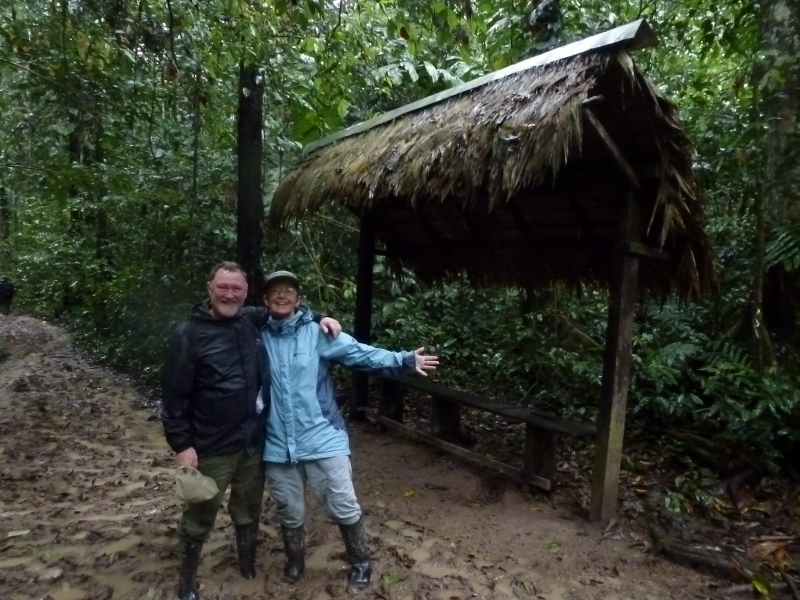
The next day we travel up river again to the Tambopata Research Centre, spotting wildlife on the way. The weather is fine and according to one of our travelling companions who is an ardent bird watcher we log 32 different species on this section, from herons to hawks, huge geese and roseate spoonbills. We arrive at another beautiful lodge, have lunch and don welly boots for a walk to the local lake. It was more than a tad muddy! After this photo was taken the mud was so deep Diane’s welly boots decide to stay put and she falls over, luckily backwards into the slurpy substance.
The boats we are to take for our trip on the lake are also somewhat wet!
But we do find a drier boat and venture out onto the lake for some birdwatching. The guide’s way of diverting us from the pouring rain is to feed the fish with bread, then we realise they are piranhas!
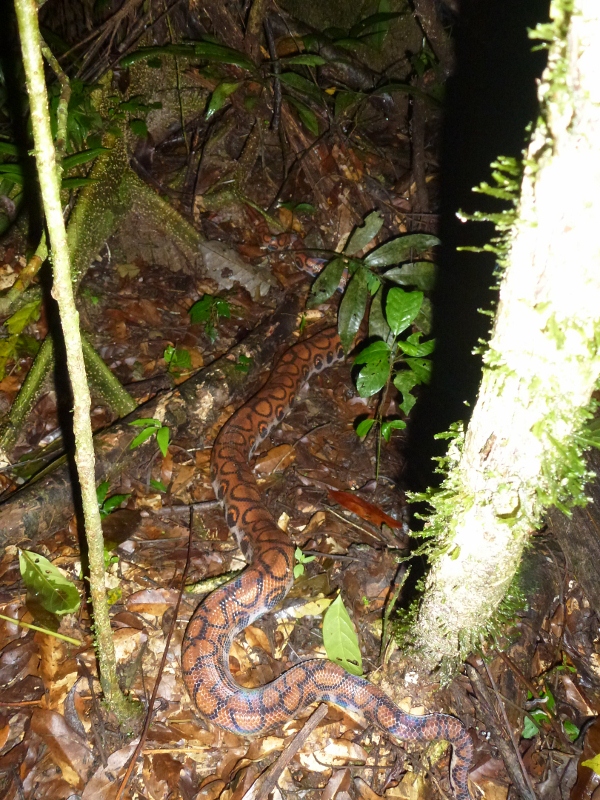
We go for a muddy nightwalk and see tracks and hear the honking of peccaries (huge pigs), spot frogs, a tarantula and snakes, including this huge boa constrictor whose skin is glistening as it is just about to be shed.
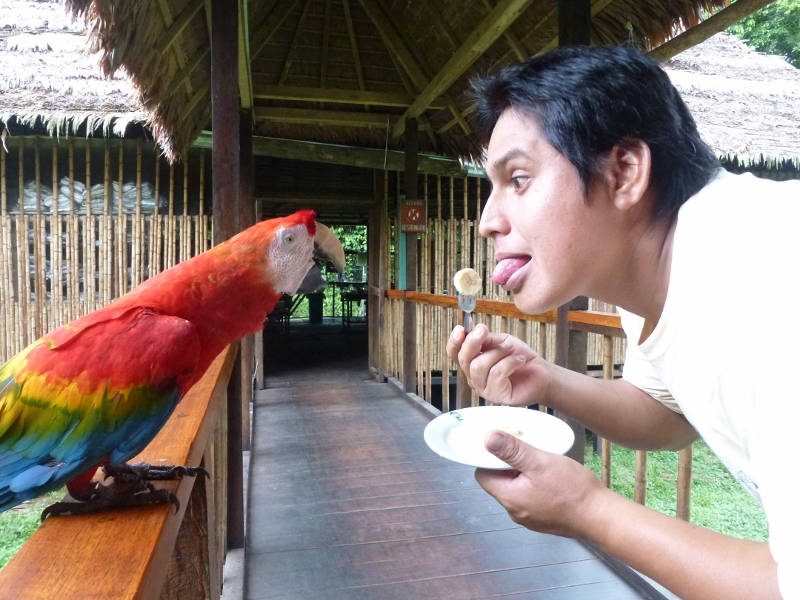
The macaws around the lodge knew where to come for breakfast!
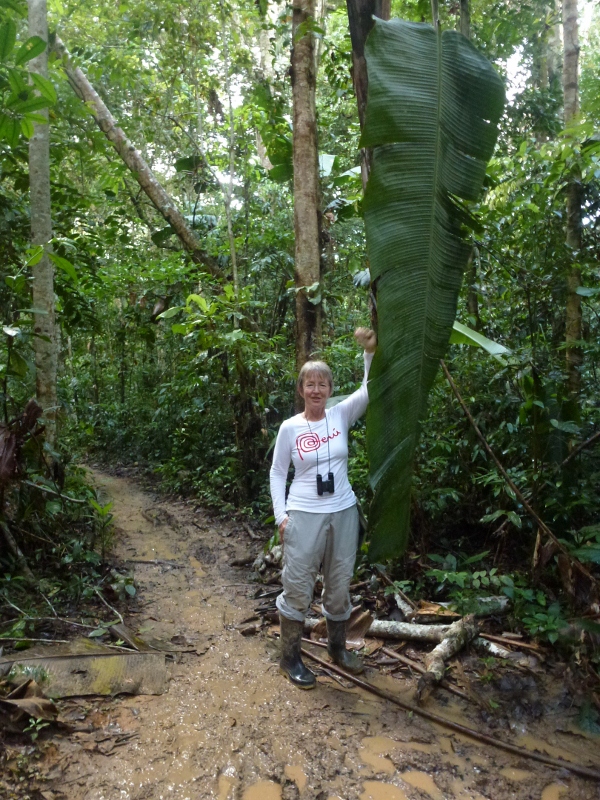
For the next couple of days we continue to walk out on local trails in the mud. The foliage is amazing and the trees huge: here’s Diane with a vast leaf. And some mud.
The next morning is another early start and on the way we spot these cute turtles complete with butterflies on their noses (maybe trying to dry out?).
And finally, one of the highlights of the trip, the macaw lick. Our boatman moored up nearby – yup you guessed it, it’s still muddy!
Unfortunately because of the continuing rain there aren’t many birds on the clay, although there are a lot in far trees. We see a few chaps trying to do their stuff in between the showers but no photos as our lens isn’t long enough. Even so, on the way back Diane seems to have had a good time despite here trousers being several shades a deeper colour of mud.
We fly back to Cusco for a couple of days rest ….. Machu Picchu here we come J
First, an apology to our regular readers: this post is late. The main reason is that the hard disk died on our trusty Sony Vaio netbook, the very machine on which I am typing these words. We use this machine a lot: we move money around with it, keep in touch with family, friends and other travellers via email and facebook, use it to store our photos, and of course to write the blog. One day it just wouldn’t boot and we needed it fixed urgently. Fortunately, over here they have a fix-it culture, so off we trotted to laptop-fixing street, actually the Centro Commercial del Carmen, a small indoor shopping mall. Businesses here tend to cluster with similar enterprises, more so than in the UK I think, so the place is stuffed with shops selling and fixing computers, printers and the like. We picked one that was open (it was 9:30am), and they agreed to replace the disk for about 75 quid and reinstall Windows and Office for about a tenner. Here’s Paul standing at the counter/workbench/desk/cartridge refilling station in the shop.
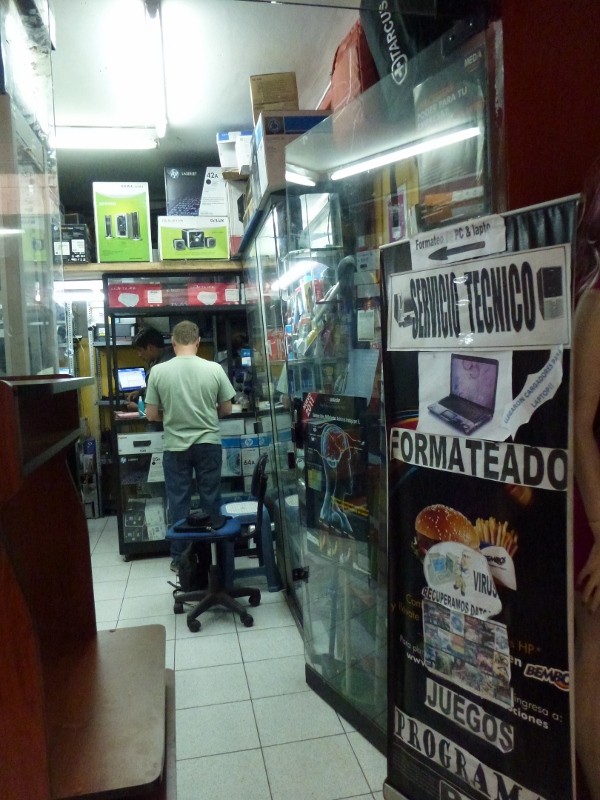
Three hours later, and we’re back up and running, with only one tiny problem: it’s the Spanish version of Windows, hence the total absence of the pound sign in this post. Somewhere between Spanish Windows and an English keyboard it got lost. Using Excel in Spanish is interesting, too. We use Dropbox to store backup copies of all our important stuff, and so a couple of hours later, we’re able to bank and blog again. Or so we think, until we find the internet in our hostel monstrously unreliable and the version of Spanish Windows so out of date that any time we do connect the machine wants to install a million updates, cutting down our access time. Eventually, this sorted itself out, and we’re up and running again.
On top of this, our best camera developed a nasty mark on the lens, probably dust and dirt from the harsh conditions over the last few months. Again, we found a camera repair shop, and got it cleaned for a few soles. We were very happy with it until a few days later when the autofocus started to play up, as ever at an inopportune moment. Luckily we had bought a cheaper camera as a spare a few months ago, although it’s just not the same quality L. And to cap it all, the frame of Diane’s glasses broke, irretrievably. For a couple of days she managed to wedge them in place, but then we were off to ‘optician street’ where a technican suggested he could put the existing lenses into a new frame. Thirty minutes later, and for less than 20 quid, she walked out with a not brilliant but perfectly adequate pair.
So, all things being equal, normal service has been resumed. We have trips planned to the Peruvian jungle and Machu Picchu via Cusco, so watch this space !
Arequipa is on the altiplano, the largest area of high desert plains in the world. It is overlooked by the snow-covered volcano El Misti, and is called the White City, perhaps because the old city was built from a local white volcanic rock, sillar. Any way up, it’s beautiful, if cold.
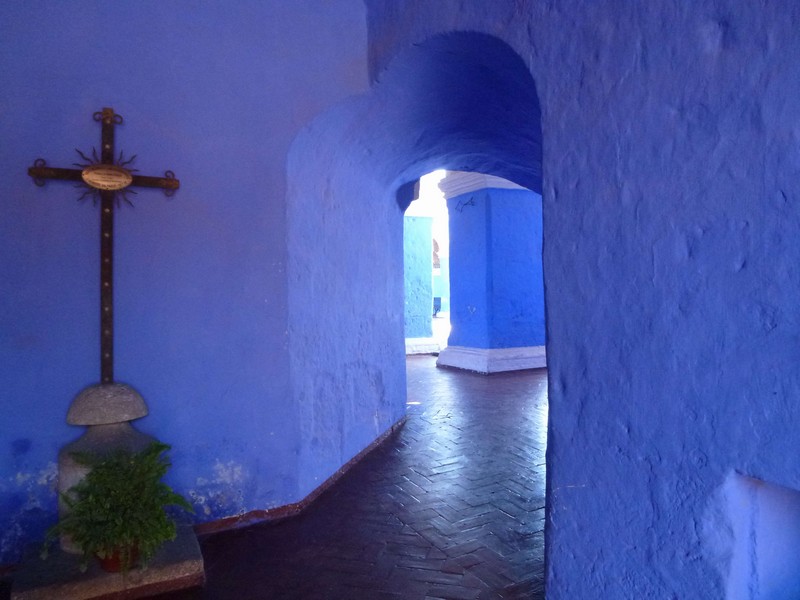
We are here for a look round, and as a staging post for a three-day trek into the Colca Canyon, about 5 hours away by minibus. Before the trek, we tour the Monasterio de Santa Catalina, a colonial-era convent. This is so large, it’s actually a city within a city. It’s been open to the public since 1970, and is still an active convent, although the nuns have moved into a newer section which is closed to the public. The interior is fantastic: walls and corridors are painted blue and red, and the play of light is marvellous. This is the corridor between the Novices Cloister and the Orange Tree Cloister.
There are six streets inside the monasterio, named after Spanish towns. The nuns had their own individual cells, some with courtyards of their own, and most with small kitchens.
The juxtaposition of blue and red is glorious: the blue reminds me of Nubian houses in Egypt. I often think it’d be a good colour for our house, but it just wouldn’t work without the strong sunlight.
The order is Dominican, and was established in 1579. Most of the early nuns were very rich, retained servants, and apparently did not live an appropriately contemplative life. In the 1870s, a new, strict Mother Superior had to be sent over to sort them out.
Shortly thereafter, we’re off to the Colca Canyon, the second deepest canyon in the world, deeper than the Grand Canyon in the USA. We’ve arranged a 2-night, 3-day trek down into the canyon and back, with a walk in the altiplano and a visit to a viewing point on the canyon rim to watch Condors. Here’s a scenic view of El Misti, with a vicuna in the foreground.
We stopped to walk around and look at the strange formations in this part of the desert.
And, of course, to look at the alpacas.
After lunch in Chivay, the regional capital, we stop to watch condors. Mature adults can have a 3.5-metre wingspan, although these guys are juveniles.
This guy is full grown though.
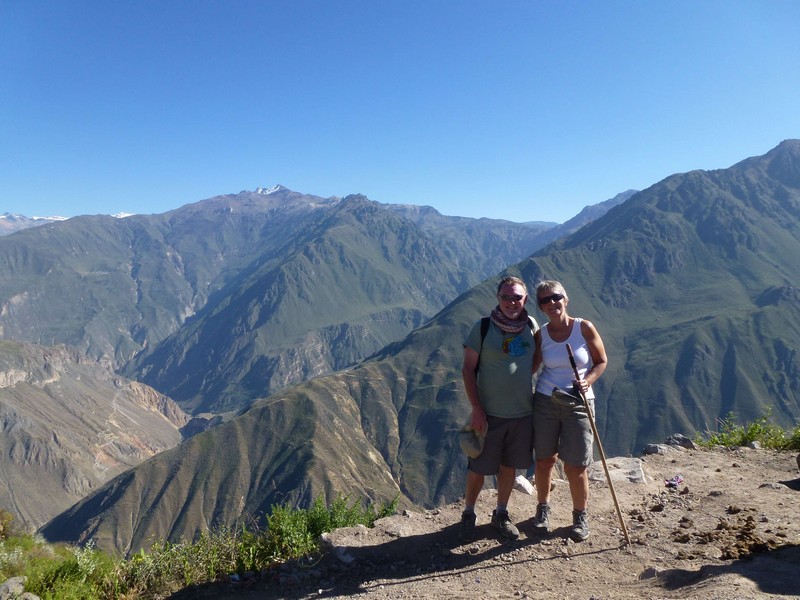
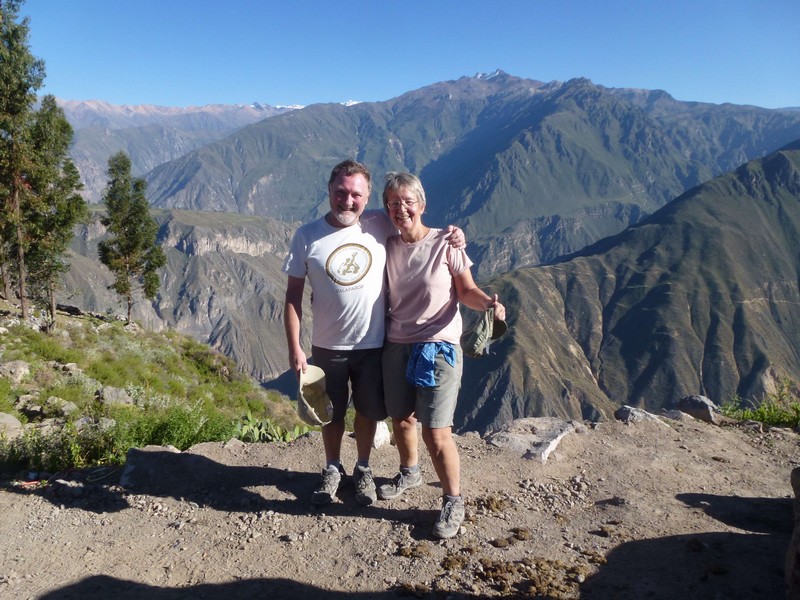
We stayed a night in the little town of Cabanaconde, and the next morning walked down into the canyon. Here we are setting off for our 3.5-hour descent.
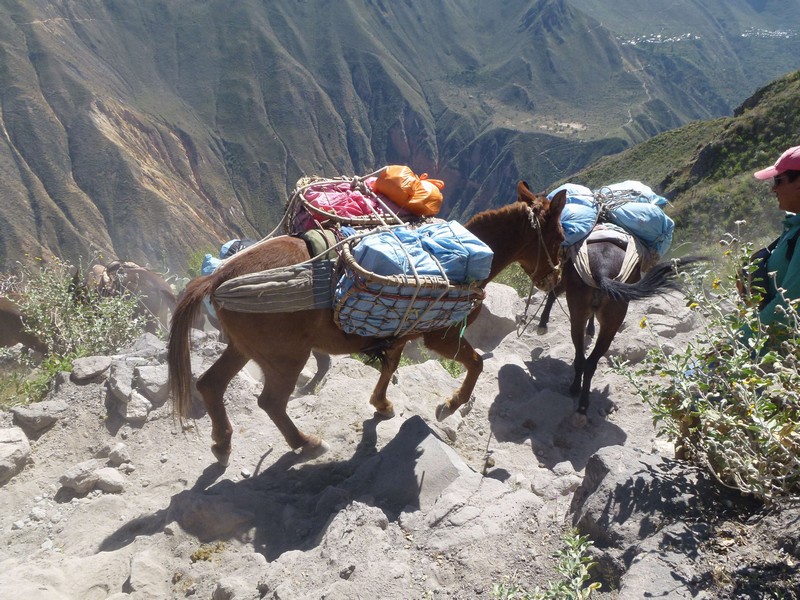
The going underfoot is pretty loose, so we take it steady, although the locals more or less run down, wearing sandals rather than walking boots.
Fortunately, we have mules to carry our spare underwear and the like.
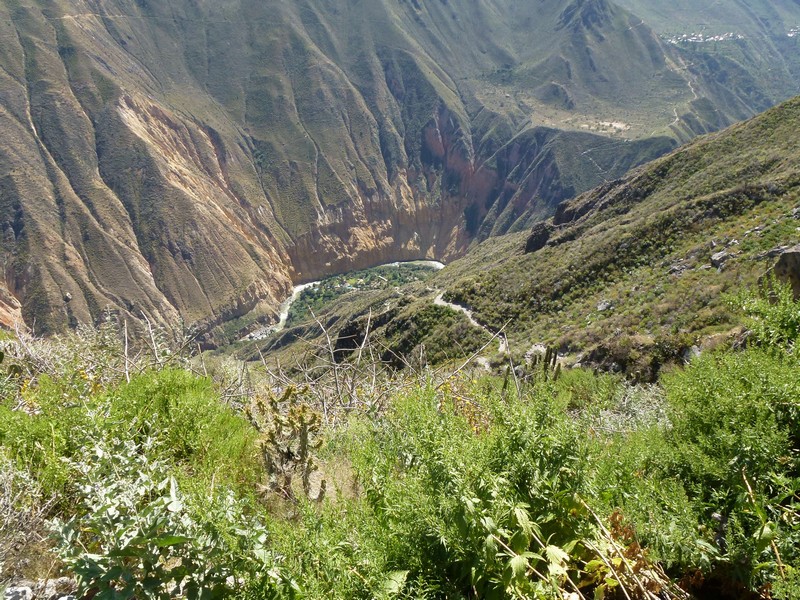
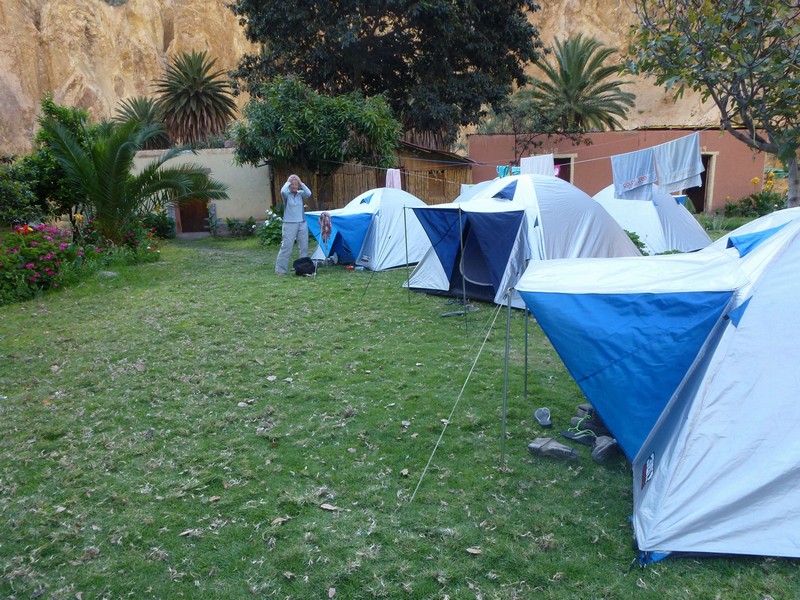
Eventually, the river appears below us, and the little flat area where we will camp. It’s 1200 metres from top to bottom.
Diane’s wondering whether she can stand a cold shower.
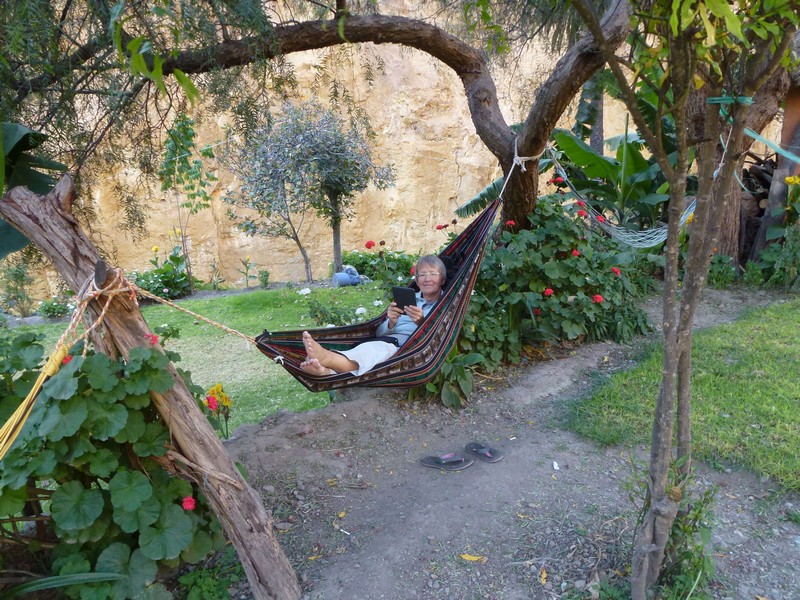
As it happens, she can, and she can also read my kindle in a hammock, it would seem.
The stars and the moon that night are absolutely fantastic. The next morning, we are up at 4am, yes, four o’clock in the morning, for the walk back up, so as to arrive at the top before the sun is too hot. About half-way up, the sunrise reaches the peaks on the other side of the canyon.
Three hours of trudging later, we are back on the top. A fantastic walk, if slightly painful for the calves.
Then it’s back to Arequipa, and a well-deserved pisco sour.
Off to Cusco now, on the overnight bus. We’re taking a 5-day trip into the Amazon rain forest, and then going to Machu Picchu and the Sacred Valley. Can’t come to Peru without seeing Machu Picchu !
We arrived in Lima early in the morning after an exceedingly comfy bus journey care of Cruz del Sur, probably the best bus company in Peru. Mind you, regular readers will remember that in Ecuador a 10-hour journey would cost US$10 (about £7), but this one cost more like £21 each. For that, though, we did get better quality movies, a pillow and a blanket ! Our hostel was on an exceedingly busy road, reminding us that Lima is the biggest city we’ve visited since Bogota, but on arrival we were immediately offered breakfast and so we felt better. Here Paul models his new Peru t-shirt, to remind you of where we’re at.

Our host, Francis, gave us a half-hour briefing about buses and the sights to see – after that we needed a coffee and a walk. About 20 minutes later we found ourselves by the sea. Lima has a warm climate, but suffers from sea fog, hence we never really saw the full expanse of skyscrapers (maybe just as well). It was 1st May, a public holiday in Peru, and there were lots and lots of surfers riding the waves. The photo was taken from an upmarket shopping mall, Larcomar, built into the cliff side.
The nearby “Love Park” has a huge statue of a kissing couple, surrounded by Gaudi-esque walls reminiscent of Parque Guell in Barcelona.
Next day it was time to venture further, into central Lima. Following the various coloured indications on our host’s map we managed to get somewhere near the historical centre. But then we found ourselves driving over a huge bridge and into the “red zone” – you don’t want to go there our host had said. Too late, so we hot-footed it off the bus, and walked quickly back to the safe side ! See how busy this place is.
We visited the main square and two of the famous sights. First was the 16th-century Convent of Santo Domingo with its exquisite courtyards, wood carvings, original frescoes, paintings, library and bell tower with views over the city – here are a few pictures. The Spanish clergy didn’t mess about with their buildings: they are beautiful, high-ceilinged, cool spaces with large cloisters like the one below.
Serious frescoes, as well. The tiles below them were imported from Spain.
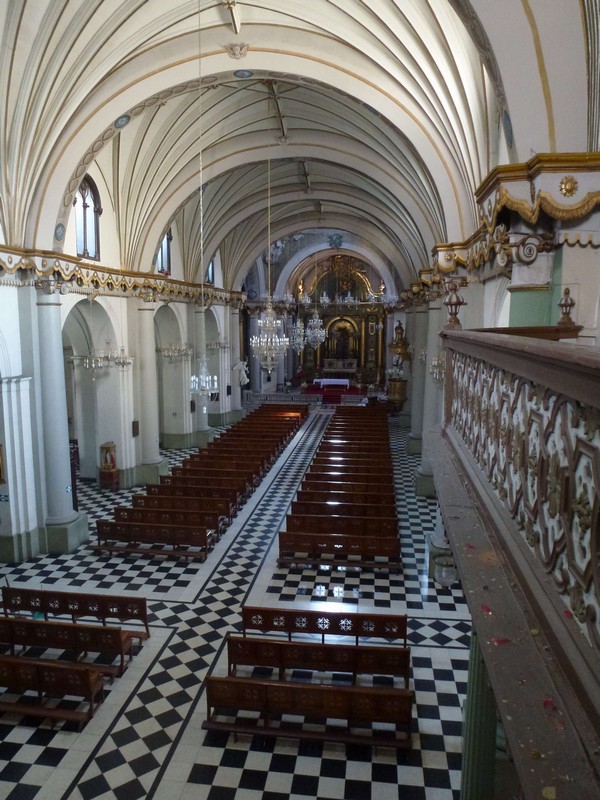
The main church, still in use. Much gold leaf was used in it’s construction. The cedar wood was brought all the way from Panama,
The parchment book in the picture below is now in the library. It was used in the Choir, the part of the church where some of the monks sat to sing during services (the picture above was taken from the choir). The book is absolutely huge so that they could see it from their seats around the walls.
Diane looks relieved at making it up the steps to the top of the bell tower.
Next we went to the 17th-century Convent of San Francisco, a little more imposing and with catacombs full of bones (they think they have the remains of about 25,000 people!) but we weren’t allowed to take photos inside, so here’s an outside shot of the huge main door of the still-active church. This place is also still a monastery, with about fifty monks.

After that all we needed to do was to get the bus back to our hostel. Unfortunately it was late afternoon rush hour and finding the bus stop turned out to be impossible – although there are signs, none of the bus drivers take any notice! After watching the locals for a few minutes (and whilst Paul was wondering if we had enough money with us for a taxi) Diane decided the only option was to wait for our bus, and as it arrived to jump out the road into the lines of buses and wave at our bus driver. Luckily it worked without her getting run over. We have heard that in the autumn there will be a new transit system introduced – maybe it’ll be a bit easier for the tourists then.
Central Lima probably deserved more time, but the city was a little too large for our liking. So the next day we decided to do something we find easy – a bike ride. We chose a tour which would take us around the coast, from where we were staying, the upmarket suburb of Miraflores, through Barranco (even more upmarket) to Chorrillo (er, not very upmarket at all). We rode first down to the sea again, perhaps Lima’s most attractive feature. Here’s an arty shot by Diane.
This is a ruined church in Barranco: it was built by fishermen before the place was populated, after a miraculous light led them back to shore when they were lost in the fog. It’s been ruined for a good while, but according to the sign, it’s restoration is imminent. I wonder if they’ll let the vultures stay. The vultures were protected here because they cleaned up after the Spanish, who, our guide said, turned the city into a sewer after they moved in.
Our group gazes down the coast past a building which was built illegally, as it blocks the view of the building behind us. They’re in court, arguing about it and in the meantime part of it is used as a car park !
Our guide tells us about the monk’s leap, where a monk infatuated with a young girl jumped into the water. The day we were there, the waves were about 4 metres, and I certainly wouldn’t have been keen.
Here we are arriving in sketchy Chorrillo. The houses here used to be upmarket, but the area is susceptible to earthquakes so all the money moved out. Today it’s a pretty poor area: there are shanty towns behind the houses you can see here.
Our hostel was a few minutes walk from the busy tourist centre of Miraflores, but we were tempted back early each evening for the free pisco sours, the local cocktail which is made with egg-white, lime juice and pisco, the local brandy. It’s delicious. Anyway, off to Arequipa in the south tomorrow on our new favourite bus company, for a quick trek down the Colca Canyon. And maybe more pisco sours J
We had a good time in Cuenca, and celebrated our final night visiting favourite eating and drinking holes. We now have to travel to northern Peru, via Loja in Ecuador, over the border to Piura in Peru, and then on to Trujillo on our way south. The bus journey to Loja was, according to the guide book, about 5 hours over narrow and twisty mountain roads. But, when we heard of a mini-bus option which would take only 3 hours we signed up quickly, despite it costing us an extra 6 dollars or so each. The minibus was almost new and exceedingly comfy (in contrast to the large public buses we usually take) and set off bang on time with only six passengers. However, as we left the depot we were told in Spanish (and then repeated again in English) that if anyone asked we were part of a tour group and we had hired the minibus for $120 group fee – mysterious we thought, especially as our $12 x six passengers didn’t add up to that amount. On the outskirts of town we were stopped by the police and although that in itself isn’t unusual, they were really probing the driver and female “tour leader” about the passenger licence and what sort of tour we were taking. At one point we were described as ‘friends’ but unfortunately that explanation fell flat when we didn’t know one another’s names J There was a lot of arguing and hand gestures and it seemed likely we weren’t going any further – at this point money changed hands ($100 apparently in favour of the chaps in uniforms !) and we sped on our way. An experience, but the bus was very comfy and the views of the Andes and the Paramo, a type of high-altitude moorland, were outstanding. Comfy is good, as over the next couple of days we have to go a long way on the bus, and every little helps.
We arrived in Loja and booked into a small hotel in the centre of town. We wandered around a bit and had a bite to eat. Nothing to interest us here apart from a small dress shop which, curiously, was also a money exchange. The rate seemed good so we changed dollars for Peruvian Soles without any written records being generated J This would save Diane haggling with the money changers at the Peruvian frontier tomorrow. There was not a single other tourist in town that we saw.
The next day’s journey over the border and into Peru was billed to be much longer, and was by public bus, so we prepared ourselves for another day of eating mainly crisps and biscuits. This bus would take us the whole way from Loja in southern Ecuador to Piura in northern Peru in about 9 hours, and would wait for us whilst we dealt with the border formalities. The border crossing was quiet and calm, and was made even easier by the Peruvian official being a fan of the Beatles: one advantage of us both having Liverpool as our town of birth on our passports ! Here’s Paul looking quite happy if a bit tired (and there’s still about 5 hours to go!). For those who are counting, Peru is country 10 on our trip.
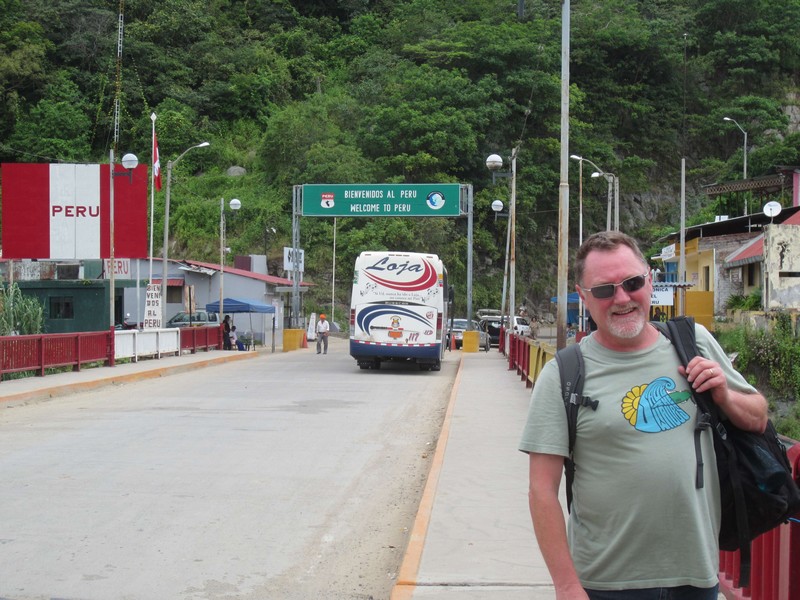
After the border the scenery changed from fertile highlands to hot and sticky lowlands. We arrived in Piura, booked into a small hostal at the second attempt and again the town didn’t really having anything interesting going on to write home about. The temperature was uncomfortably hot, and we found a nice hotel on the main square with an air-conditioned bar: nice, we thought. Until we got the bill, that is: all that aircon costs L
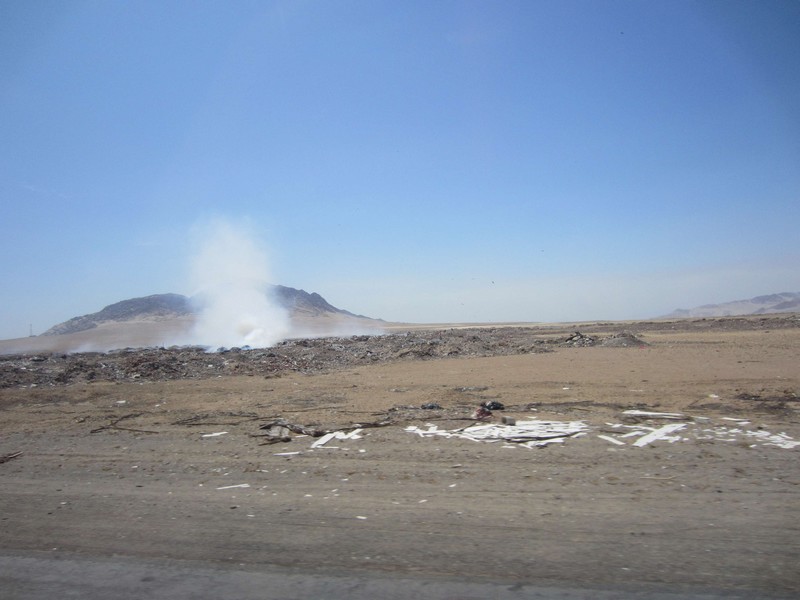
The next day was a double anniversary: a few years of marriage (who’s counting?) and six months of this trip, on the same day. Well, guess what, we were on a bus again – this time to Trujillo, and a mere 7 hours. As usual we arrived far too early for the bus and this time we practiced our Spanish translation of the notices in the bus station: for example it’s quite easy to take excess or unaccompanied luggage here – fancy taking a gas cooker (20 Soles, about £5) or a large table (15 Soles) ? As we left Piura the humidity reduced and the scenery changed almost immediately to sandy windswept desert. In some places it looked like they had been using the flatlands to burn rubbish rather than landfilling it, and in fact they have.
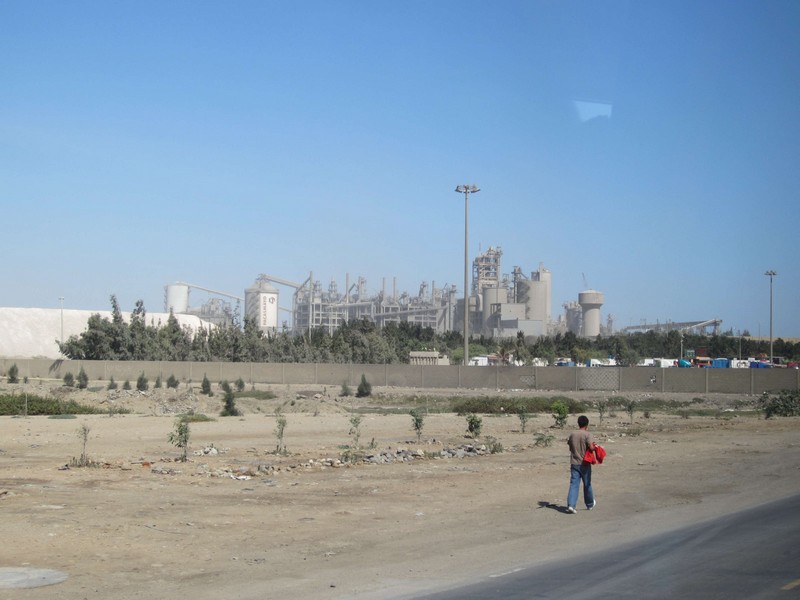
There was also a rather un-picturesque cement factory, but they’re seldom works of art, are they ?
We arrived in Trujillo wondering what we would find. The guidebook we’re following didn’t rate the town, but we found a hostal near the main square with a nice room on the top floor overlooking the central courtyard. This made a nice change from the last couple of grungy nights.
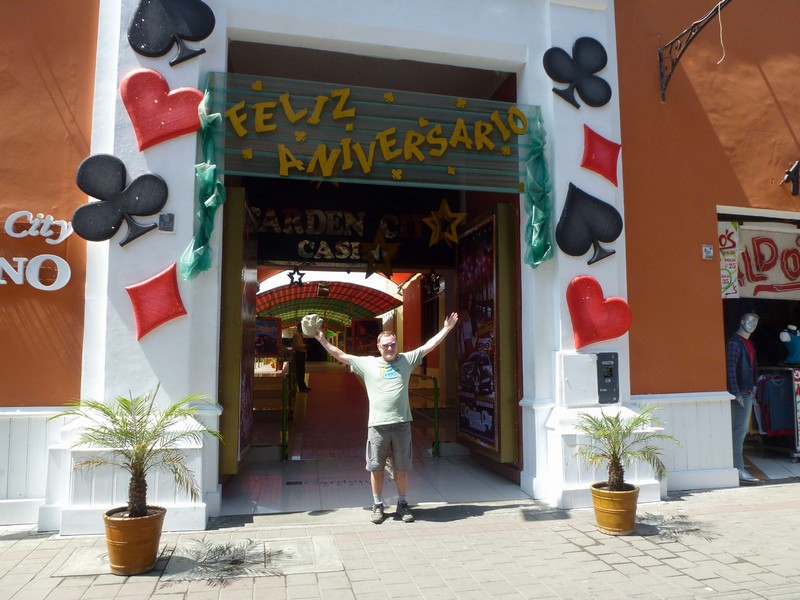
We wandered around and began to like the town, which immediately had a friendly feel. The temperature was warm and dry rather than humid, so we were happy. Somehow they even knew it was our anniversary! (Actually, this was just one of the many casinos in town, but we stuck to the traditional alcohol-based celebrations.)
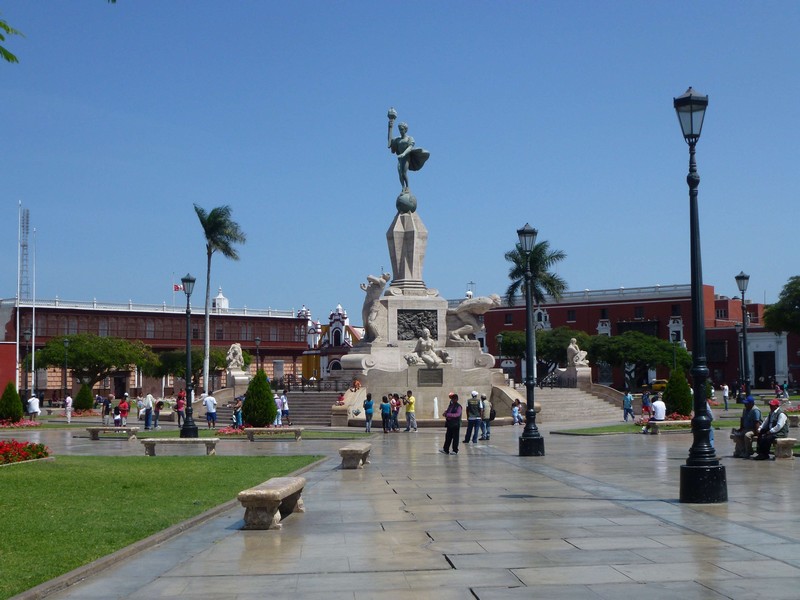
The main square was lively and surrounded by beautiful buildings.
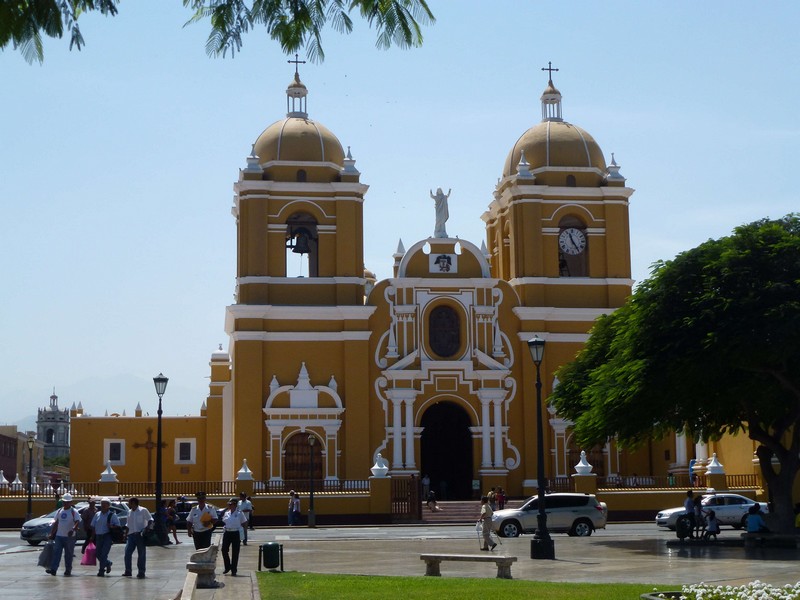
Our hostal was also a tour agency, so decisions were easy to make and we went on three excursions to a number of nearby pre-Incan sites, all of which are old but only relatively recently discovered. Chan Chan, the ancient capital of the Chimu people, the Huacas del Sol and Luna (pyramids of the Sun and Moon), built by the Moche people, and El Brujo, where a mummy of a queen of the Moche was discovered recently, buried with many gold artifacts. The majority of other tourists were Spanish-speaking, so our limited language skills were tested a little. Mostly the locations involved minor conservation of the adobe brick structures, hence the photos here aren’t very colourful! Here is a selection of the archaeology just to give you an idea. The museums were also exceptionally interesting and the ceramics superb. What a treat to visit sites with so few people around and at the infancy of their conservation. Here are just a few snaps.
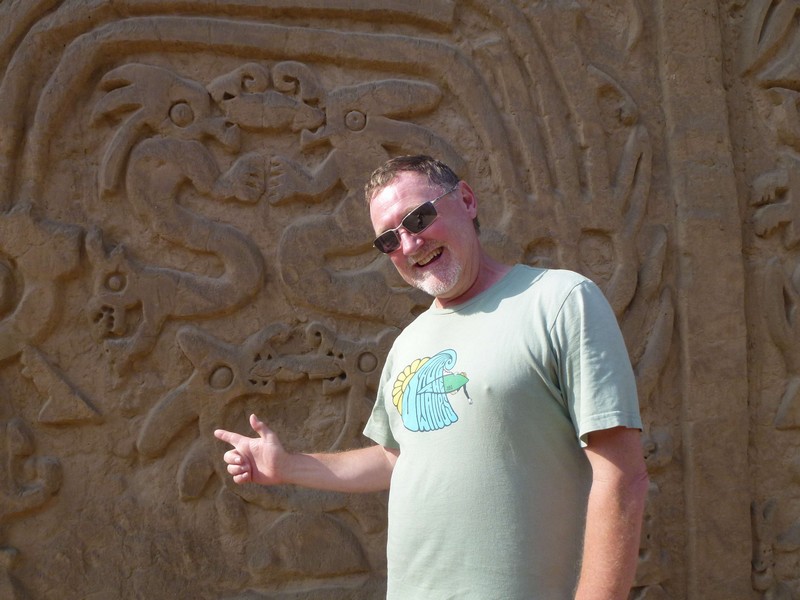
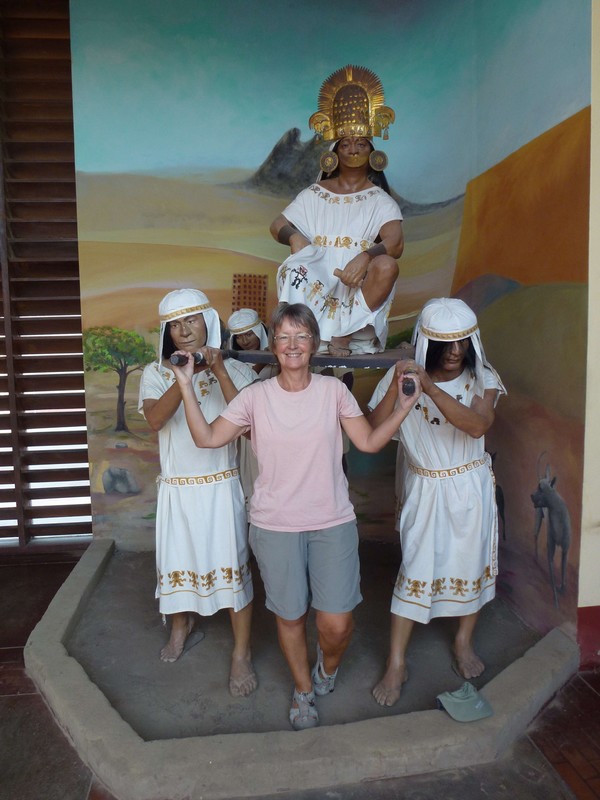
Diane hams it up with a museum display. They used a lot of nose ear-rings, as our guide called them, which dangled down in front of their mouths.
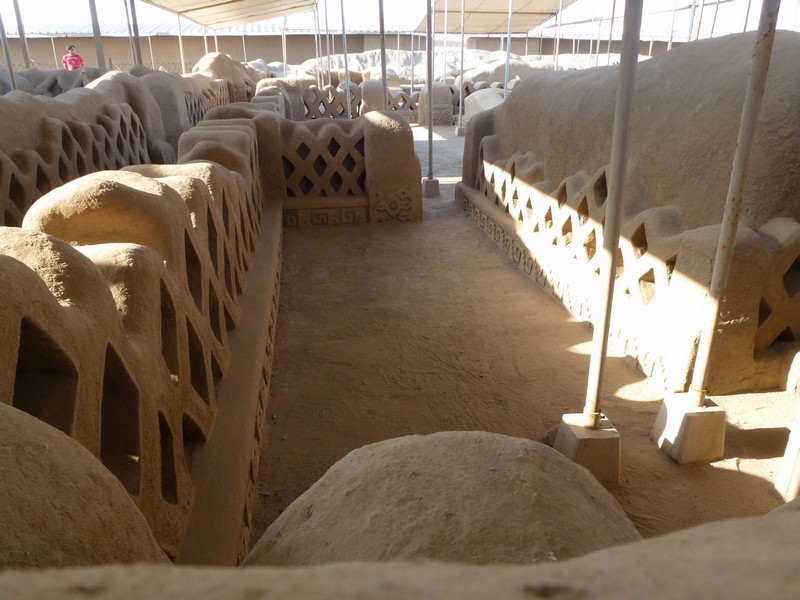
These are store rooms for offerings to the temple: the criss-cross design represents fishing nets, and also allows air flow into the rooms.
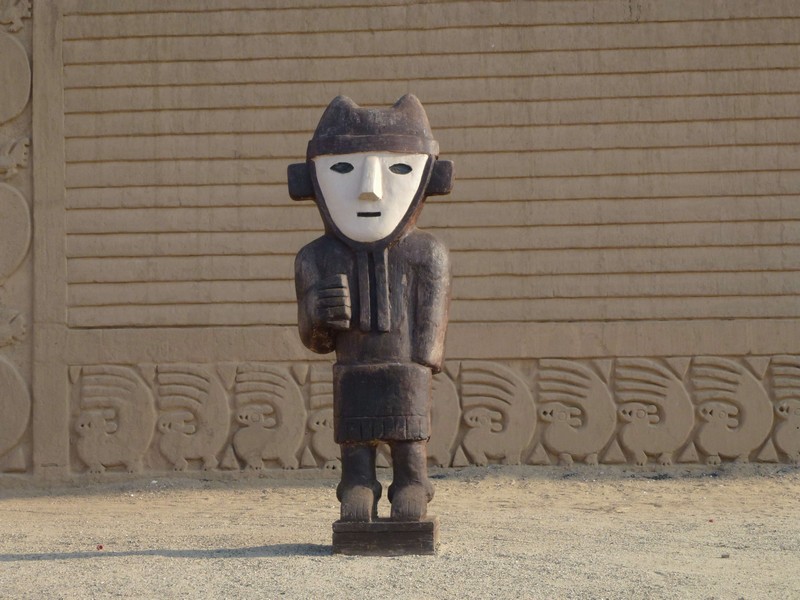
Anyone remember the Homepride men (Graded Grains Make Finer Flour) ? You have to be a certain age, I guess. This is one of two guarding part of the main plaza in the old city of the Moche and is about six feet high.
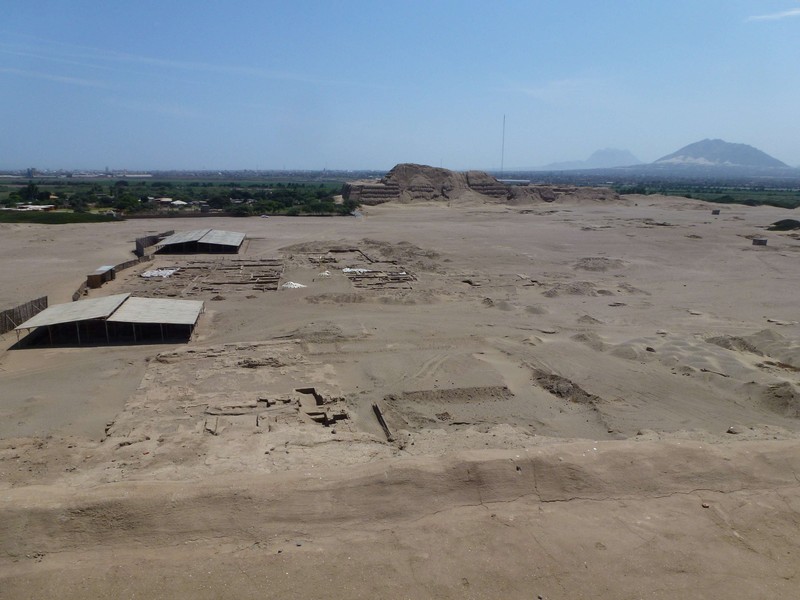
Here’s a view from the top of a huaca, looking towards modern Trujillo, which has pretty much overrun the site. As you walk around, there’s a lovely smell from the massive chicken farm next door.
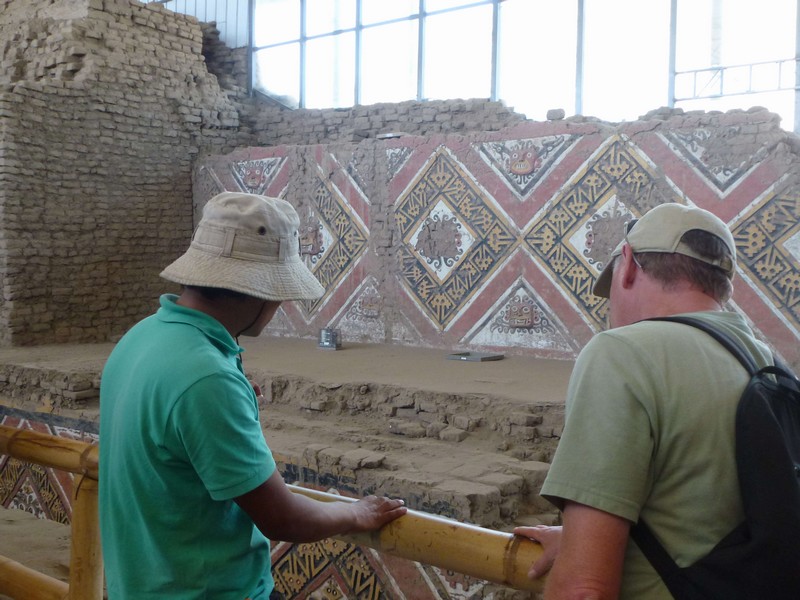
Paul and the guide look at the decorations on the walls of the huaca.
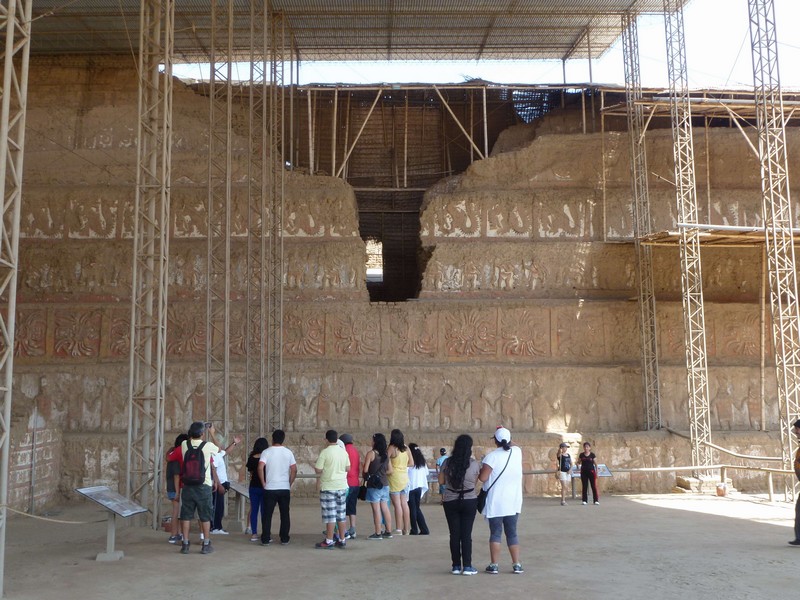
Here’s the facade of the huaca showing the six levels, each covering the one before, so the huaca grew and grew.
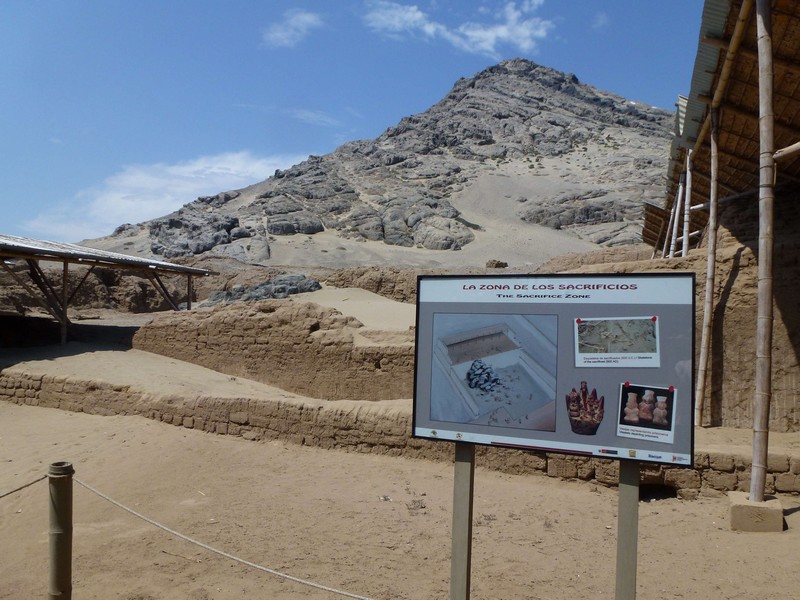
They were big on human sacrifices here, to ensure fertility of the fields.
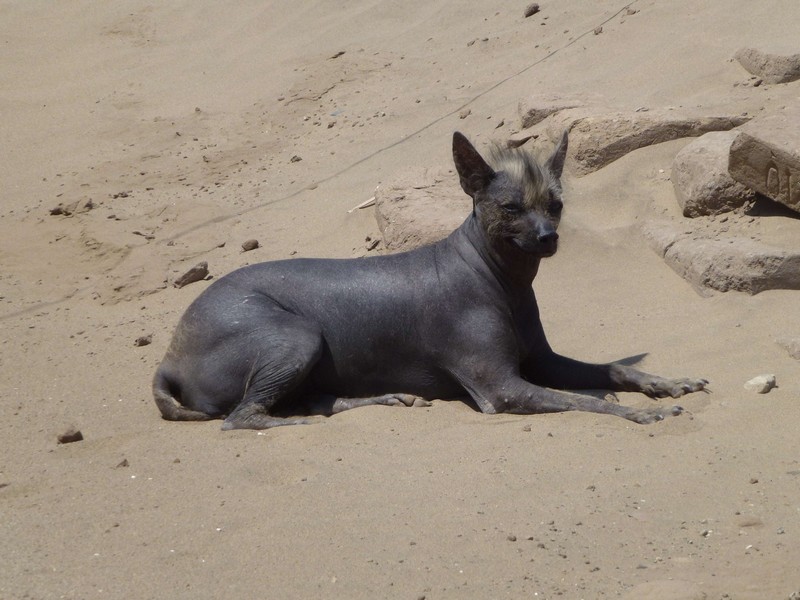
Another interesting sight is the Peruvian hairless dog, which accordingly to the guidebook was traditionally used as a body warmer by people with arthritis, though think I might prefer a hot water bottle myself: they don’t bark ! We saw a few, but this was the cutest with a quiff of hair on his head.
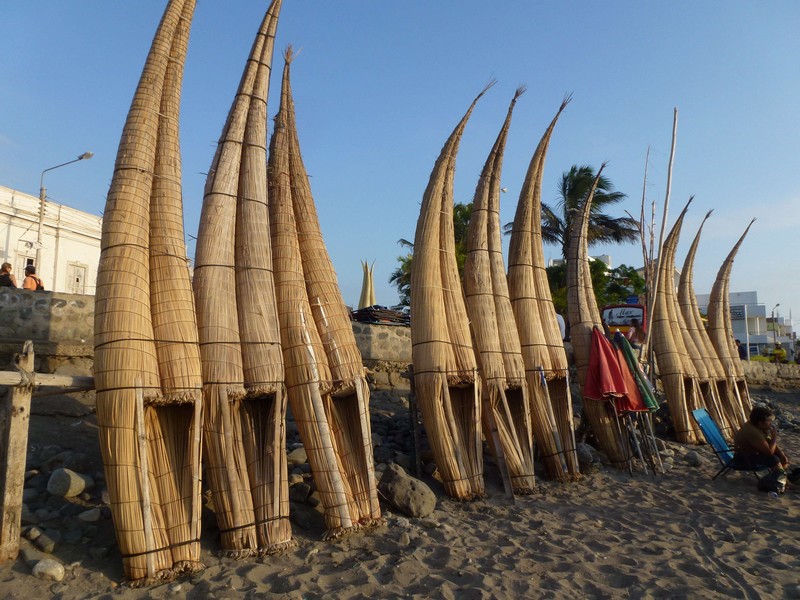
We went to the beach at Huanchaco about 8 miles south of the city, formerly a little fishing village and now popular with surfers. Over the last year or so we’ve travelled down an awful lot of the Pacific coast, and seen many surf towns, in the US and further south, and they are all strangely similar. These places start out as little fishing villages reflecting their local customs, but after the surfers have arrived, they tend to the same look: beach-front bars with sunset happy hours, often called things like “The Surf Shack” or “Sunset Bar”, hostels offering surf lessons, and restaurants selling pizza and burgers. I guess that’s what surfers want. The local fishermen here, though, still use traditional boats, called totoras, made from reeds.
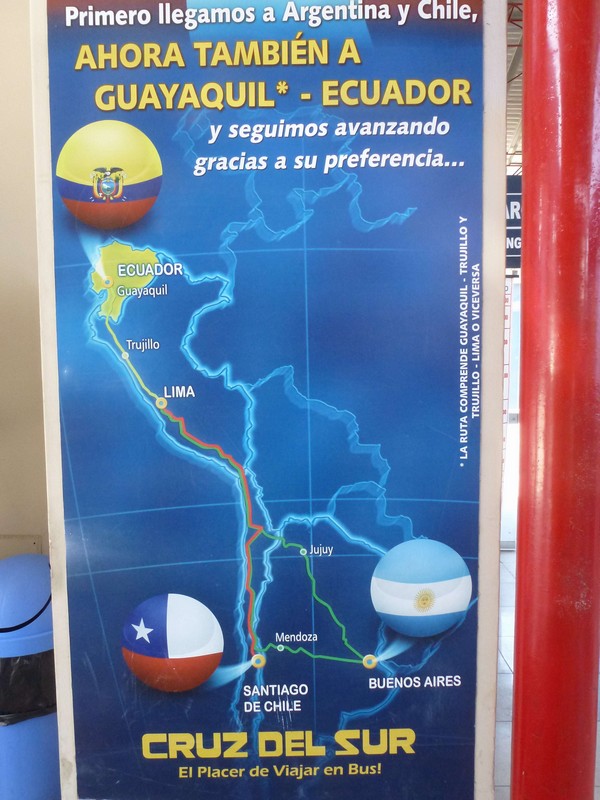
We stayed here longer than anticipated: we liked Trujillo. Next stop Lima on the overnight bus. If you want you can also take it all the way to Buenos Aires or Santiago de Chile in one hit! Our trip to Lima is only nine hours: BA is over 3 days away. As for us, we’re still enjoying a slower itinerary: Six months so far, Mexico to northern Peru – will we make it all the way to Rio in only another 5 months or so ?
“El Placer de Viajar en Bus”, by the way, means “The pleasure of travelling by bus”. Hmm. Ask us in another six months.
Yes readers, we’re still in Ecuador and loving it ! On our trip so far, this is the longest we’ll have spent in one country: 46 days. We left Banos on an early morning bus bound for Riobamba, where we were told it was an easy change of bus towards Cuenca, our destination. Unfortunately the conductor was really confused, and tried to persuade us to get off the bus on the outskirts of town. A number of friendly Ecuadorian travellers, and indeed the driver, suggested this was a bad move, so we all climbed back on. We arrived at the bus terminal and were straightaway shuffled onto another bus bound for Cuenca – yes, it was easy after all (and as usual very cheap). The only problem with these long distance journeys is getting food (or food as we know it). Of course, numerous vendors always come onto the bus: you can buy ice cream (Ecuadorians love their ice cream), sugary drinks, crisps, jewellery, newspapers and even CDs. This time we cracked and bought crisps, the only food we ate all day ! Still, the scenery was exceptionally good as our journey continued through the Andes. People-watching here is fascinating, also. There were lots of local indigenous families travelling in between the mountain villages: interesting clothes, hats, babies in shawls, all juggling said unhealthy food items whilst crammed into a bus containing about 20 more passengers than was feasible.
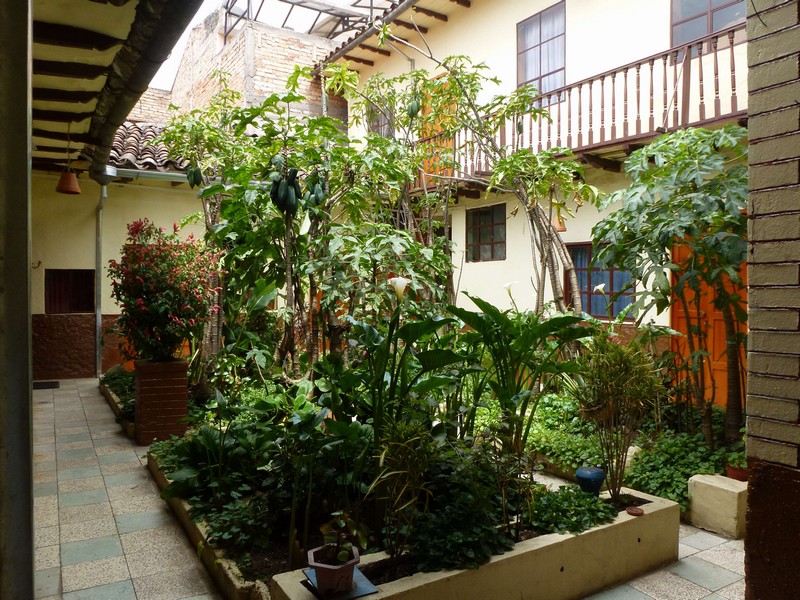
As we neared Cuenca it started to rain, then it turned to hail and the grass verges turned white ! Luckily by the time we got off the bus it had stopped – April showers and all that. Cuenca is a beautiful colonial city at about 2500m. We are currently in the rainy season and for what it’s worth it’s winter, although when the sun shines you wouldn’t know it as it’s pretty hot. We found our hostel easily and again it’s in a refurbished old colonial building with central garden and huge hummingbirds drinking from the flowers. Oh, and it’s oh so quiet at night, we’re happy bunnies.
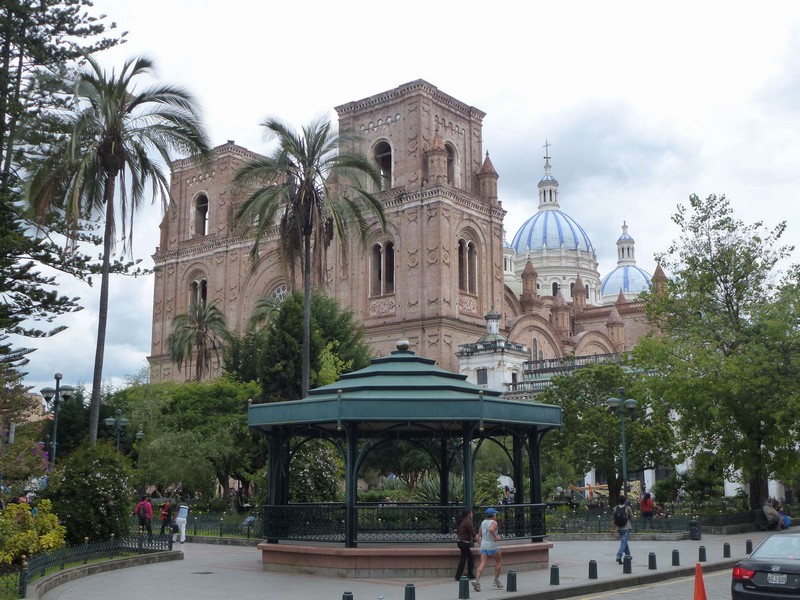
The next morning we wandered around town, found the beautiful main square (Parque Calderon), had breakfast and visited a Spanish School nearby. We had decided to take some more lessons, although didn’t fancy the standard group deal from 8-12 every morning. The school seemed pretty flexible, as it’s low season here, and we signed up for three hours in the mornings, concentrating on conversation. Here’s a photo of the bandstand in the main square near the school. Occasionally there are bands playing music here, but more usually it’s the preferred spot for break dancing practice!
The Spanish lessons went quite well, although they’re hard work, and we had the afternoons free to look around the city. We took a tour bus to get an idea of the layout and some of the buildings were even more beautiful viewed from the top deck.
We reached a beautiful viewpoint, Mirador de Turi, a couple of miles south of the centre (and luckily it wasn’t raining!).
It was the week after the 455th anniversary of Cuenca’s foundation and luckily for us there were several events. We went to three free music concerts and a ‘Mother Earth’ festival celebrating healthy living, but we still managed to lunch on salchipapa, basically sausage and chips :’) There were several native folk dances, buskers, and various stalls (but not many tourists).
Here’s Diane discussing the merits of eating guinea pig with a young student (however it’s unlikely she was negotiating to buy two).
We had heard previously that Panama hats are made in Ecuador – Cuenca seems to be the epicentre of production. As well as making new hats, which can cost $100 or so, local tradesmen refurbish them: it’s big business. We even went to the Panama Hat museum and were shown how the top of the hat is moulded.
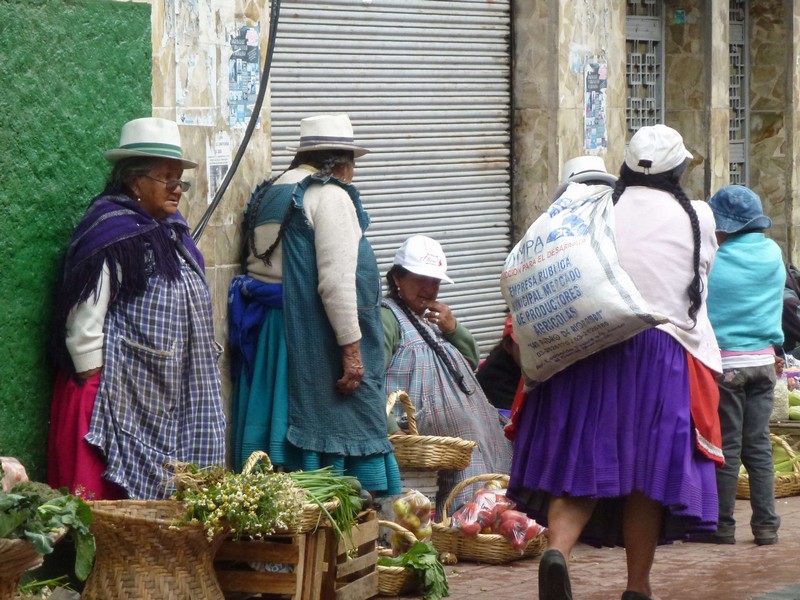
As usual, the area around the city’s market is fascinating. Here are some of the local fruit and vegetable vendors in their traditional dress.
Another interesting conundrum for us was to work out what this confection consisted of. They’re ice cream cones, but it would have melted too quickly, so it couldn’t be ice cream. Diane had to give up and ask her Spanish teacher – it is meringue, and both adults and children can be seen enjoying them in the parks and outside churches.
The street art is fascinating too.
Cuenca is a good place, if perhaps just a little too touristy for our taste, although there is a nice microbrewery J We’re heading to Loja, a few hours south of here, and then we’ll pick up a bus for the trip to Peru. And we’ll soon be celebrating six months of our trip !
|
|




























Recent Comments