|
|
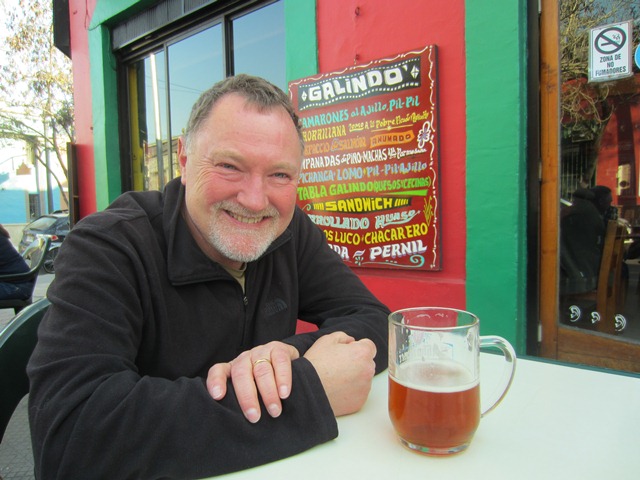
We have a slightly dodgy couple of hours getting from La Paloma, Uruguay, to a petrol station on a major road 15 miles away to pick up our overnight bus at 11pm, heading for Brazil. It involves a taxi, a local bus, and then another taxi to Km 207, where the bus is inevitably late. The local bus passed within 400m of this point, but despite half the passengers of the aforementioned bus arguing on our behalf the conductor wouldn’t stop and let us off. Hey ho. At 8am the following morning, we arrive in Porto Alegre, a large city, and pass a couple days recovering from the journey. There’s not much to do here, but we take a turn round town on the tourist bus and eat in the central market. Oh and yes, we find out that Portuguese is impossibly difficult to understand and no-one around here speaks any English or Spanish. Then it’s off to Florianopolis, further up the coast, a more touristy town, although it’s still early season here, so there aren’t many people around. Here’s a couple of shots of us in Floripa, enjoying the coast and enjoying the beer, which they serve in little insulated jackets to stop it warming up in ten seconds. It’s really warm here.
 
We travel by overnight bus to Foz do Iguacu, a small town on the border of Brazil, Argentina and Paraguay. We’ve got four days here, so on the first day we decide to go to the point where the three countries meet, a well-known tourist attraction, and a simple ride on the local bus. Too complicated for us, though, as we get on the wrong one, travelling in completely the wrong direction. We end up, bizarre though it sounds, at a Buddhist temple, where a large statue of a laughing Buddha gazes across the river at Paraguay. I’m laughing too, doubtless at the serendipity which led us here. He’s probably laughing at us for getting on the wrong bus.
It’s a nice quiet place with many other statues.
The Iguacu falls divide Brazil and Argentina, so we decide to see them from both sides, even if it means another trip back into Argentina. First the Brazilian side, a simple trip on a local bus (and we get it right this time). They are marvellous, stretching for a kilometer or more. Here we are enjoying the views before we walk out on the walkway to get a close up view and get pretty wet.
The next day we take a trip to the Argentinian side, which involves a minivan transfer, a simple border crossing and yet more Argentinian passport stamps. The area of national park here is much bigger and it’s easy to spend the whole day here. We begin with a walk along a metal walkway almost 2km long – it’s hard to picture the scale and force of the water in the following photos, where the separate waterfalls coincide to create a jawdropping sight.
The little blobs in the bottom half of this photo are swifts which are nesting in the cliffs above the falls.
We’re tempted with a boat ride to view the falls close up. You know how Captain Paul loves boats and water.
Yup, it’s touristy but good fun – and we get wet, very very wet from head to toe!
So, once drowned you might as well go down the trail again and get even wetter.
The wildlife alongside the trails is pretty tame. The butterflies insist on landing on you, and are very photogenic.
These guys were basking in the sun.
The coatis are everywhere, even rifling the bins.
All in all a grand couple of days out, in our opinion a true wonder of the world.
We have half a day to use up before our last (yes, the very last) overnight bus of the trip. We take a local bus ride to the Itaipu Dam, the world’s second largest. We take their short tour, but nothing to write home about and the photos are of huge grey concrete structures, not very inspiring. We’re happy to board the bus early evening headed for Sao Paulo and then on to Parati – if all goes well we will arrive a mere 24 hours later! On the plus side it saves money on a hotel room for the night :’)
The check in for our boat journey from Buenos Aires is more like an airline operation and the journey is only three hours. We arrive in the huge port of Montevideo in the early evening. After a wander round the nearby streets Paul finds an office to change our remaining Argentinian pesos for Uruguayan, and this time we lost on the deal due to the poor state of the Argentinian currency. The city has a good feel early evening and our hotel is very close to the centre of town. This is Plaza Independencia, our main walking route to the bars, restaurants and old town sights.
We walk to the market near the port, which is stuffed full of parillas (steak houses), and start to feel very hungry.
We recognise very little of the Spanish language on the menus but each finally decide on a chivito, which is basically a huge steak sandwich with roasted vegetables and slathered with cheese and bacon, yum! Oh, yes and some healthy greens down the bottom somewhere. Still, at least we didn’t have chips with it (this time, anyway).
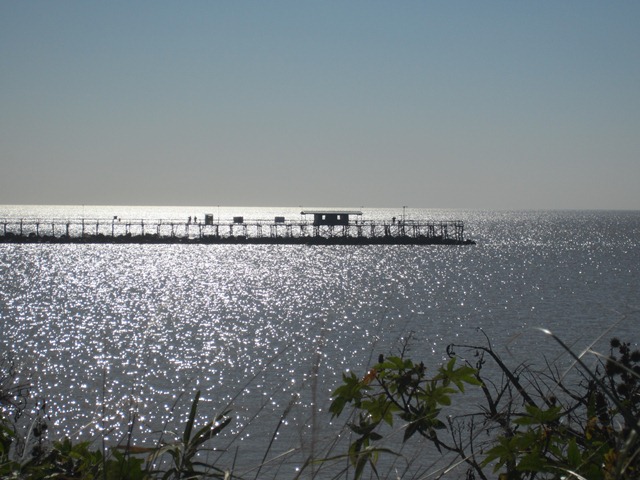
We’re close to the Atlantic, but not quite there yet, officially still in the estuary of the Rio Plata. Still, Montevideo does have some nice beaches, the weather is warm and sunny and we walk a few kilometres along the beautiful Rambla, the promenade, which runs around a lot of the city.
And Diane can’t resist a paddle, as ever.
After a couple of days, we bus it about four hours up the east coast to the seaside town of La Paloma. According to the Lonely Planet it’s a surfer’s dream, but we have no inclination to venture into the cold Atlantic Ocean in winter. We had been warned that the place will be quiet out of season and book into a really nice hotel (for a change), only a few steps from the sea and the one tourist attraction in town – a working lighthouse.
We’re lucky that the weather is warm and sunny, though a tad windy, and we spend two days walking on the empty beaches, watching the birds and marine life. We see a Southern Right whale, a basking shark, seals, a Magellanic penguin (dead unfortunately and a little way off course) and other unidentifiable swimming mammals. Where is everyone? This is heaven.
Here’s Paul, sitting in the lifeguard hut out of the wind and very happy as he has a map.
Finally, we find out that this chattery and distinctive wading bird is the Southern Lapwing and that the Uruguayan national rugby team has made it their mascot. Although they are wading birds, they lay their eggs on the ground – in this case right on the main path – just as well there are hardly any people around.
We are sorry to leave this sleepy place, but it’s time for another bus – to our final country, and number 15 of the trip. Brazil here we come, hope it’s just a teeny bit warmer.
Apartment life is relaxing after our ten months on the road, and the big city continues to entertain us. We find a friendly bar round the corner, although we are missing good British real ale, and several supermarkets within five minutes walk, so we eat in a lot: eating out every single night gets a bit boring after about six months, so we’re ripe for some home cooking. The people living here are called ‘Portenos’ (because BA is a port city), and are friendly, busy people. They love drinking coffee and chatting, and so do we, so we know we’re going to like it here. We spend a lot of time walking around town, as the subway workers go on strike, asking for a 28% wage rise ! The strike finally ends ten days later when the union negotiators agree to a 23% rise but they’re still arguing about holiday and other benefits. We don’t worry much when the newpaper distributors and the teachers go on strike as well, but this probably gives you an inkling into the financial situation here: galloping inflation is doing everyone in. The weather turns rainy so we take advantage of our gym membership: we both attend the Iyengar yoga class and Diane loves the Latin Aerobics, both of which help us learn a whole new set of Spanish vocabulary, mostly about parts of the body. We eat a lot of fabulous Argentinian steak and drink a lot of fabulous Argentinian wine. The Olympic Games close and everyone in our gym is impressed with the organisation and coverage – well done, London !
It rains as well, it has to be said, as it’s winter here. After one particularly heavy downpour, our city map disinitegrates. Paul is happy when we find a tourist information kiosk which is both open and has a map. In the tourist poster is an arty flower structure in one of our local parks which automatically opens at sunrise and closes at sunset, though we’re never there when it’s doing anything, so we can’t confirm it.
One of the nearby shopping malls is Galerias Pacifica and is mentioned in all the guidebooks. It is full of upmarket shops and has beautiful ceiling paintings dating back to the ’50s renovated recently. Buenos Aires is a pretty dressy city, and we’re as scruffy as ten months on the road will make you J We know we really ought to buy some new clothes, but this place isn’t quite within our budget.
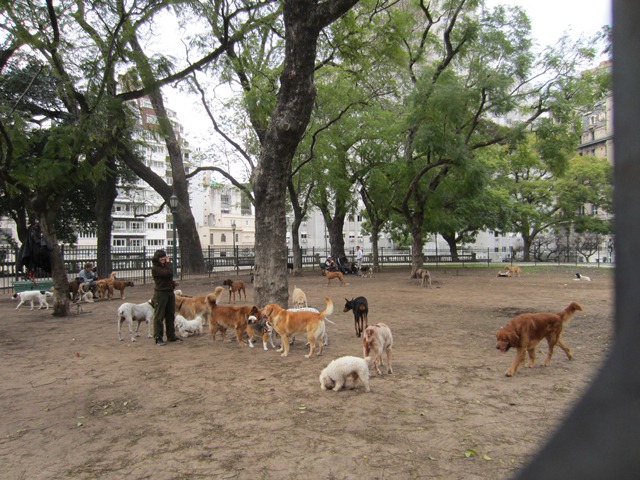
Dog owners in BA seem to have no problem with paying someone to walk their dogs. It’s common to see a walker with twelve pooches or more all walking quite politely together. If you’re really experienced you can obviously walk a bicycle too.
Now, what happens when all these dogs are caught short in the parks you may wonder? No problem, the park authorities provide special areas where the dogwalkers can get together to chat and the dogs can water the trees and run around, only noteworthy because at home we would expect a fenced in area to provide completely the opposite function.
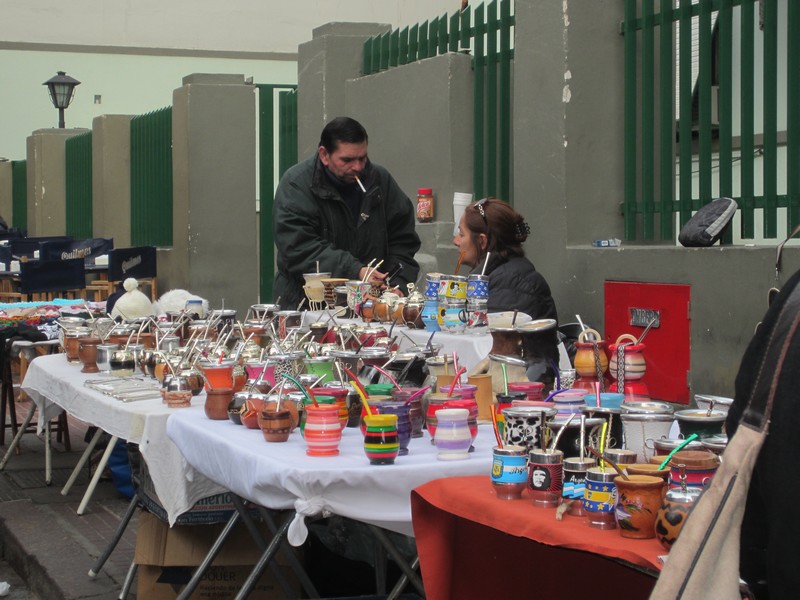
We visit the local flea market on a Sunday afternoon. The locals here drink yerba mate, apparently the dried chopped leaf of the common holly tree, contained in a gourd and sipped from a straw with a filter. It’s common to see people carrying them around, sharing with family and friends. Here’s one of many stalls selling the gourds – needless to say, we resist a purchase. Diane tasted mate a while ago and thinks it’s a smoky yucky liquid, nothing like good old British tea which we’re longing for.
You won’t be surprised to know that the Palacio del Congreso was modelled on the Capitol building in Washington DC, although the main garden area is fenced off and now the only visitors are pigeons and feral cats.
We pick a nice weather day to visit Tigre, a few miles north of Buenos Aires, and go on the train, which costs only 30 pence per person – bargain of the week although we remember that we had to defer the visit because of a train crash last week! Anyway, Tigre town is surrounded by streams and rivers and we take a touristy boat trip which passes more rowing clubs than we have ever seen in one place. They are everywhere, often in really grand old buildings like this one.
Here’s the beautiful Art Museum at the end of town, but the weather is so nice we stay outside in the warm sun.
Except of course when we find the Naval Museum. Paul is in seventh heaven and stays a tad longer than expected ! They have some really fine torpedos, an exhibition about the Belgrano (yes, the one that went down in the Falklands conflict), and much else besides.
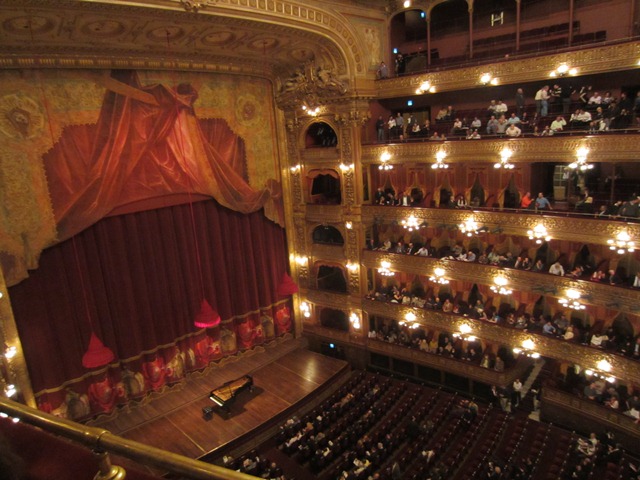
The Teatro Colon is in the centre of Buenos Aires, and was opened in the 1850s: it has recently been renovated at vast cost over four years. It’s a great building, although it fronts one of the main roads through the centre of BA, so it’s a bit noisy, and it’s hard to take a photograph without five taxis and a mad motorbiker in it. But here’s one.
The tour around the Teatro Colon is pretty pricey, so we book tickets to see pianist Andras Schiff instead. Although we don’t pay for a seat in one of the royal boxes (not wishing to pay a King’s ransom), we do have a fabuous view of the stage and the opulent surroundings. He plays well, and does four encores, so we have a fine time.
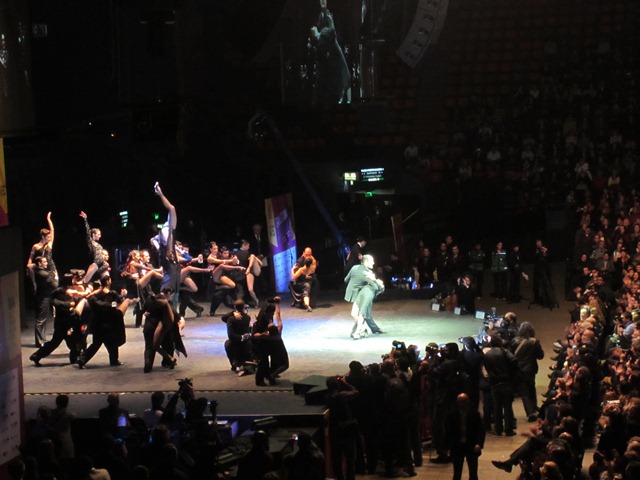
Little did we know when we arrived that we’re here during the Buneos Aires Tango Festival and Mundial, a yearly celebration of tango, together with a dancing competition to find the world champions. The central exhibition hall, where a lot of it happens, is only a few minutes walk from our apartment so we visit, listen to tango music, and watch both professionals and more ordinary people practising their dance steps. After queueing for two hours on a cool morning we get free tickets for the finals of the competition at at the town’s biggest concert venue, Luna Park. Tango is completely new to us, but we enjoy watching two different forms: Salon and Stage. Salon Tango is interesting but it is the Stage event that interests us more and seems to consist of aerobatics, amazing dresses and a lot of pouting. How the women can dance in four inch high heels continues to amaze us. The mostly Argentinian crowd are really into it all, and get pretty excited when their local heroes are dancing. The winners of the Stage tango competition are Uruguayan, as it happens, just over the Rio Plata, and our next port of call.
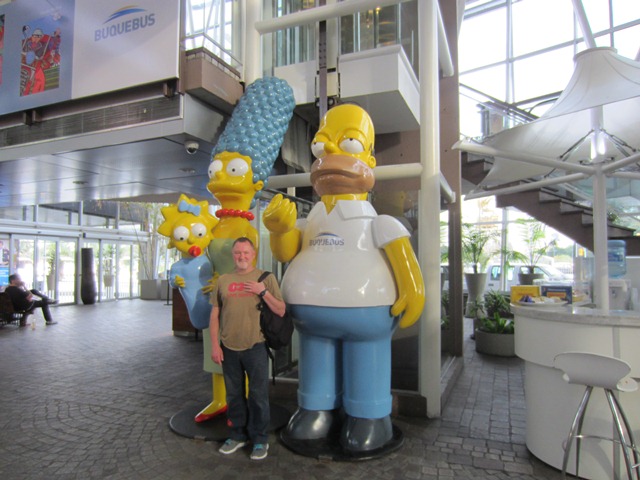
Our relaxing month soon comes to an end, and we book tickets for the boat ride to Montevideo, Uruguay. For some reason, the ferry company have massive statues of Los Simpson (as they are known here, and before you ask, no, not Los Simpsons) in the main hall.
So, here we come Uruguay, country number 14 of the trip. Only a month till we return to the UK, unfortunately J
We arrive in Buenos Aires, on the day bus from Cordoba, into the massive Retiro bus station. We’re booked into a small aparthotel in a residential area close to Palermo and many elegant statues, buildings and parks. The city has a good feel, perhaps more cosmopolitan and pseudo-European than anywhere else we’ve been on this trip. We stay here for a few days whilst negotiating how to pay rent for a private apartment. The cost of living here is higher by a significant amount than other countries we have visited on this trip, perhaps even Chile, so renting privately seems a good idea. But as we now learn, the bank rate and the ‘going’ (blue) rate for the Argentinian peso are different and cause us a lot of confusion. Eventually we sort out the currency issues and start enjoying our time here. We watch the opening ceremony of the Olympics on the TV, finding it visually impressive and we’re pleased that our favourite Bradley Wiggins is included ! Maybe we found it more interesting without the media hype in English (our Spanish still isn’t too good).
We enjoy walking round the local area, visit many amazing old fashioned cafes and marvel at some of the street art.
We find some beautiful areas for walks: here’s a local nature reserve called Costanera Sur. It looks like the sea but its really the huge estuary of the Rio Plata. We’ve decided that we are turning into unfit, lardy whales so we resolve to take more exercise and start by jogging here, distracted from the initial pain by the beautiful views, the parakeets flying overhead and guinea pigs snuffling around in the undergrowth.
Walking round town we’re reminded of current events – surprise, surprise they seem to want the Brits out of the Falklands. We decide to keep a low profile on the topic.
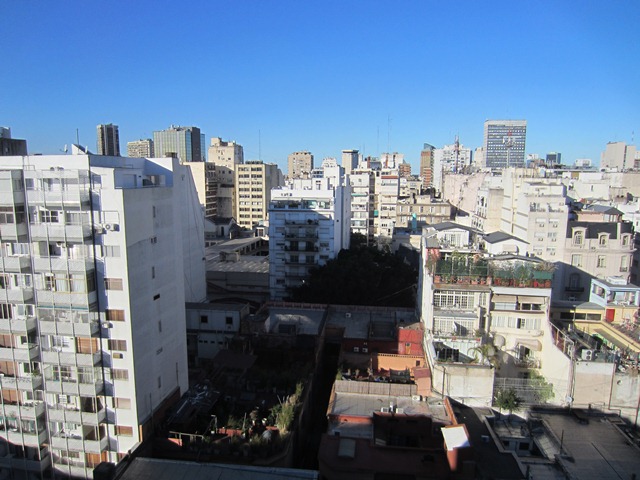
After a few days we move into our rented apartment. It’s on the 13th floor of a high rise building, this time nearer the city centre and in a posh area called Recoleta. Here’s the view from our bedroom window and a photo of us in the extemely small lift, which for our liking has far too many mirrors !
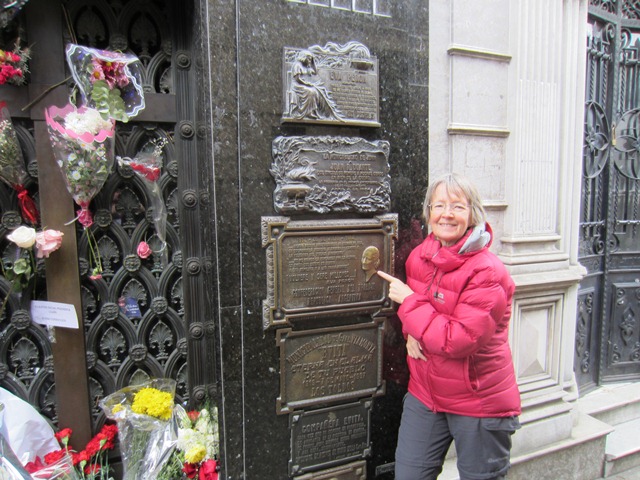
We visit Recoleta cemetery, which is only around the corner from our new ‘home’ and the guidebook says it’s one of BA’s prime tourist attractions, so how can we refuse? It’s a cool and cloudy day and we have the place almost to ourselves. The ornate tombs are laid out almost like streets, and the inhabitants are famous citizens, business people, politicians and presidents. It’s enormous and at the entrance you’re encouraged to study the map to ensure you can find your way out.
Paul has to go back to the entrance to look at the map again, but eventually we find the tomb of Eva Peron (under the family name Duarte).
We settle down to city life quite happily, and enjoy spending time mooching around our new neighbourhood. Its quite posh, and as it’s winter here there are lots of women wearing fur coats! We find a local cinema and watch the new Batman movie (in English) and a nearby concert hall which hosts lunchtime free concerts for young stars. We enjoy an unusual piano concert for eight hands, two players at each piano, and later, a full orchestral concert. The weather turns mild and rather rainy, so we decide to join the nearby gym. Going in the morning we’re often the youngest clientele, but the equipment is good and they run a variety of classes including yoga. Our bodies are soon reminding us we’ve done little for the last few months other than sit on buses for hours at a time. Watching others is easier on our bodies and they tango all the time here!
So, a couple of weeks has passed in no time and we are here for another three – good times yet to come, watch this space !
We are planning on spending some time in Buenos Aires, but first we have to get there, and it’s on the other side of the continent. We could do it all in one very long, journey, but we decide to split it up and stop in Cordoba, Argentina, for a couple days. So it’s 23 hours from Valpo to Cordoba, and then 10 hours from there to BA. The trip to Cordoba is in two halves, on different bus lines: the first takes us all day, and we arrive in Mendoza, Argentina, late afternoon. We change our Chilean pesos for Argentinian pesos and make a small profit, weird we think but at this point we don’t realise fully the state of Argentinian finances. A beer and a couple of hours later we set off on an overnight bus ride to Cordoba. Of course, because the locals like to eat and party late, they show a late film (the rather strange Hereafter) which doesn’t finish till 2am, but who needs sleep ? About the only thing we knew about Cordoba is that a number of people disappeared there during the military dictatorship in the late 70s and early 80s. A couple of months ago, I took a cycling trip down the Most Dangerous Road In The World, near La Paz, (it’s not that dangerous) and also on the trip was a Scandinavian human rights lawyer, who had been working in Cordoba for some months on matters arising from this. Aside from this memorial and museum, you wouldn’t know. The lines here are the names of those who disappeared or died.
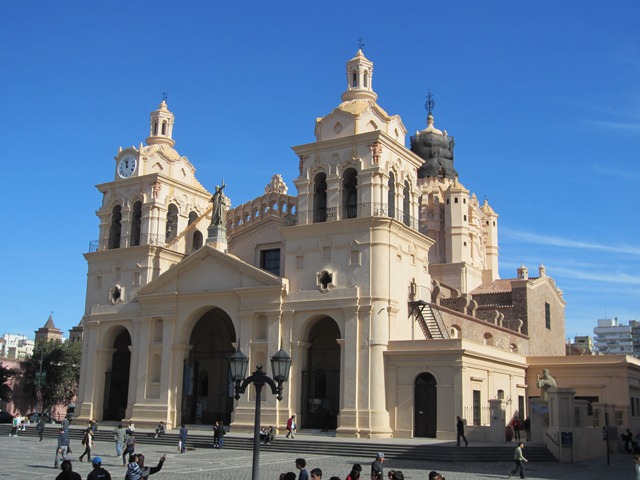
Nearby there’s a beautiful cathedral. We’ve seen a few good ones on our trip, but here the inside and the ceiling paintings are pretty impressive.
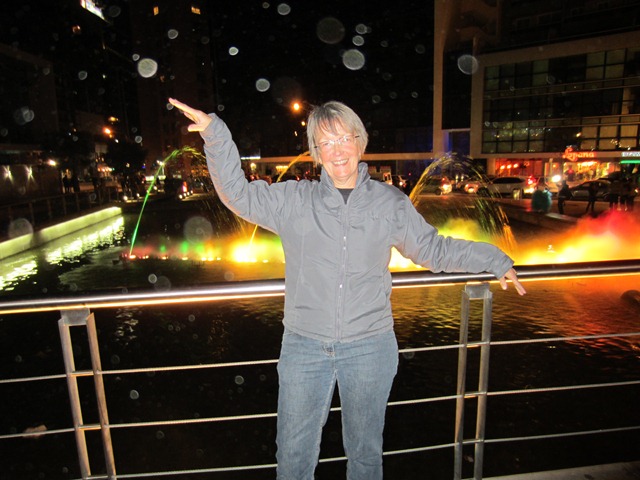
One evening we go to see the local free show: water and lights choreographed to music. Much more interesting are the antics of local young women, dressed to impress for professional photoshoots. Diane tries to imitate but is lacking both the evening dress and style !
Also while we are there Bradley Wiggins wins the Tour de France !! We watch the last stage around the Champs Elysee in a bar, as the TV in our apartment doesn’t work. Nobody else in the entire town, and possibly the country, seems to care, but we do. Fantastic. Anyway, a couple of days later we’re off in the bus to Buenos Aires.
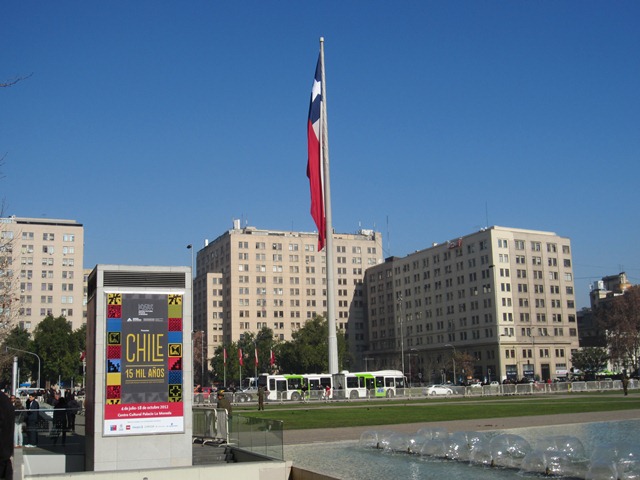
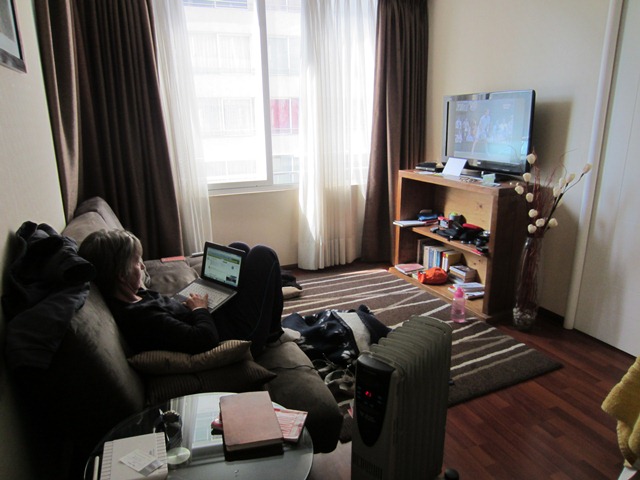
So, we’re over the Andes, and it’s winter, so Chile is pretty chilly. We’re also pretty knackered, so we decide to rent an apartment for a week and catch up on world events, principally Wimbledon and the Tour de France. Our apartment is in a high rise block (complete with outside swimming pool!) right in the centre of the city, next to the Palacio de la Moneda and a flagpole with a giant Chilean flag. Here’s the aforementioned flag, which must measure 100ft by 50ft, and also Diane watching Wimbledon in the mess we called our living room. We got up early-ish and watched the whole of the mens’ final. So near and yet, so far.
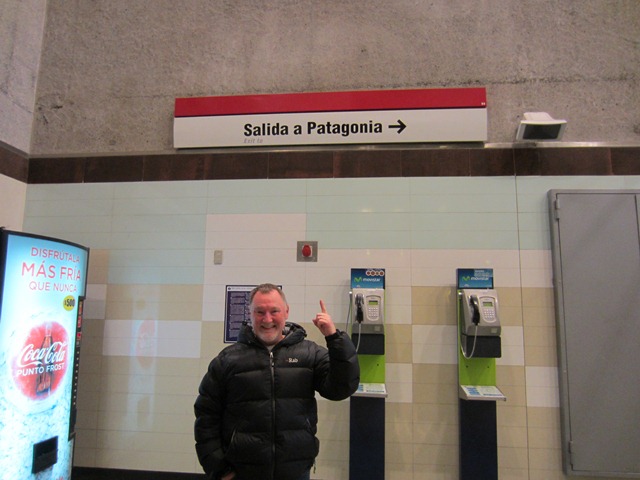
As we do every now and again, we decide to go to the cinema and watch El Sorprendente Hombre Arana, the latest Spiderman movie (in English). The cinema is in a mall some way away, complete with upmarket shops and a Starbucks, so we have to travel by the good, though overcrowded, metro system which apparently runs all the way to the south of the continent. Ha ha. We do enjoy the film, though: it was a bit lighter than the previous versions where he was always a bit whiny and depressed.
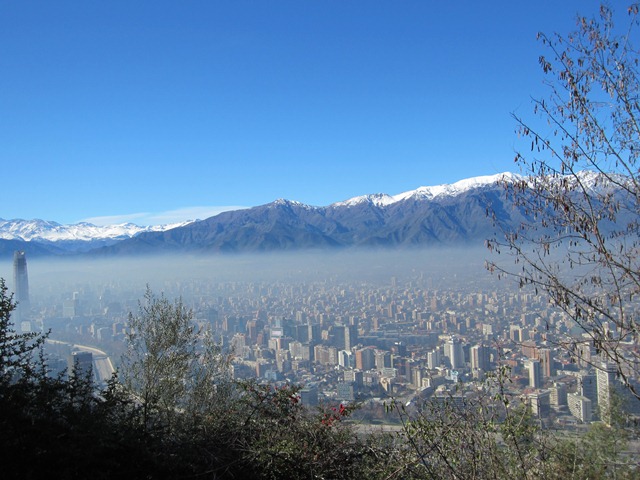
Another day we walk to the top of Cerro San Cristobal, and look down over Santiago. As you can see, it’s a tad polluted in the winter. If you look closely, very closely indeed, you should be able to see a ski resort on the snowy peaks in the distance on the left of the photograph. This is Valle Nevado: we considered going for a day’s skiing, but it would have cost us about 300 quid, so we didn’t.
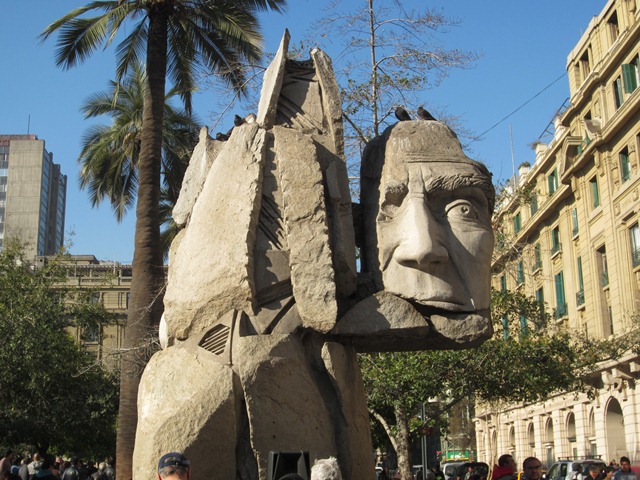
Like most South American cities, in the middle of the city is the Plaza de Armas. This unusual statue is there, along with lots of people playing chess, hanging round, preaching, selling postcards (and stamps in the same place, what heaven!), eating ice cream and generally doing their thing.
We visit the central market and discover the delights the empanada (like a small cornish pasty, but tending to squidge out down your clothes if you’re not careful) and the berlina (a doughy donut with custard). We also explore the rather touristy area called Bellavista, where we find a bar selling Kross beer, which is really rather nice, and benefits from not being lager.
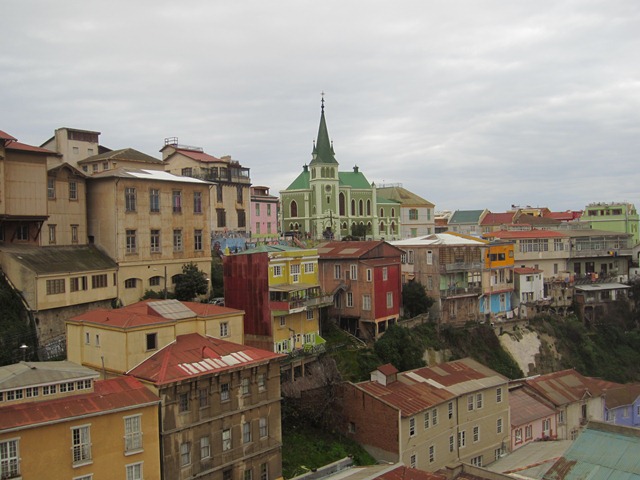
After a week or so, we head for the coast at Valparaiso to see the Pacific Ocean for the first time since Lima. Valparaiso gets mixed reviews: some people love it, some hate it. Our taxi driver when we arrived in Santiago described it as “feo”, ugly. It is, but it’s also a bit charming. The main problem, though, with Valpo, and especially where we are staying, is the dog, er, waste product, which comes from the stray dogs all over the place. Even the locals are hacked off about it: there were articles in the local paper (incidentally, the oldest newspaper in South America): nobody collects them up, and local people feed them, so the problem grows and grows. There are vast numbers now: on some days, there were 25 in the little square at the bottom of our road alone. This leads to a lot of, er, product. Every few feet on some streets. You really had to keep your eyes out. Anyway, enough of that, here’s a picture of a pretty bit.
We went to an old bar called La Playa a few times, interesting with lots of old film and music posters. It also stays open until 5am as Valpo is a pretty big party town.
Valpo is built on a series of hills called cerros. Cerro Concepcion and Cerro Alegre are jolly touristy, and expensive, but so is the whole of Valparaiso. This is a restaurant called Brighton, looking nice at night.
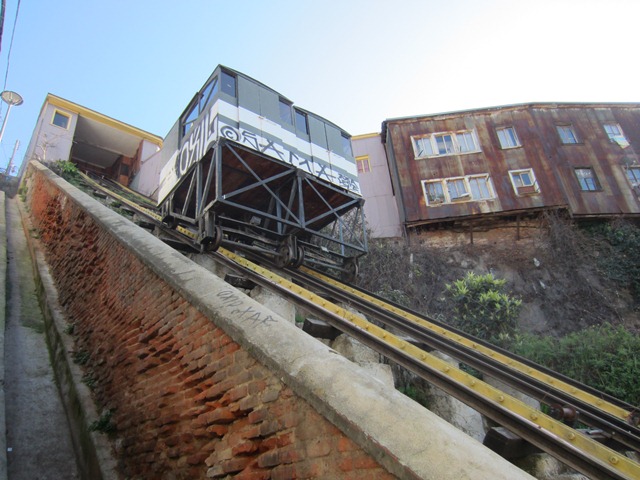
To save people the fag, there are cable cars up the cerros. All are marked on the tourist map but a lot of them aren’t working – somehow these are the ones we kept aiming for so we ended up walking everywhere.
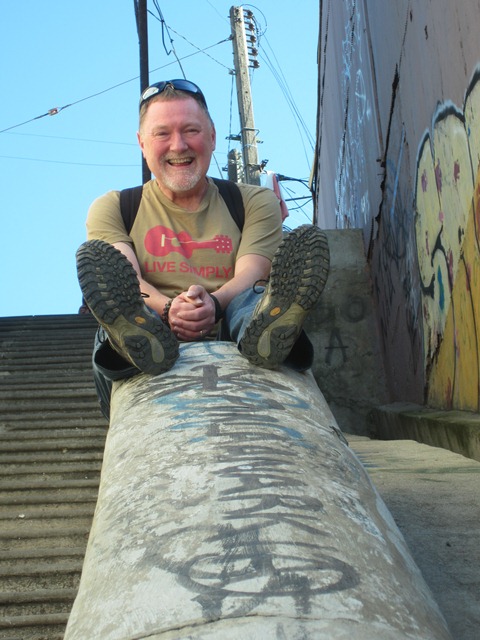
The steps next to it are pretty steep. Here’s me grinning inanely near the top and showing that I don’t have any products on my shoes today.
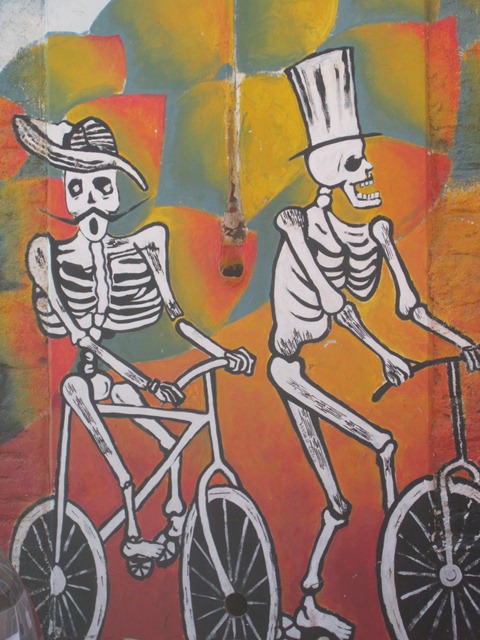
Valpo is very arty: there’s lots of street paintings and the like, and Pablo Neruda, Chile’s most famous poet, had a house here, and wrote a poem about the town.
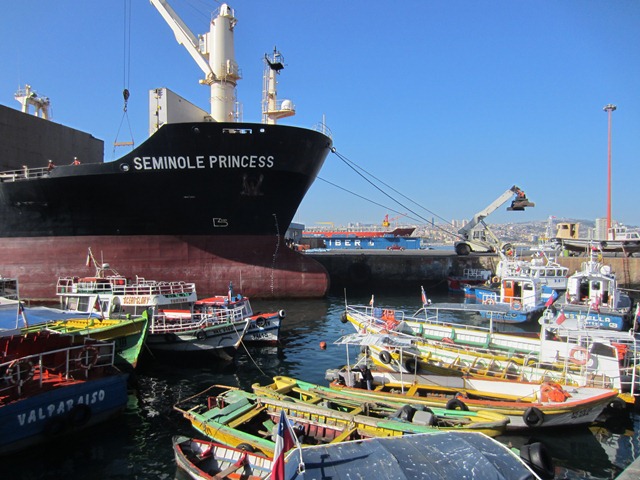
There’s also the Pacific ! It’s lovely, one of my favourite oceans. It’s right in town, as well, as are the cargo ships.
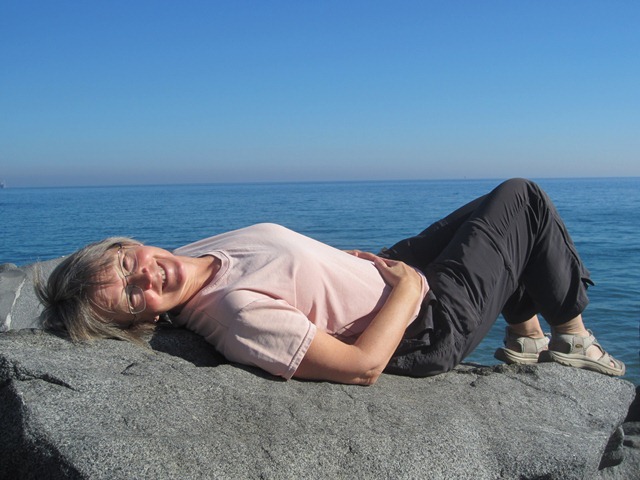
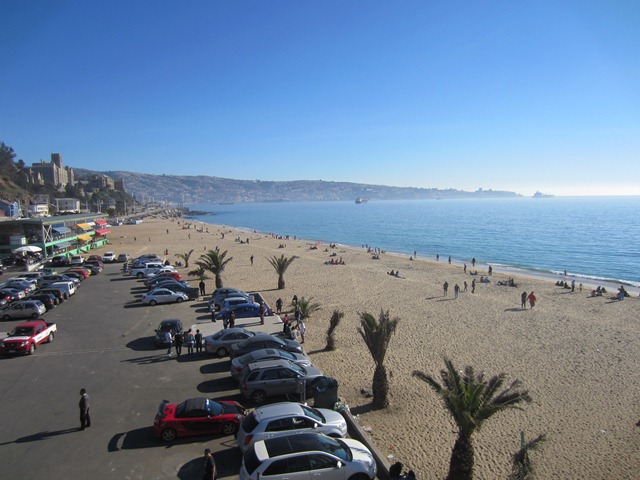
The following day, we catch the local train to Vina del Mar, a rather more upmarket town just down the coast. Here’s Diane lounging on some rocks in the winter sun, and a picture looking down the beach, with Valpo in the distance.
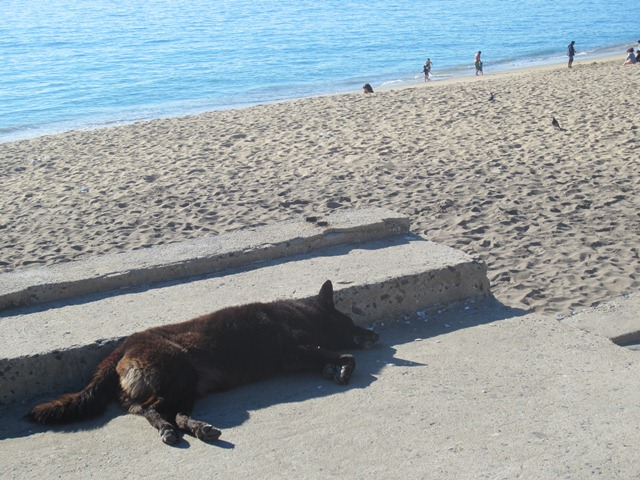
Here’s one of the fabled dogs in typical pose. They spend most of the day like this, in any warm spot they can find.
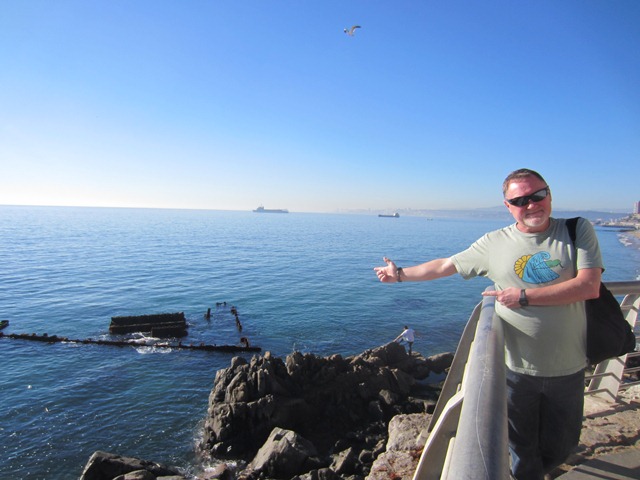
We walk back to Valpo, passing a wreck on the way !! It’s so shallow it’s almost on the beach. Perfect: a wreck you can walk to.
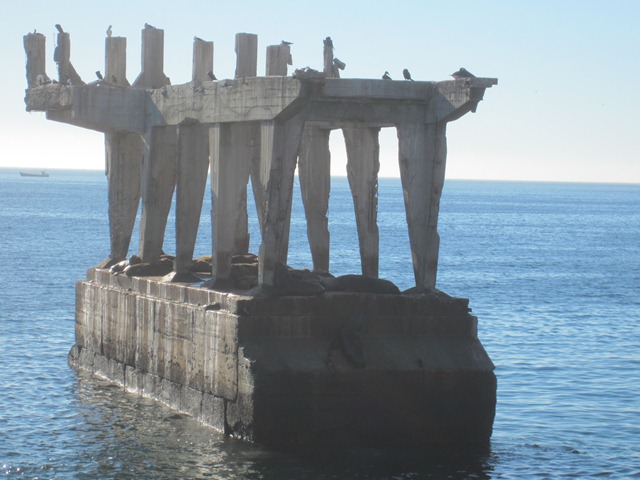
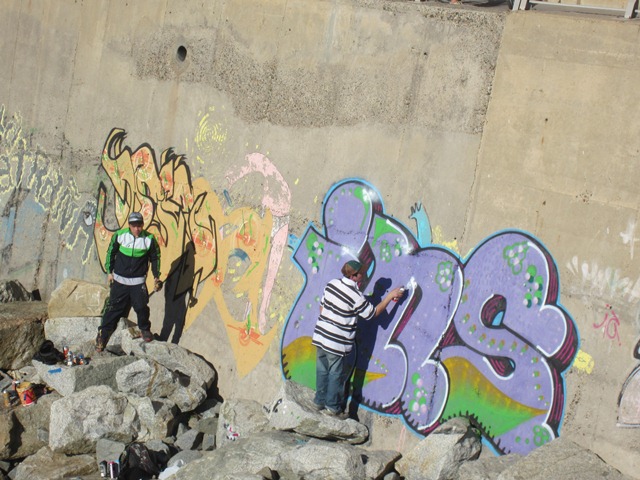
We also pass a lot of sea lions, hanging out on a disused pier support. The platform is about 15 feet above sea level, and the lions have to jump to the sloping bit, hang on, then shuffle up to the top. It’s an impressive jump, over their body length, straight up. Many of them fail and splosh back into the water. And nearby are two guys working hard on their latest graffiti project, they’re real professionals!
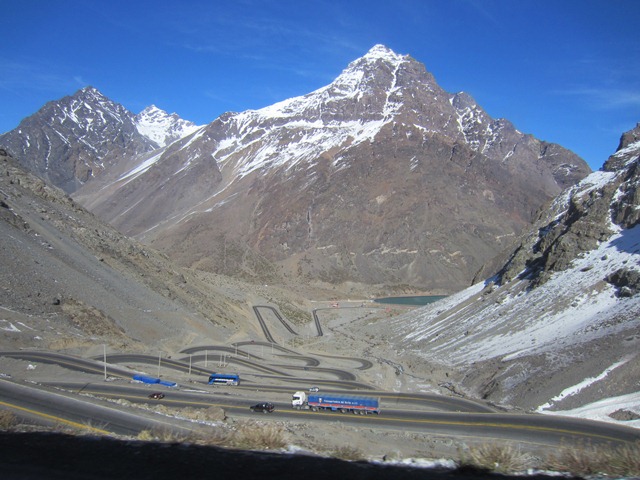
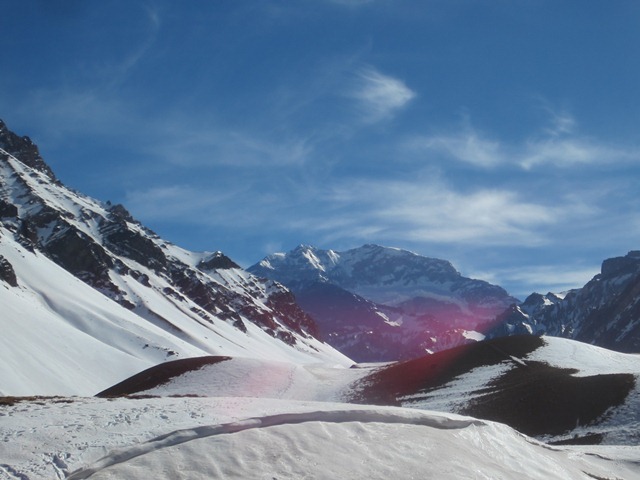
After a couple of days we head back over the Andes, but this time to Cordoba in Argentina, a 23-hour bus journey. Good heavens. Here’s the view back down the pass, and another of the snow.
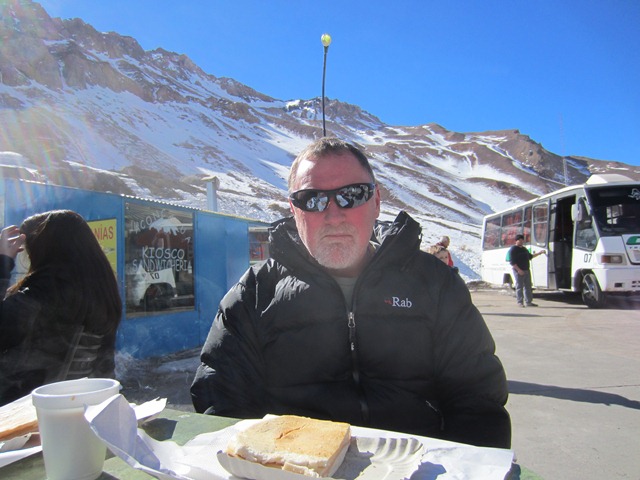
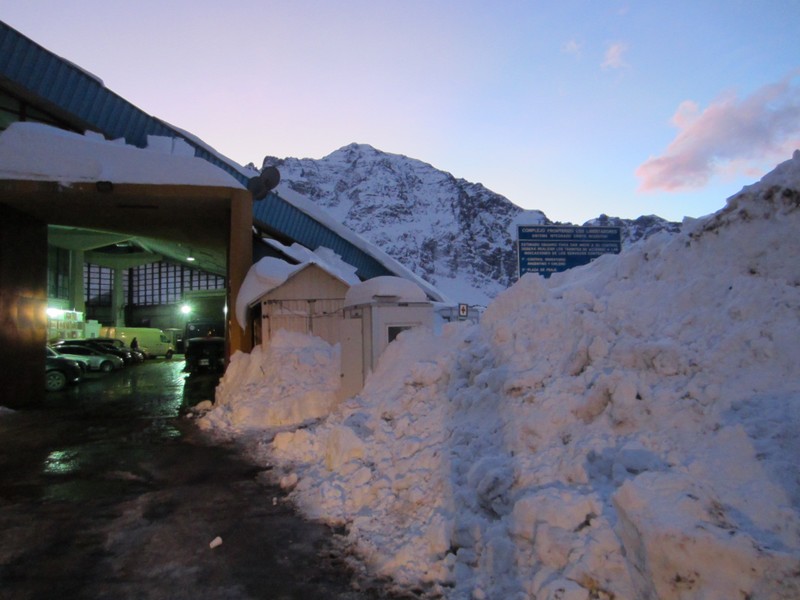
We stop at the top for a sandwich at the immigration and customs post. The bus passengers far outnumber the few skiers who’ve trekked over from Argentina to ski at local resort Portillo, although it is early season and there isn’t much snow about really.
So farewell then, Chile. Back to Argentina !
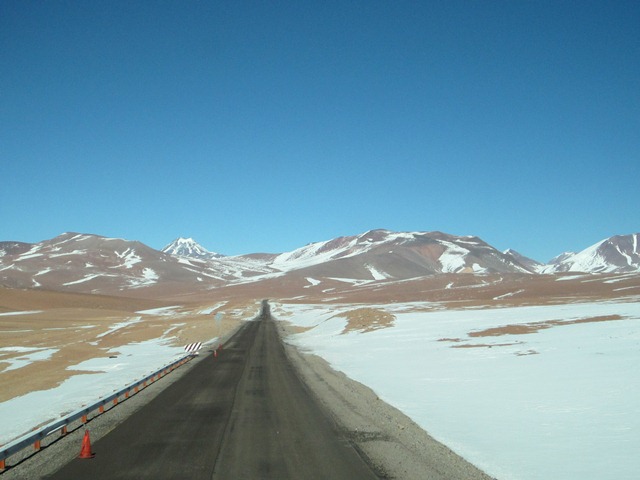
One thing which they have in Chile and Argentina, which we haven’t seen for a while, is roads. Real roads, with tarmac surfaces, road markings and everything. Bolivia’s a wee bit short on this stuff. Here’s a picture taken from the bus as we cross from Chile into Argentina. More top salt-flat and Andean scenery.
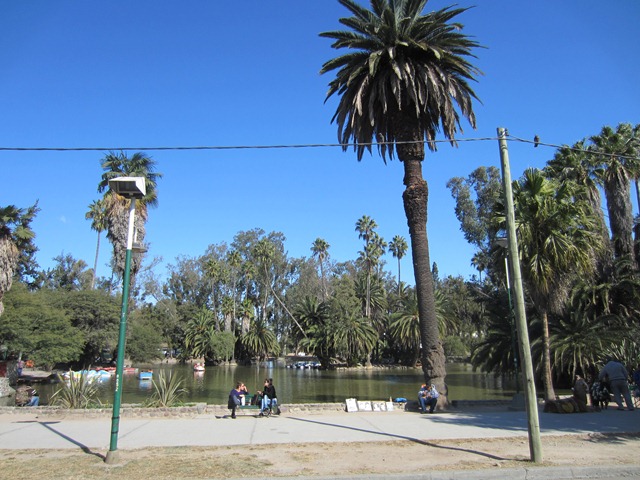
Salta is considerably lower than we’ve been of late, so it’s warmer. It’s winter, but it’s still sunny, and as warm as an English late-summer day. Very nice after the chill of the high desert.
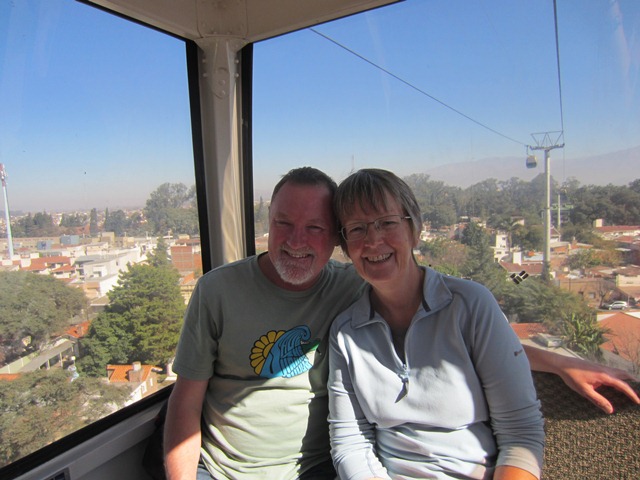
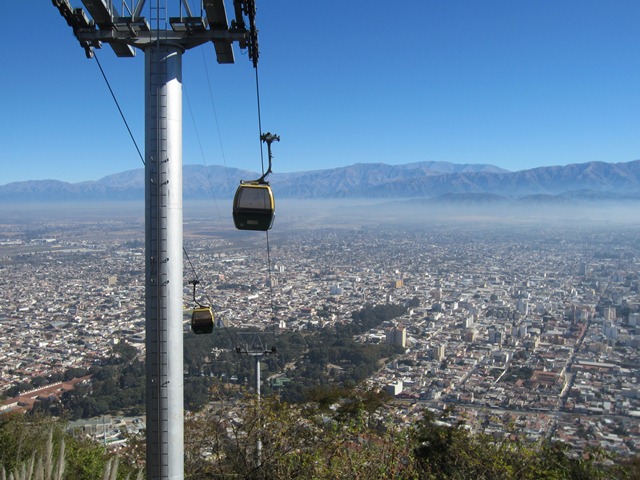
We take the cable car up the local hill for a view of the city. Note: no down jacket or silly llama hat, and happiness caused by being able to feel your feet.
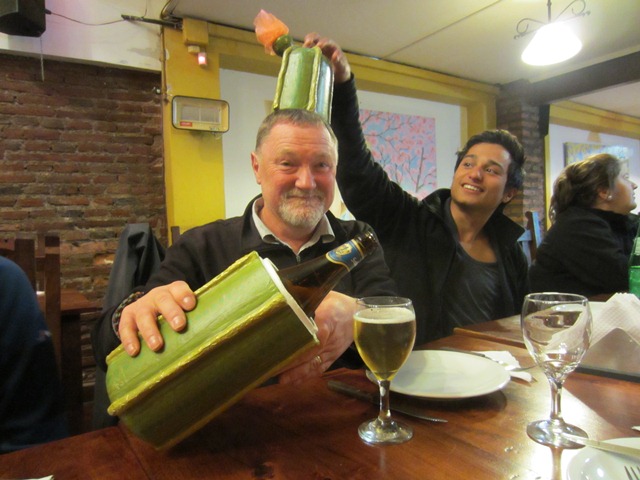
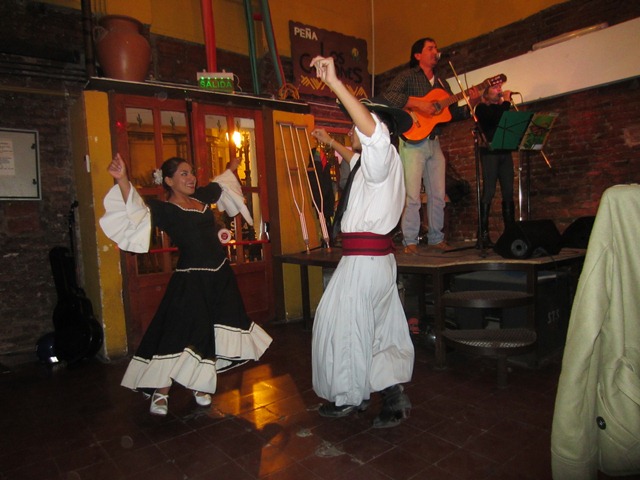
One evening, we go to a Pena, which is basically dinner and a show given by local musicians and dancers. The restaurant we chose makes sure your beer stays cool by putting it in a cooler shaped like a cactus. Got to get me one of those J
The show was quite fun, also: three bands with dancers.
The only tiny problemette ? Argentinians don’t really get weaving on the dining front until about 11pm. We were the first in the restaurant at 9:45pm, and left at about 00:30am. I could probably get used to it, but I’m not sure I want to. Anyway, the day after we catch another bus to Mendoza, the wine capital of Argentina: we’ve been drinking their products for years. We go on a tour of two wineries: the massive Trapiche, and the much, much smaller Di Tomasso. Trapiche have two wineries here: a high-end winery, where they produce about 5 million bottles of wine a year, and what they describe as their “entry-level” winery next door, which produces 25 million bottles a year. The tour is around the high-end winery, which in a restored old building which they took over some years ago. It’s beautiful, complete with a Louvre-style glass pyramid in the courtyard.
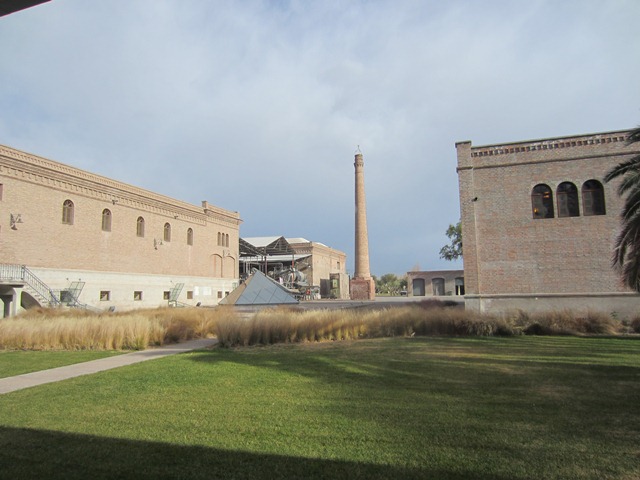
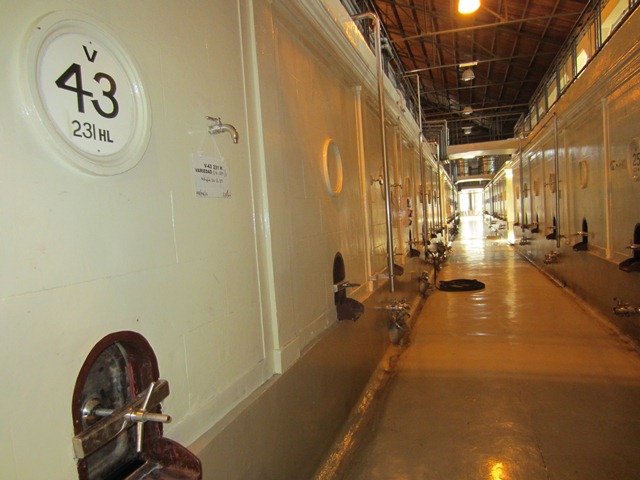
We tour the building and see the tanks where the wine is made. These are original, concrete tanks, but lined now with stainless steel. The equipment and buildings are listed, so they can’t change too many things, but they still have to comply with modern requirements for winemaking.
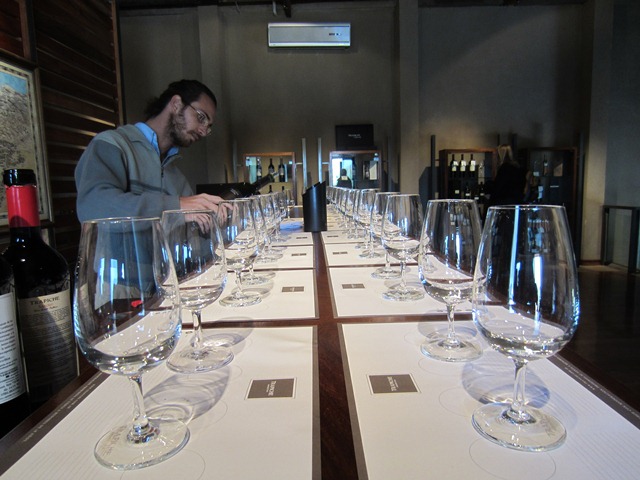
Finally, we arrive at the tasting room, where we try three wines, ranging in price from about ten quid to fifty-odd quid a bottle. The room is marvellous, with a glass floor looking down into the storage area, leather sofas, and a balcony. Here’s our guide pouring the wine.
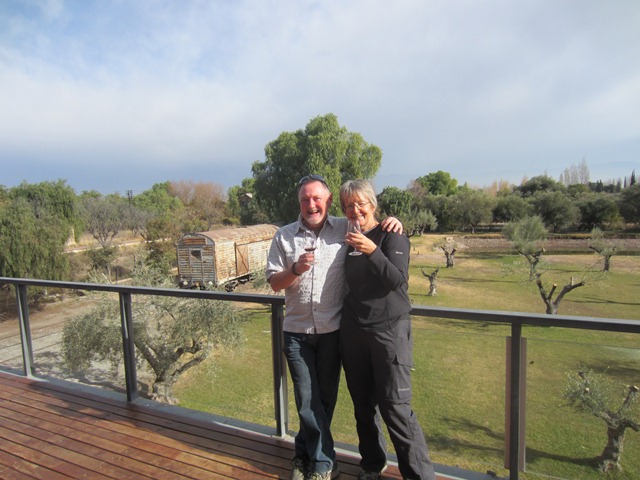
Here’s us on the aforementioned balcony.
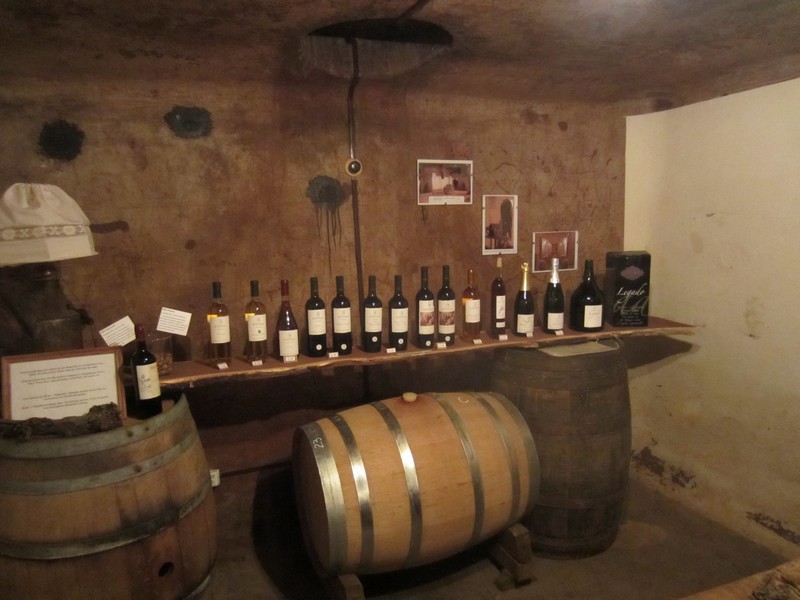
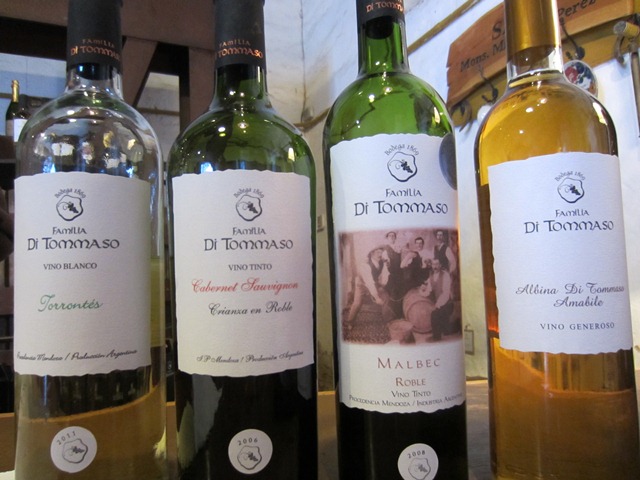
Suitably refreshed, we moved to the much smaller Di Tomasso winery. They produce only tens of thousands of bottle a year, and sell only in high-end wine shops in a few cities. It’s a much more modest operation.
But, the wine is delicicious J We also had a lengthy lunch here, with wine, which was also delicious.
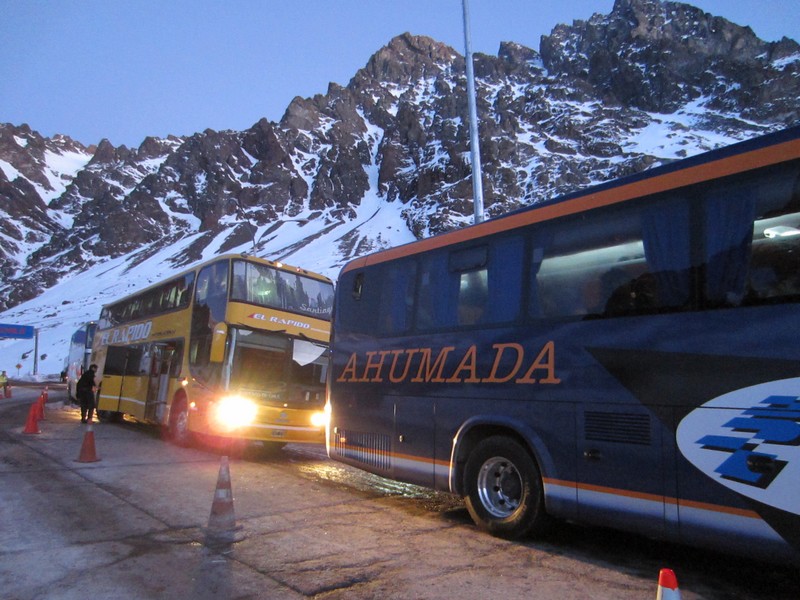
We’d just about exhausted the charms of Mendoza, but unfortunately the weather took a hand: the pass over to Santiago was closed by snow, so we were stuck for an extra night. Eventually, we leave at 1pm instead of 7:30am, and the journey takes 11 hours rather than 6, because of backed-up traffic.
We were on the not-very-aptly named El Rapido bus.
Still, we eventually pitch up in Santiago de Chile at 11pm, and hit the hay. We leave the tour group here, and propose exploring Santiago and Valparaiso for a week or two before heading back to Argentina and over to Buenos Aires.
We set off on a local bus from Potosi. We tourists have seats, but as we head into the wilds of the countryside the bus picks up more and more people and several sit down in the aisle, either on little portable seats or (in the case of local women) on their multicoloured blankets. Real life, and lots of it. Great scenery, and we arrive in windswept and rubbish-strewn Uyuni – anyone fancy helping with a litter pick for the next 15 years or so? We remember the previous few hotels have been cold, but here we are down yet a few more degrees. We find the only restaurant in town with a log fire, eat pizza and later tuck ourselves up in bed supplemented by the sleeping bags we have rented from our tour company.
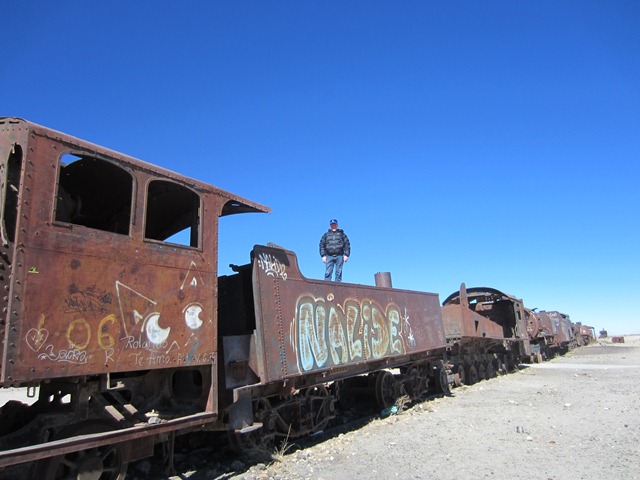
Next morning we are greeted by 4WD LandCruisers for our tour to the Salt Flats, the world’s largest at over 4000 square miles. A few minutes later we visit the one and only local tourist sight, the Train Cemetery. The train lines were built by British engineers near the end of the 19th century and the trains used mostly by the mining companies, although the trains were later abandoned here when the industry collapsed. Nowadays visitors clamber all over the rusty heaps – not a safety notice in sight!
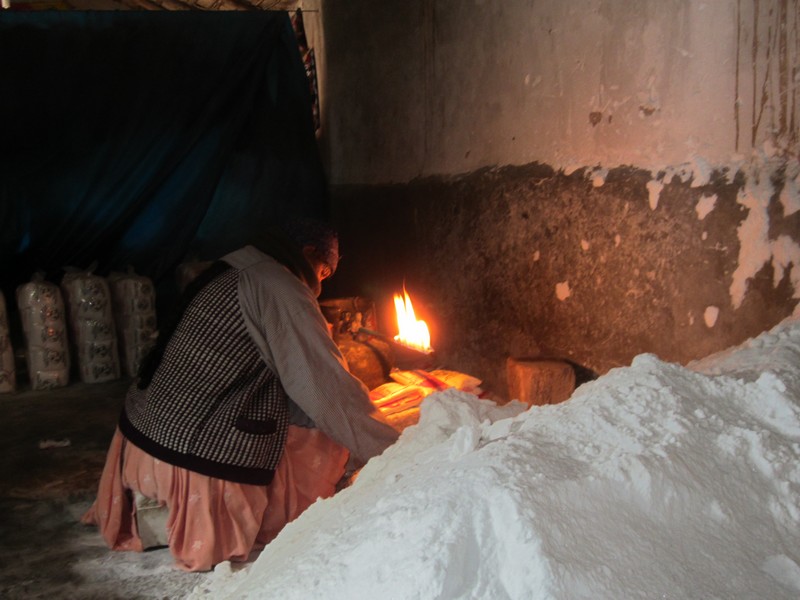
We stop nearby to hear an explanation of how the salt is extracted and processed hand: lots of digging, drying and then finally the backbreaking-looking bagging process – not a job we fancy !
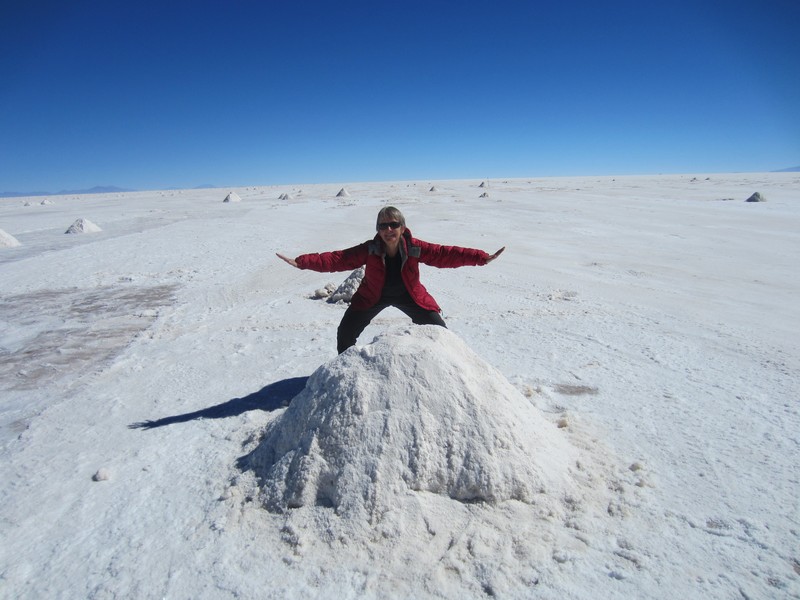
We drive onto the salt flats and see the salt piles which have been manually shovelled and are now ready for collection.
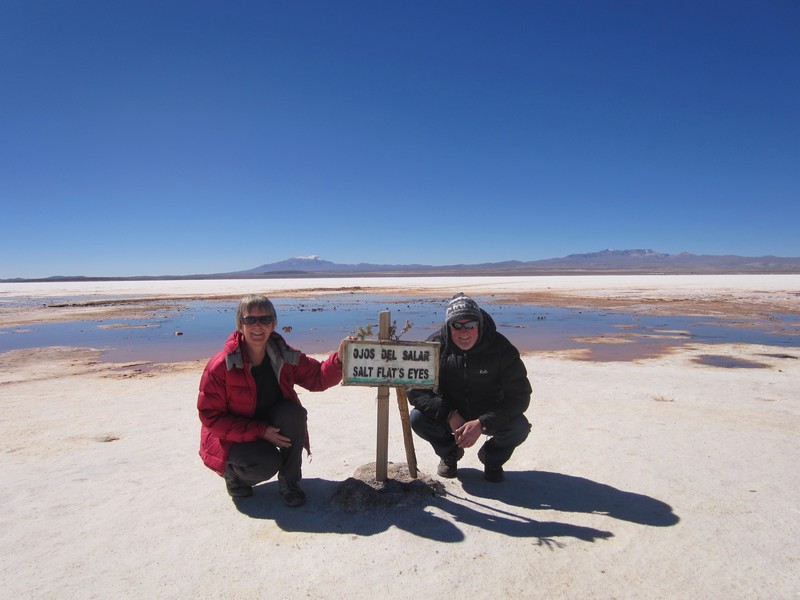
In many places the salt is a metre or more deep, but just occasionally there are large holes where the gas bubbles up, called “the eyes of the salt flats”.
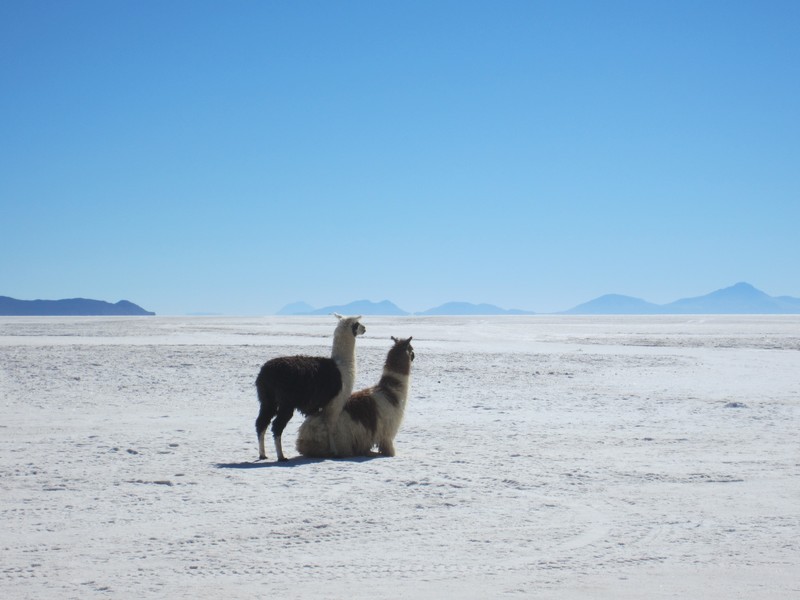
A couple of local residents who can withstand the cold rather more easily than us.
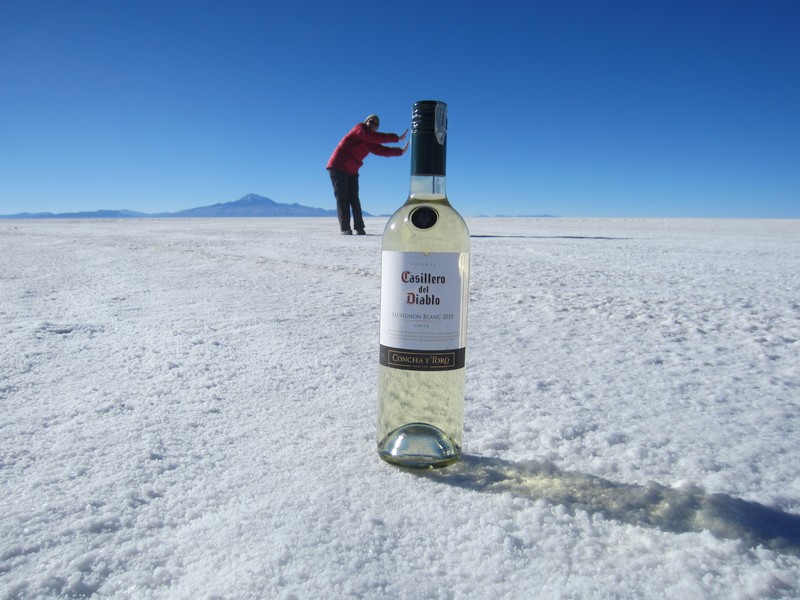
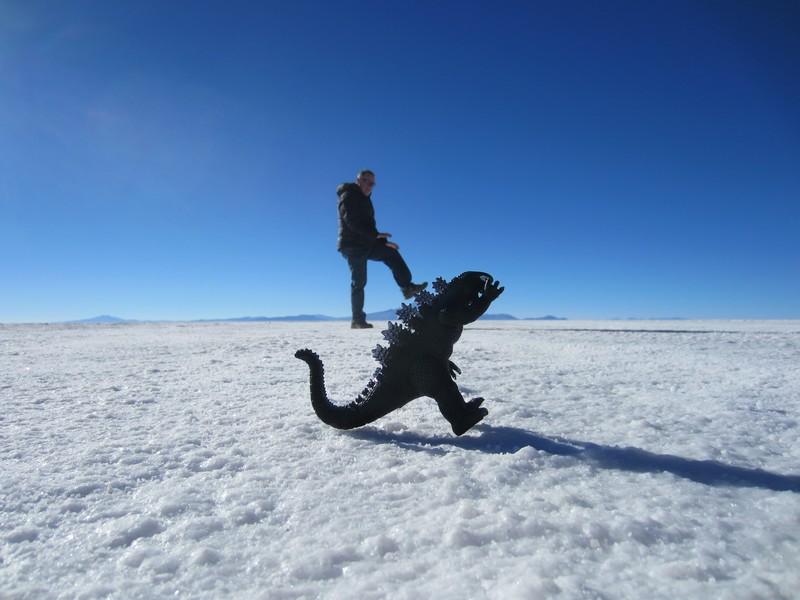
After lunch we spend ages taking silly photographs, which seems to be the thing to do round here.
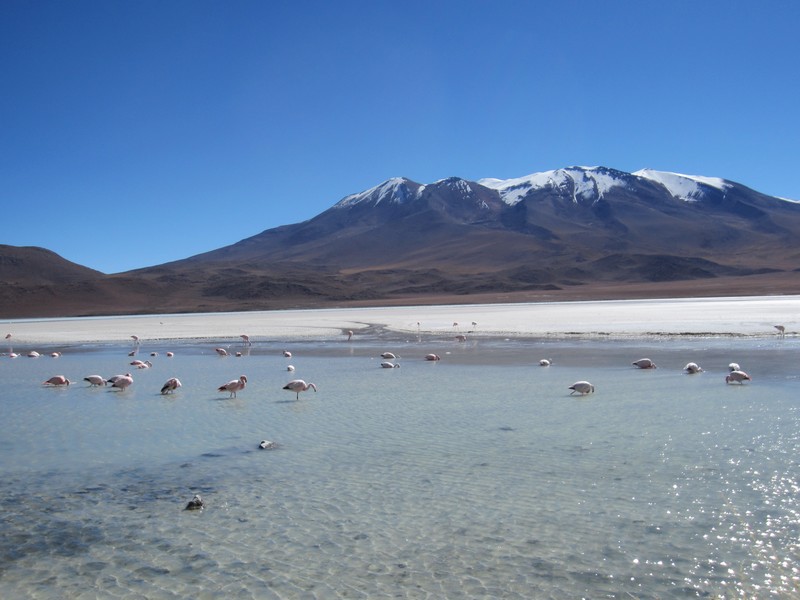
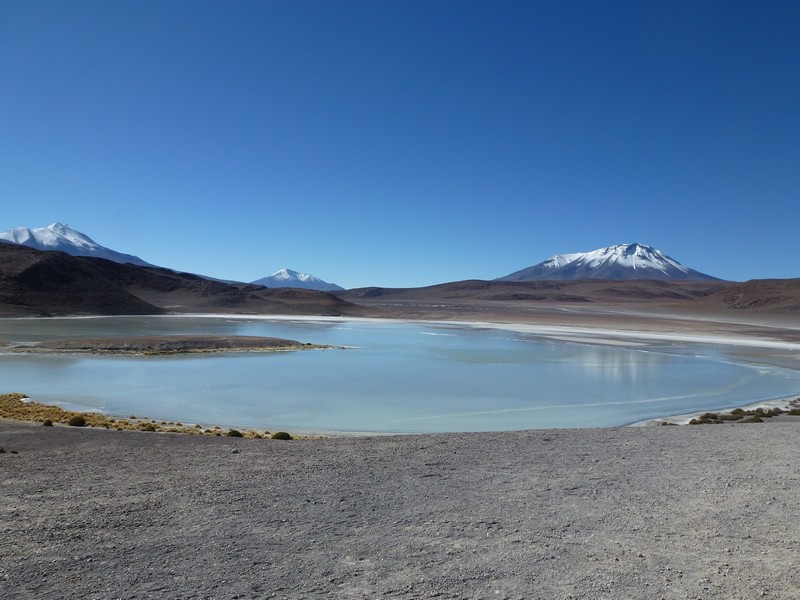
After another cold night in a hostel where the floor, the tables, the chairs and even the bed supports are made of salt (!) we carry on across the salt flats – more stunning scenery. Over the next couple of days, the scenery gets more impressive, and the accommodation gets ever colder. Here’s a selection of views. First off, volcanoes and flamingoes.
Chile is over there somewhere, I think. The air is so clear you can’t tell how far away things are.
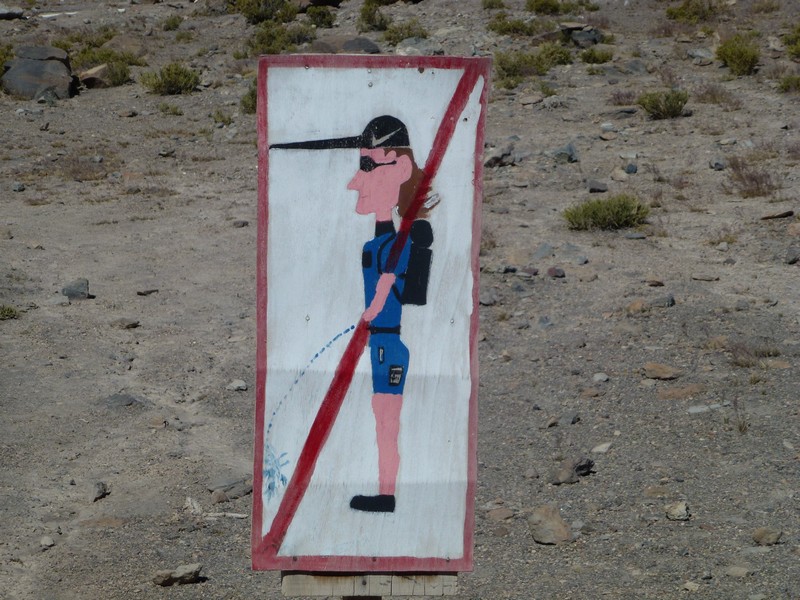
No peeing in the lakes. Even for girls.
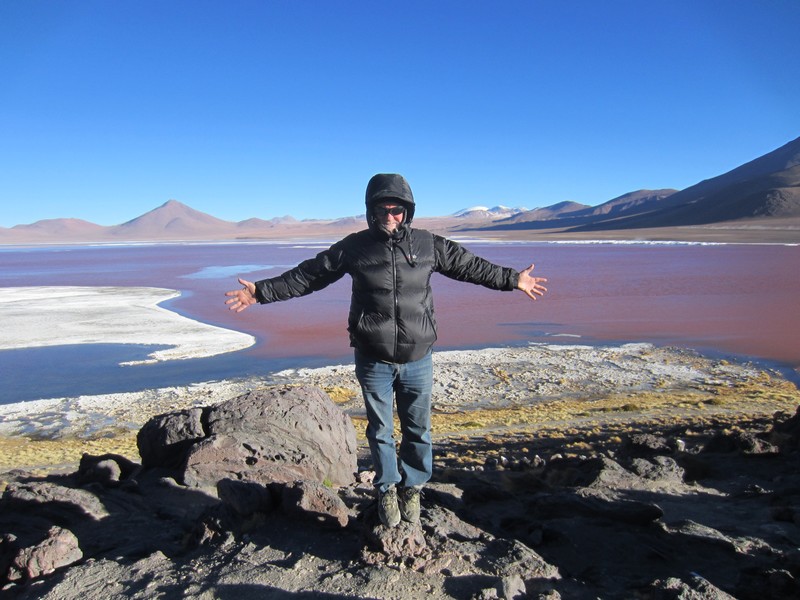
Cold or what ? Laguna Colorado, so called because it is coloured by algae.
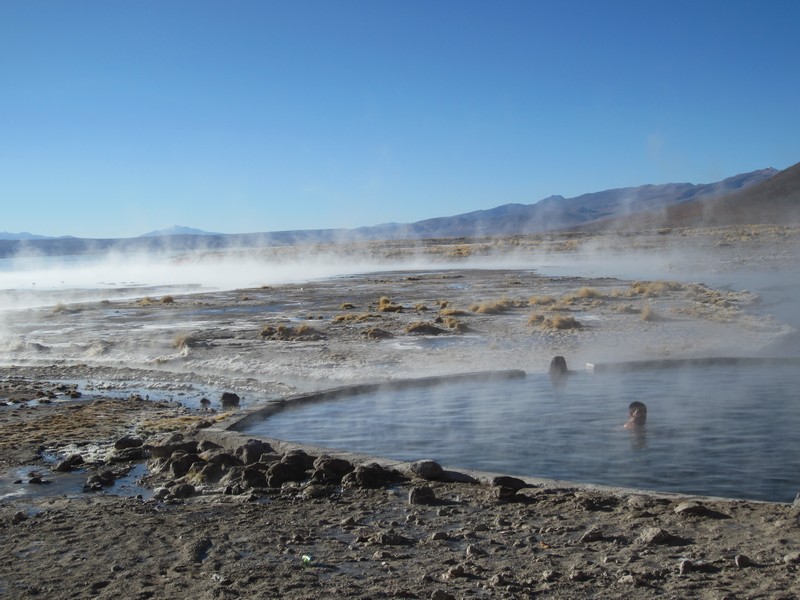
Our last night in the flats is spent in dormitories with no heating, and in fact no lighting for most of the time. According to the park rangers, the temperature had dropped to -24c the night before. It didn’t quite hit that for us, but we get up at 4:00am and it is plenty cold, probably -10c or so. The drivers have to warm the cars up for 30 minutes before we can leave, by which time we are absolutely frozen. No problem, though: we drive to a hot spring in a volcanic crater and all jump in. No, I’m not making this up.
The only problem ? It’s still -10c when we get out onto the cold rock. Makes changing out of your swimmies an interesting, not to say speedy, experience. Then we hit one final sight, a geyser, before heading on to San Pedro de Atacama, in Chile. Diane says, look, it’s a geyser, and I’m frozen stiff.
San Pedro, while still high in the Andes, is comparatively balmy, and permits the wearing of single layers of clothing in the wintery sun. We’re only staying one night, then we’re off to Salta, in Argentina.
After our lazy few days in La Paz it is time to join our group trip and depart the busy city. Our itinerary over the next three weeks will take us south through Bolivia into Argentina and Chile, and leave us in Santiago in early July. We booked the trip to enable us to travel a tad quicker than we tend to travel on our own. In preparation for the rumoured freezing conditions further south Diane buys a small hot water bottle, which later proves well worthwhile. Our group leader ushers us to the main bus station in La Paz well in time for our overnight bus, but the local miners have other ideas – they have been in dispute with the authorities for some weeks and we find out they have blocked the main road south with huge boulders. So, we turn around, go back to the hotel and wonder what to do next as there is no sign of the dispute ending quickly. We end up spending a couple more nights in the city before taking a short internal flight to Sucre.
The atmosphere and the traffic here are relaxed, making a great change from La Paz, and there are many beautiful buildings built from white stone hence it’s nickname as the White City.
Sucre has a fabulous local market, including amazingly cheap fresh fruit and juices.
Next day we take a shorter bus ride, only four hours this time, to Potosi. At 4,300 metres it feels incredibly cold and Diane is really pleased she bought that hot water bottle ! According to our guidebook “Potosi shocks” and we need to find out why. In the 1500s silver was discovered in the nearby Cerro Rico mountain and slave labourers worked in appalling conditions. The silver deposits have now been depleted but today thousands of miners still work there to extract various minerals. We decide to take the controversial tour to a local mining co-operative the next day, and here we are dressed up with the mountain behind us.

Our guide is a miner and relates many stories, explanations of the long working hours and the necessity to chew coca leaves and drink 96% alcohol called Ceibo (sometimes mixed with Fanta) to enable them to work 12 hours or more at a stretch – apparently eating food is over-rated. We all take a small swig of the alcohol, but it’s not a great experience. Our guide explains that there are still some mining operations run by the government and they have a few rules: for example the age boys can start work, the maximum hours which can be worked and even health insurance. But the co-operative mine we are visiting has no such rules. Our guide had started working in the mine at age 12 !

We are shown sticks of dynamite, fuses and detonators, all of which are legal to buy in the miners shops – but take those items outside that street and you will be arrested by the police. We are asked to buy gifts of coca leaves, alcohol, Fanta and gloves to give to the miners we will meet. We’re warned that our safety can’t be assured and that the fumes might cause us breathing problems, so we don masks.
We walk into the mine via an extremely small entrance littered with pipes and other obstacles at awkward angles, and also used by miners pushing carts filled with heavy crud containing raw minerals.
We walk quickly through muddy and sludgy tunnels, bending constantly to avoid the pipes and other protrusions and the helmets come into their own as we’re always banging our heads. It quickly becomes dark and we are pleased of our bright headlights.

After a few minutes some of our party, including Paul, manage to climb and clamber up a gruelling slope, needing both guts as well as upper body strength. Not everyone can manage this and Diane and others stay on the lower level listening to stories from one of the guides of the harsh working conditions. Several miners pass by, pushing carts full of heavy rock: each cart weighs one ton empty. Paul carries on up into the individual seams worked by the various teams in the cooperatives, and shares more alcohol with the miners. This involves a ritual whereby each person drinks two rounds of alcohol, sharing a bit each time with Pachamama, mother earth, for luck. Many miners are killed by rock falls: the cooperatives don’t communicate, they compete, so one team could be dynamiting a seam, and another could be ten feet away when it goes off. The combination of coca, 96% alcohol and dynamite is probably quite explosive, also. Here we all are in a seam.

On the way out we pass by the effigy of Tio, the spirit worshipped by the miners and who it is hoped will protect them from the hellish working conditions. His head and chest are covered with green coca leaves and cigarettes are placed in his mouth as an offering. Other occasional offerings include alcohol and llama blood !
Suitably briefed on the appalling working conditions we are desperate to escape the dirt and darkness and retreat back to our hostel for a hot shower, knowing that the miners inevitably have many more hours of hard work in front of them. Tomorrow we’re setting off on a journey onto the Salar de Uyuni, the world’s largest salt flat.
The bus trip from Copacabana to La Paz is billed as about 4 hours, but made a bit more interesting by having to cross Lake Titicaca by ferry. Unlike most ferry journeys we’ve taken we passengers are ushered to a ferry boat ticket office whilst our bus (and all our luggage) is loaded onto a barge and manually pushed out onto the lake for quite a way until the motor kicks in. In the meantime we lose sight of the bus as our tiny boat bobs about in the choppy waves.
We’re reunited with the bus after eating some pescaditos (a bit like whitebait) from a street stall, and an uneventful couple of hours later we arrive on the outskirts of La Paz, where the city buildings cling to the sides of steep canyons, an amazing sight. The centre of the city is at an altitude of about 3650 metres, although the difference over the whole city area is about 1000 metres. Later we will find walking up and down the steep streets hard work!

Our budget hostel near the centre of town is comfortable, if a bit chilly. Sorry if this is becoming a bit of a theme, but we are travelling in the winter season here and are still surprised that the hostels and restaurants rarely provide heating. Over the last few days we’ve both been suffering from chesty colds (but luckily not the flu which seems to be dominating the local news) and we decide to bunker down, eat, sleep and not do very much for a few days. To help us relax we find an apartment to rent a few minutes walk from the centre and above a French restaurant. For the first time in months we have somewhere to properly relax and can cater for ourselves. Close by are a couple of supermarkets and a local market for fresh fruit, bread and vegetables, bliss! Oh, and the apartment building is shaped like a ship!
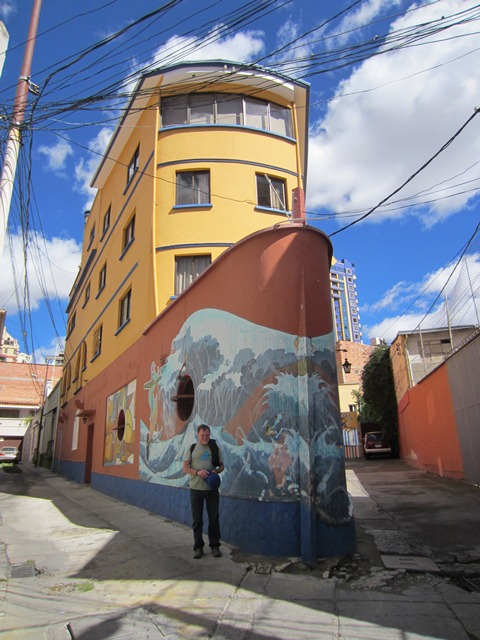
We’re in an area of upmarket residences, embassies and high-rise flats. From our lounge windows and in between the skyscrapers we have a great view of the houses up the steep hillsides.
Walking into town along busy streets there’s the occasional relief from the constant traffic, mostly minibuses and taxis.
On Sundays they close the main street, Prado, to traffic. There’s every kind of stall you can imagine providing food, drink, entertainment, jewellery and the ever essential woollen handicrafts. If you fancy, you can slide down King Kong and get a coffee or icecream at the bottom.
Mostly the streets are full of cars and people. We love wandering around the busy areas, the pavements made more difficult to negotiate by the street vendors. But it’s so interesting, and we see few tourists.
We mooch around, drink coffee and browse the paper in some of the pleasant squares. This is Plaza Murillo, heart of the government metropolis and pigeon central.
Nearby some local women are passing the time of day.
And the main church of San Francisco. Nearby here are many sellers of Saltenas, a cheap local snack of meat in a delicious sweet sauce and covered in pastry, yum ! It’s like a cornish pasty with more sauce inside and very messy to eat, but so delicious we get rather hooked.
After a few days we have regained our energies and decide to venture outside the city. Paul decides to test his mountain biking skills on a trip down the Most Dangerous Road in the World. This involves three or so hours riding downhill on a dirt road to the little town of Coroico. Well, riding is putting it a bit high: it’s a very long dirt track, really, about 40 miles. As long as you don’t get too grabby with the brakes, or lose it on a bend, it’s fine. Make a mistake, though, and it’s a very long drop. Here’s a picture of us giving it some on the way down: I’m the one in front, wearing about ten times more protective gear than I would on a similar ride in the UK.
Diane decides to take a more leisurely option and visits two local areas by bus. First stop is Valle de la Luna, only 10km from the city. It was once mountains of clay, now eroded, leaving a strange area looking a bit like stalagmites protruding from deep canyons.
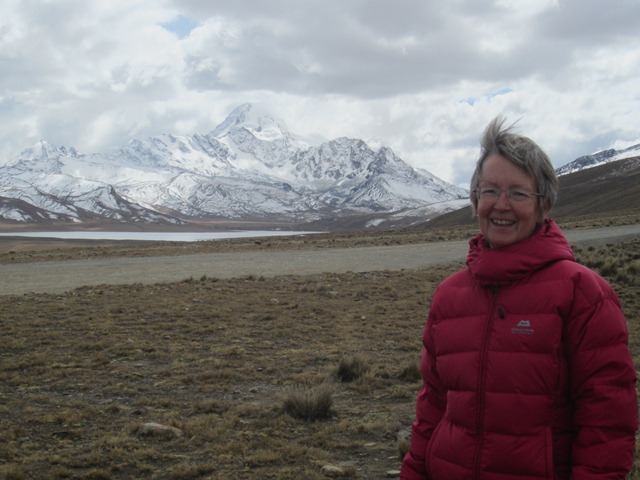
The highlight of the trip is a visit a couple of hours north into the Cordillera Real in the Bolivian Andes, splendid scenery and a view of Huayna Potosi, a popular outing for climbers at about 6,100m.
Our trusty bus carries on and up to Chacaltaya, once the highest lift-served ski area in the world. Unfortunately skiing has been impossible recently due to lack of snow and rapid glacier melt. However, scientists are monitoring conditions which means that, luckily for tourists, a road is maintained through the snow up to 5,300 metres. From there we plod slowly, huffing and puffing until we reach the top at about 5,400 metres!
We have another couple of days spare, so we mooch around the city and visit a museum or two. We spend a delightful hour in the tiny Museum of Musical Instruments. Paul reminds us how far we’ve come so far on our trip.
Now we are joining a three-week tour to take us further south: all the way to Santiago in Chile. We’re looking forward to someone else organising everything for us for a change!
|
|



















Recent Comments